
Mind map
Pricing Strategies
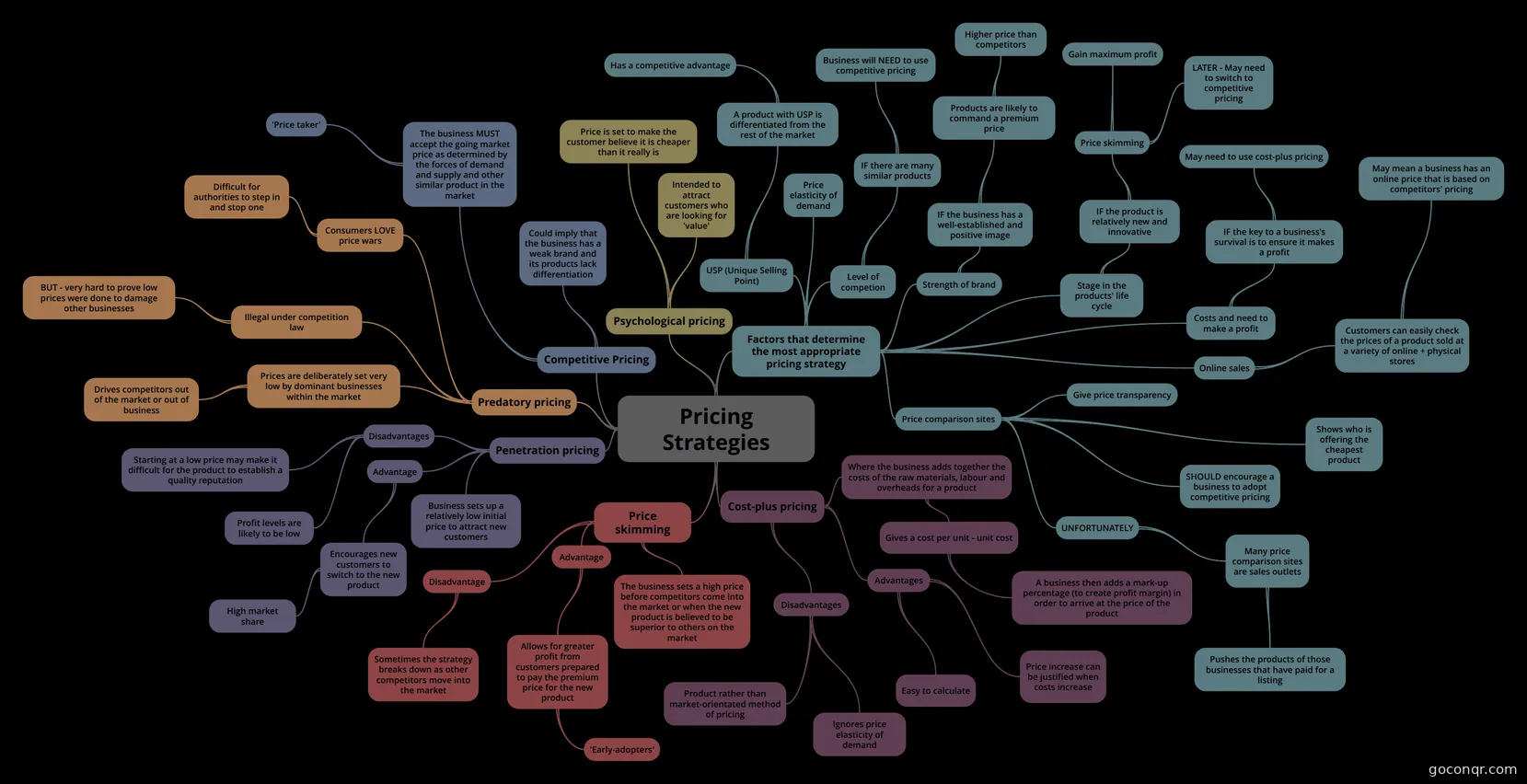
Mind map: Pricing strategies
Map content
Pricing Strategies
Cost-plus pricing
- Where the business adds together the costs of the raw materials, labour and overheads for a product
- Gives a cost per unit - unit cost
- A business then adds a mark-up percentage (to create profit margin) in order to arrive at the price of the product
- Gives a cost per unit - unit cost
- Advantages
- Easy to calculate
- Price increase can be justified when costs increase
- Disadvantages
- Ignores price elasticity of demand
- Product rather than market-orientated method of pricing
- Where the business adds together the costs of the raw materials, labour and overheads for a product
Price skimming
- The business sets a high price before competitors come into the market or when the new product is believed to be superior to others on the market
- Advantage
- Allows for greater profit from customers prepared to pay the premium price for the new product
- 'Early-adopters'
- Allows for greater profit from customers prepared to pay the premium price for the new product
- Disadvantage
- Sometimes the strategy breaks down as other competitors move into the market
Penetration pricing
- Business sets up a relatively low initial price to attract new customers
- Advantage
- Encourages new customers to switch to the new product
- High market share
- Encourages new customers to switch to the new product
- Disadvantages
- Profit levels are likely to be low
- Starting at a low price may make it difficult for the product to establish a quality reputation
Predatory pricing
- Prices are deliberately set very low by dominant businesses within the market
- Drives competitors out of the market or out of business
- Illegal under competition law
- BUT - very hard to prove low prices were done to damage other businesses
- Consumers LOVE price wars
- Difficult for authorities to step in and stop one
- Prices are deliberately set very low by dominant businesses within the market
Competitive Pricing
- The business MUST accept the going market price as determined by the forces of demand and supply and other similar product in the market
- 'Price taker'
- Could imply that the business has a weak brand and its products lack differentiation
- The business MUST accept the going market price as determined by the forces of demand and supply and other similar product in the market
Psychological pricing
- Price is set to make the customer believe it is cheaper than it really is
- Intended to attract customers who are looking for 'value'
Factors that determine the most appropriate pricing strategy
- USP (Unique Selling Point)
- A product with USP is differentiated from the rest of the market
- Has a competitive advantage
- A product with USP is differentiated from the rest of the market
- Price elasticity of demand
- Level of competion
- IF there are many similar products
- Business will NEED to use competitive pricing
- IF there are many similar products
- Strength of brand
- IF the business has a well-established and positive image
- Products are likely to command a premium price
- Higher price than competitors
- Products are likely to command a premium price
- IF the business has a well-established and positive image
- Stage in the products' life cycle
- IF the product is relatively new and innovative
- Price skimming
- Gain maximum profit
- LATER - May need to switch to competitive pricing
- Price skimming
- IF the product is relatively new and innovative
- Costs and need to make a profit
- IF the key to a business's survival is to ensure it makes a profit
- May need to use cost-plus pricing
- IF the key to a business's survival is to ensure it makes a profit
- Online sales
- Customers can easily check the prices of a product sold at a variety of online + physical stores
- May mean a business has an online price that is based on competitors' pricing
- Customers can easily check the prices of a product sold at a variety of online + physical stores
- Price comparison sites
- Give price transparency
- SHOULD encourage a business to adopt competitive pricing
- Shows who is offering the cheapest product
- UNFORTUNATELY
- Many price comparison sites are sales outlets
- Pushes the products of those businesses that have paid for a listing
- Many price comparison sites are sales outlets
- USP (Unique Selling Point)
Information
- Description
- AS level Business (Theme One) Mind Map on Pricing Strategies, created by Caitlin Trees on 19/04/2019.
- Created by
- Caitlin Trees
- Views
- 1
- Rating