
Mind map
Additional member system AMS
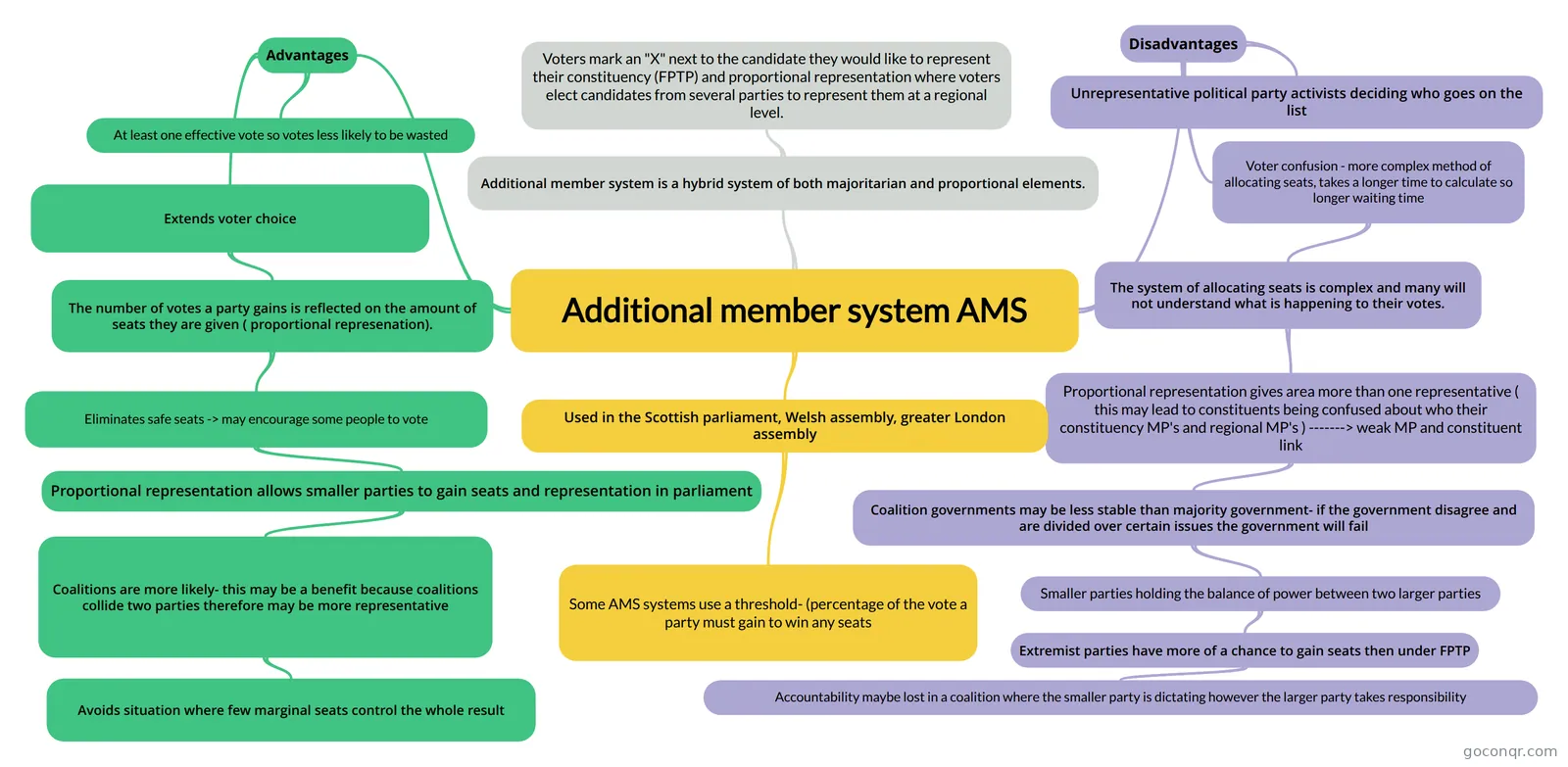
Mind map: Additional member system AMS
Map content
Additional member system AMS
Additional member system is a hybrid system of both majoritarian and proportional elements.
- Voters mark an "X" next to the candidate they would like to represent their constituency (FPTP) and proportional representation where voters elect candidates from several parties to represent them at a regional level.
Advantages
- At least one effective vote so votes less likely to be wasted
- Extends voter choice
- The number of votes a party gains is reflected on the amount of seats they are given ( proportional represenation).
- Eliminates safe seats -> may encourage some people to vote
- Proportional representation allows smaller parties to gain seats and representation in parliament
- Coalitions are more likely- this may be a benefit because coalitions collide two parties therefore may be more representative
- Avoids situation where few marginal seats control the whole result
- Coalitions are more likely- this may be a benefit because coalitions collide two parties therefore may be more representative
- Proportional representation allows smaller parties to gain seats and representation in parliament
- Eliminates safe seats -> may encourage some people to vote
- The number of votes a party gains is reflected on the amount of seats they are given ( proportional represenation).
Disadvantages
- Voter confusion - more complex method of allocating seats, takes a longer time to calculate so longer waiting time
- The system of allocating seats is complex and many will not understand what is happening to their votes.
- Proportional representation gives area more than one representative ( this may lead to constituents being confused about who their constituency MP's and regional MP's ) -------> weak MP and constituent link
- Coalition governments may be less stable than majority government- if the government disagree and are divided over certain issues the government will fail
- Smaller parties holding the balance of power between two larger parties
- Extremist parties have more of a chance to gain seats then under FPTP
- Accountability maybe lost in a coalition where the smaller party is dictating however the larger party takes responsibility
- Extremist parties have more of a chance to gain seats then under FPTP
- Smaller parties holding the balance of power between two larger parties
- Coalition governments may be less stable than majority government- if the government disagree and are divided over certain issues the government will fail
- Proportional representation gives area more than one representative ( this may lead to constituents being confused about who their constituency MP's and regional MP's ) -------> weak MP and constituent link
- The system of allocating seats is complex and many will not understand what is happening to their votes.
- Unrepresentative political party activists deciding who goes on the list
- Voter confusion - more complex method of allocating seats, takes a longer time to calculate so longer waiting time
Used in the Scottish parliament, Welsh assembly, greater London assembly
- Some AMS systems use a threshold- (percentage of the vote a party must gain to win any seats