
Mind map
Class Differences (Internal Factors) - The Self-Fulfilling Prophecy
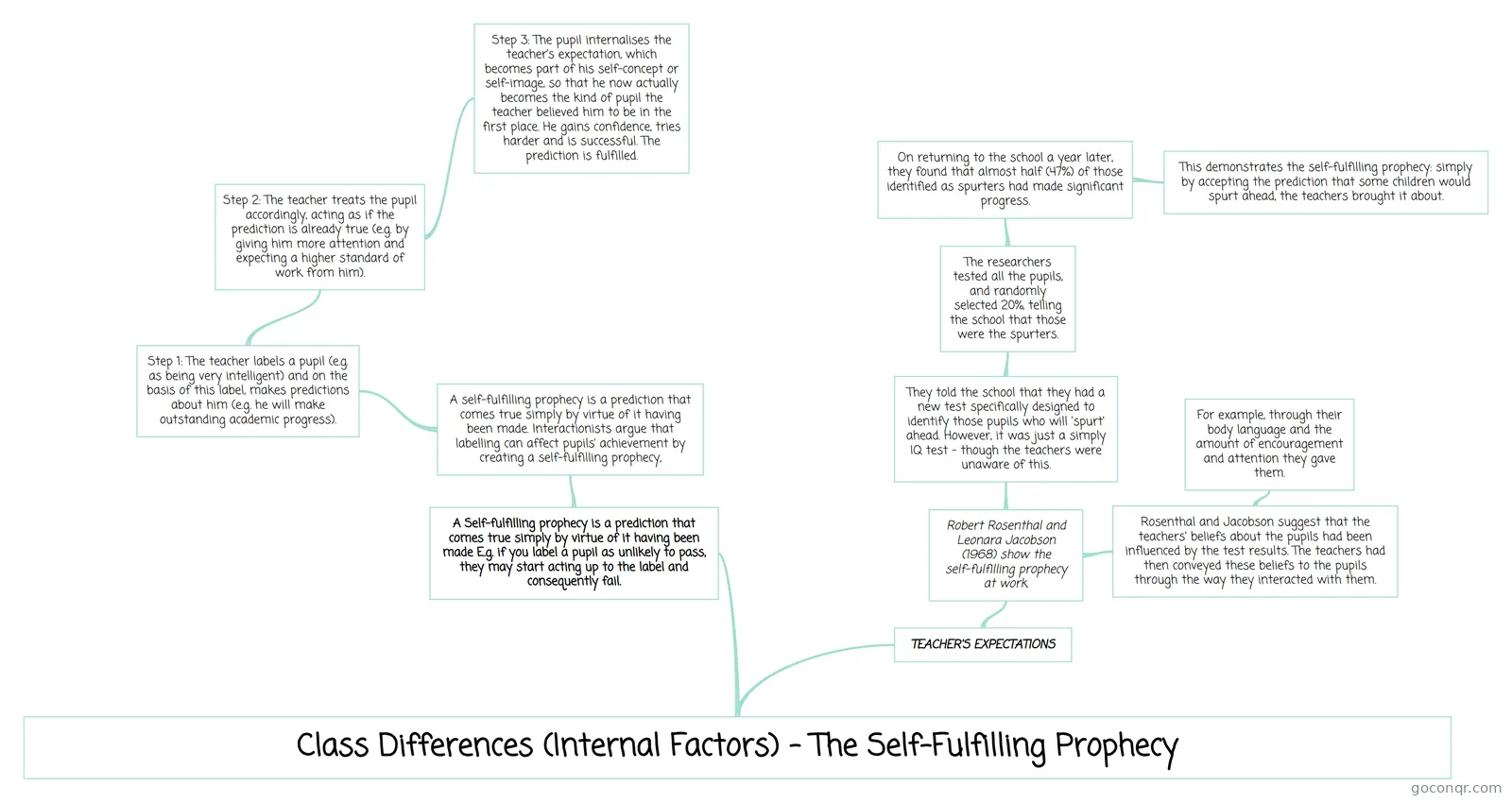
Mind map: Self-fulfilling prophecy in education
Map content
Class Differences (Internal Factors) - The Self-Fulfilling Prophecy
A Self-fulfilling prophecy is a prediction that comes true simply by virtue of it having been made E.g. if you label a pupil as unlikely to pass, they may start acting up to the label and consequently fail.
- A self-fulfilling prophecy is a prediction that comes true simply by virtue of it having been made. Interactionists argue that labelling can affect pupils’ achievement by creating a self-fulfilling prophecy,
- Step 1: The teacher labels a pupil (e.g. as being very intelligent) and on the basis of this label, makes predictions about him (e.g. he will make outstanding academic progress).
- Step 2: The teacher treats the pupil accordingly, acting as if the prediction is already true (e.g. by giving him more attention and expecting a higher standard of work from him).
- Step 3: The pupil internalises the teacher’s expectation, which becomes part of his self-concept or self-image, so that he now actually becomes the kind of pupil the teacher believed him to be in the first place. He gains confidence, tries harder and is successful. The prediction is fulfilled.
- Step 2: The teacher treats the pupil accordingly, acting as if the prediction is already true (e.g. by giving him more attention and expecting a higher standard of work from him).
- Step 1: The teacher labels a pupil (e.g. as being very intelligent) and on the basis of this label, makes predictions about him (e.g. he will make outstanding academic progress).
- A self-fulfilling prophecy is a prediction that comes true simply by virtue of it having been made. Interactionists argue that labelling can affect pupils’ achievement by creating a self-fulfilling prophecy,
TEACHER'S EXPECTATIONS
- Robert Rosenthal and Leonara Jacobson (1968) show the self-fulfilling prophecy at work.
- They told the school that they had a new test specifically designed to identify those pupils who will 'spurt' ahead. However, it was just a simply IQ test - though the teachers were unaware of this.
- The researchers tested all the pupils, and randomly selected 20%, telling the school that those were the spurters.
- On returning to the school a year later, they found that almost half (47%) of those identified as spurters had made significant progress.
- This demonstrates the self-fulfilling prophecy: simply by accepting the prediction that some children would spurt ahead, the teachers brought it about.
- On returning to the school a year later, they found that almost half (47%) of those identified as spurters had made significant progress.
- The researchers tested all the pupils, and randomly selected 20%, telling the school that those were the spurters.
- Rosenthal and Jacobson suggest that the teachers' beliefs about the pupils had been influenced by the test results. The teachers had then conveyed these beliefs to the pupils through the way they interacted with them.
- For example, through their body language and the amount of encouragement and attention they gave them.
- They told the school that they had a new test specifically designed to identify those pupils who will 'spurt' ahead. However, it was just a simply IQ test - though the teachers were unaware of this.
- Robert Rosenthal and Leonara Jacobson (1968) show the self-fulfilling prophecy at work.
Information
- Description
- All credit goes to the 'AQA A Level Sociology Book One [Including AS Level]'. Any opinions expressed are the opinions of the sociologists mentioned. Author credits: Rob Webb, Hal Westergaard, Keith Trobe and Annie Townend
- Created by
- A H
- Views
- 8
- Tags
- History
-
- Created by a deleted user · Dec 13, 2016
- Copied by A H · Sep 18, 2017
- Rating