Mind map
UNIT 3 - Atomic Structure and Periodic Trends

Map content
UNIT 3 - Atomic Structure and Periodic Trends
* atoms
- * nucleus
- outside
- * electrons
- - charge
- m = ~1/2000 amu
- electrons don't contribute much to the mass of an atom
- involved in chemical reactions
- * electrons
- inside
- * protons
- + charge
- m = 1 amu
- determines element
- * neutrons
- no (neutral) charge
- m = 1 amu
- affects mass and nuclear stability
- * protons
- has most of atom's mass
- outside
- most of its volume is in space where electrons are
- * ions
- an atom with a charge
- * isotopes
- atoms of the same element with different numbers of neutrons
- atoms of the same element have the same # of protons
- [p = e]
- * nucleus
* Isotope Notation
- * mass #
- [p + n]
- doesn't include e
- [p + n]
- * atomic #
- [p]
- * charge
- [p - e]
- * mass #
* Plum Pudding Model
- majority of space is mass of +
- electrons float around inside atom
- *Gold Foil Experiment
- most particles went through, some deflected at wide angles, and others went backwards
- if P.P. true --> alpha particles would not have passed through foil
- P.P. disproved
- Nuclear Model
- protons at dense, small, concentrated nucleus
- electrons revolve around nucleus in wide orbits
- no way to make predictions off of N
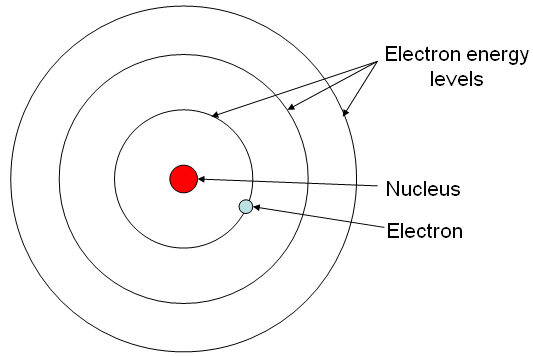
- Bohr's Nuclear/Planetary Model
- electrons move around nucleus in circular orbit
- only specific orbits are allowed
- an electron in a given orbit has a specific energy
- * photons
- absorb/give off energy when traveling between orbits
- [-Rh/n^2]
- electrons farther from the nucleus have larger energy
- * ground state
- lowest energy orbit
- * absorption spectrum
- when electrons gain enough energy (the exact difference between the Eh and El) to move to a higher energy level
- * emission spectrum
- when electrons lose enough energy (the exact difference between the Eh and El) to move to a lower energy level
- [-Rh/n^2]
- absorb/give off energy when traveling between orbits
- * photons
- an electron in a given orbit has a specific energy
- * orbit
- aka discrete energy levels
- has several limitations
- only works for matter w/1 electron
- attraction/repulsion between particles depends on distance between electrons, and if there was more than one electron, the distance would be fluctuating
- only works for Hydrogen
- the laws of physics disagree
- physics predicts that an accelerating charged particle should lose/radiate energy. In the Bohr model, the electron is accelerating because it's moving in a circle, so it should lose energy and crash into the nucleus, destroying the atom and rendering the concept of life impossible
- model violates Heisenberg Uncertainty Principle
- you cannot tell both the position and momentum/momentum (p = mv)
- B's N/P disproved
- Quantum Model
- only works for matter w/1 electron
- Bohr's Nuclear/Planetary Model
- Nuclear Model
- P.P. disproved
- if P.P. true --> alpha particles would not have passed through foil
- most particles went through, some deflected at wide angles, and others went backwards