
Mind map
Carbonyls and Carboxylic Acids
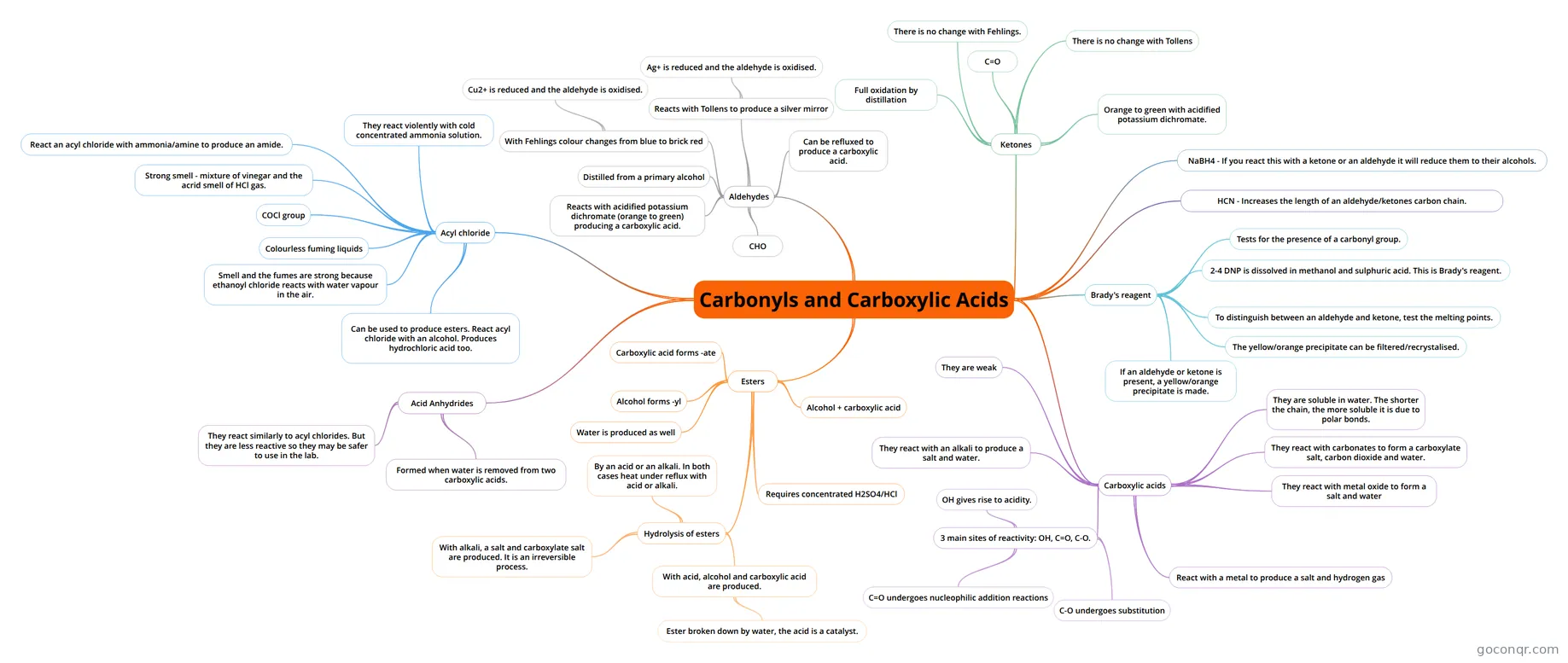
Mind map: Carbonyls and Carboxylic Acids
Map content
Carbonyls and Carboxylic Acids
Aldehydes
- CHO
- Distilled from a primary alcohol
- Reacts with acidified potassium dichromate (orange to green) producing a carboxylic acid.
- Can be refluxed to produce a carboxylic acid.
- Reacts with Tollens to produce a silver mirror
- Ag+ is reduced and the aldehyde is oxidised.
- With Fehlings colour changes from blue to brick red
- Cu2+ is reduced and the aldehyde is oxidised.
Ketones
- C=O
- Full oxidation by distillation
- Orange to green with acidified potassium dichromate.
- There is no change with Tollens
- There is no change with Fehlings.
Brady's reagent
- Tests for the presence of a carbonyl group.
- If an aldehyde or ketone is present, a yellow/orange precipitate is made.
- 2-4 DNP is dissolved in methanol and sulphuric acid. This is Brady's reagent.
- To distinguish between an aldehyde and ketone, test the melting points.
- The yellow/orange precipitate can be filtered/recrystalised.
Carboxylic acids
- They are weak
- They are soluble in water. The shorter the chain, the more soluble it is due to polar bonds.
- They react with carbonates to form a carboxylate salt, carbon dioxide and water.
- They react with metal oxide to form a salt and water
- React with a metal to produce a salt and hydrogen gas
- They react with an alkali to produce a salt and water.
- 3 main sites of reactivity: OH, C=O, C-O.
- C-O undergoes substitution
- C=O undergoes nucleophilic addition reactions
- OH gives rise to acidity.
Esters
- Alcohol + carboxylic acid
- Requires concentrated H2SO4/HCl
- Alcohol forms -yl
- Carboxylic acid forms -ate
- Water is produced as well
- Hydrolysis of esters
- By an acid or an alkali. In both cases heat under reflux with acid or alkali.
- With acid, alcohol and carboxylic acid are produced.
- Ester broken down by water, the acid is a catalyst.
- With alkali, a salt and carboxylate salt are produced. It is an irreversible process.
Acyl chloride
- Colourless fuming liquids
- Strong smell - mixture of vinegar and the acrid smell of HCl gas.
- Smell and the fumes are strong because ethanoyl chloride reacts with water vapour in the air.
- COCl group
- Can be used to produce esters. React acyl chloride with an alcohol. Produces hydrochloric acid too.
- React an acyl chloride with ammonia/amine to produce an amide.
- They react violently with cold concentrated ammonia solution.
Acid Anhydrides
- Formed when water is removed from two carboxylic acids.
- They react similarly to acyl chlorides. But they are less reactive so they may be safer to use in the lab.
NaBH4 - If you react this with a ketone or an aldehyde it will reduce them to their alcohols.
HCN - Increases the length of an aldehyde/ketones carbon chain.
Information
- Description
- A level Chemistry (Chapter 26 - Carbonyls and Carboxylic Acids) Mind Map on Carbonyls and Carboxylic Acids, created by Chloe Drewery on 09/11/2017.
- Created by
- Chloe Drewery
- Views
- 7
- Rating