
Mind map
Acute Kidney Injury
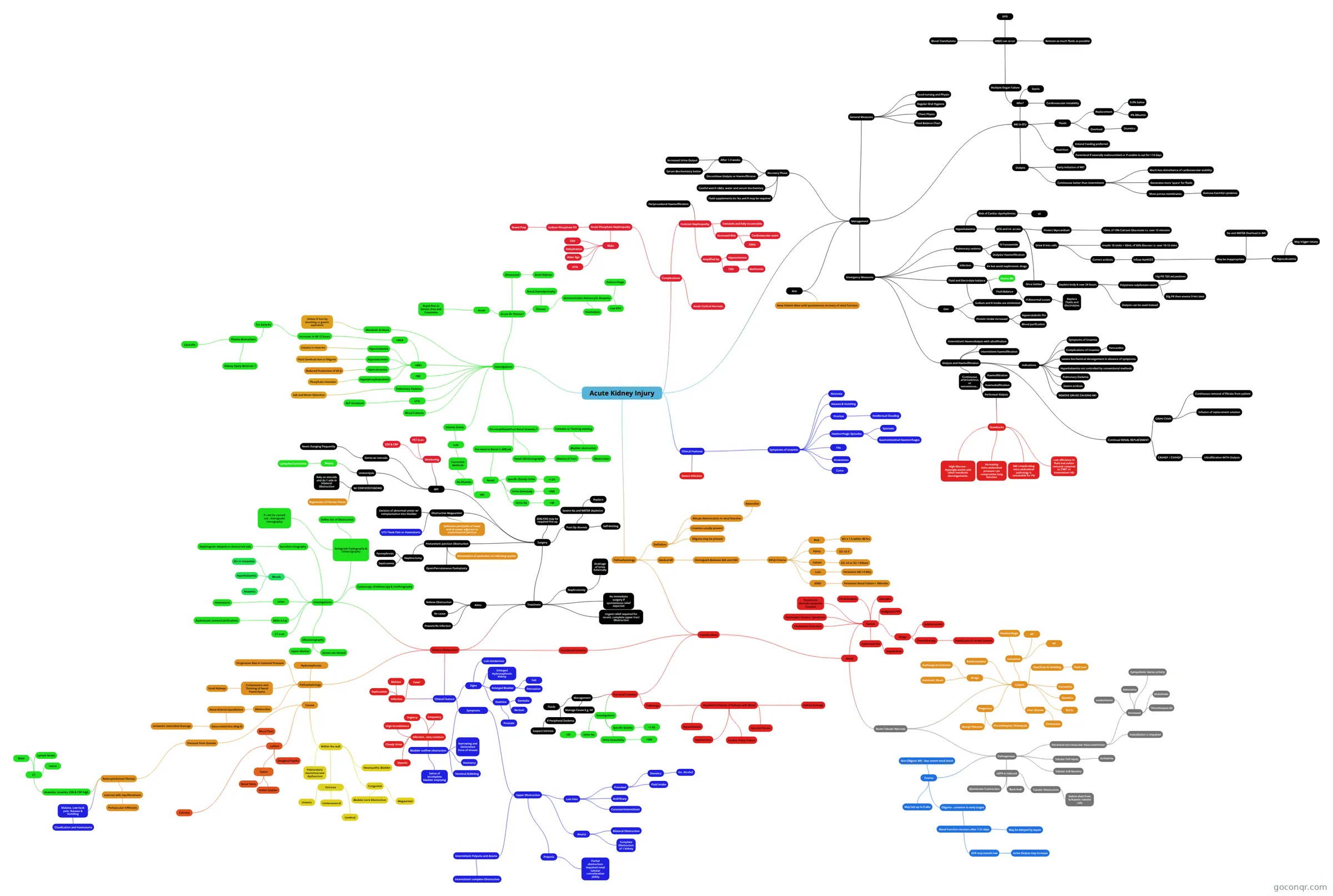
Mind map: Acute kidney injury
Map content
Acute Kidney Injury
Pathophysiology
- Definition
- Abrupt deterioration in renal function
- Reversible
- Uraemia usually present
- Oliguria may be present
- Abrupt deterioration in renal function
- Medical ER
- Distinguish Between AKI and CKD
- RIFLE Criteria
- Risk
- SCr x 1.5 within 48 hrs
- Injury
- SCr x2-3
- Failure
- SCr x3 or SCr >350um
- Loss
- Persistent AKI >4 Wks
- ESKD
- Persistent Renal Failure > 3Months
- Risk
- RIFLE Criteria
- Distinguish Between AKI and CKD
- Classifications
- Pre-renal Uraemia
- Pathology
- Impaired Perfusion of kidneys with Blood
- Hypovolaemia
- Hypotension
- Cardiac Pump Failure
- Vascular Disase
- Kidney Damage
- Impaired Perfusion of kidneys with Blood
- Investigations
- Specific Gravity
- >1.02
- Urine Osmolality
- >500
- Urine Na
- <20
- Specific Gravity
- Management
- Fluids
- If Peripheral Oedema
- Suspect Intrinsic
- If Peripheral Oedema
- Manage Cause E.g. HF
- Fluids
- Pathology
- Renal
- Acute Tubular Necrosis
- Causes
- Ischaemia
- Haemorrhage
- MI
- HF
- Burns
- Diarrhoea & Vomiting
- Fluid Loss
- Pacreatitis
- Diuretics
- Pregnancy
- Abrupt Placenta
- Pre-eclampisa / Eclampsia
- Drugs
- Endotoxic Shock
- Radiological Contrasts
- Rabdomyolysis
- Liver disease
- Cholestasis
- Ischaemia
- Pathogenesis
- Intrarenal microvascular Vasoconstriction
- Increased
- Endothelin
- Adenosine
- Thromboxane A2
- Leukotrienes
- Sympathetic Nerve activity
- Vadodilation is impaired
- Increased
- Tubular Cell Injury
- Ischaemia
- Tubular Cell Reovery
- eGFR is reduced
- Glomerular Contraction
- 'Back leak'
- Tubular Obstruction
- Debris shed from Ischaemic tubular cells
- Course
- Oliguria - common in early stages
- Renal Function recovers after 7-21 days
- May be delayed by sepsis
- GFR may remain low
- Urine Output may increase
- Renal Function recovers after 7-21 days
- Non-Oliguric AKI - less severe renal insult
- May last up to 6 wks
- Oliguria - common in early stages
- Intrarenal microvascular Vasoconstriction
- Causes
- Causes
- Vasculitis
- Malignant HTN
- Cholesterol Embolism
- Haemolytic Uraemic Syndrome
- Thrombotic thrombocytopenic Purpura
- Pre-Eclampsia
- Drugs
- Sulphonamide
- Chemotherapy
- Rapid Lysis of certain tumors
- Pyelonephritis
- Suppurative
- Acute Tubular Necrosis
- Post-Renal Uraemia
- Urinary Obstruction
- Pathophysiology
- Causes
- Lumen
- Calculus
- Blood Clots
- Tumor
- Renal Pelvis
- Ureter bladder
- Sloughed Papilla
- Within the wall
- Pelviureteric neuromuscular dysfunction
- Stricture
- Ureteric
- Ureterovesical
- Urethral
- Congenital
- Bladder neck Obstruction
- Megaureter
- Neuropathic Bladder
- Pressure from Outside
- Reteroperitoneal Fibrosis
- sclerosis with myofibroblasts
- Perivascular Infiltrates
- Malaise, Low back pain, Nausea & Vomiting
- Claudication and Haematuria
- Anaemia, Uraemia, ESR & CRP high
- CT
- Mass
- Lymph Nodes
- Tumor
- CT
- sclerosis with myofibroblasts
- Reteroperitoneal Fibrosis
- Lumen
- Hydronephrosis
- Progressive Rise in lumenial Pressure
- Compression and Thinning of Renal Parenchyma
- Small Kidneys
- Obstruction
- Renal Arterial vasodilation
- Vasoconstriction (Ang-II)
- Ischaemic Interstitial Damage
- Vasoconstriction (Ang-II)
- Renal Arterial vasodilation
- Causes
- Clinical Feature
- Symptoms
- Upper Obstruction
- Loin Pain
- Dull/Sharp
- Constant/Intermittent
- Provoked
- Fluid Intake
- Diuretics
- Inc. Alcohol
- Anuria
- Bilateral Obstruction
- Complete Obstruction of 1 kidney
- Polyuria
- Partial obstruction: Impaired renal tubular concentration ability
- Intermittent Polyuria and Anuria
- Intermittent complete Obstruction
- Loin Pain
- Bladder outflow obstruction
- Hesitancy
- Narrowing and Diminished force of stream
- Terminal Dribbling
- Sense of incomplete bladder emptying
- Infection - very common
- Frequency
- Urgency
- Urge Incontinence
- Cloudy Urine
- Dysuria
- Upper Obstruction
- Infection
- Malaise
- Fever
- Septicaemia
- Signs
- Loin tenderness
- Enlarged Hydronephrotic Kidney
- Enlarged Bladder
- Felt
- Percussion
- Examine
- Genitalia
- Rectum
- Prostate
- Symptoms
- Investigations
- Bloods
- SCr or Ureaemia
- HyperKalaemia
- Anaemia
- Urine
- Haematuria
- Abdo X-ray
- Radiolucent stones/Calcifications
- CT scan
- Ultrasonography
- Upper dilation
- Stones are missed
- Excretion Urography
- Nephrogram delayed on obstructed side
- Antegrade Pyelography & Ureterography
- Defins site of Obstruction
- If cant be carried out...Retrograde Uterography
- Cystoscopy, Urethroscopy & Urethrography
- Bloods
- Treatment
- Aims:
- Relieve Obstruction
- Rx cause
- Prevent/Rx Infection
- Nephrostomy
- Drainage of Urine Externally
- Urgent relief required for recent, complete upper tract Obstruction
- No immediate surgery if spontaneous relief expected
- Surgery
- DIALYSIS may be required Pre-op
- Post-Op diuresis
- Self-limiting
- Severe Na and WATER depletion
- Replace
- Peviureteric Junction Obstruction
- Disturbance of peristalsis of collecting system
- Open/Percutaneous Pyeloplasty
- Nephrectomy
- Pyonephrosis
- Septicaemia
- Obstructive Megaureter
- Defective peristalsis of lower end of ureter adjacent to ureterovesical junction
- UTI/ Flank Pain or Haematuria
- Excision of abnormal ureter w/ reimplantation into bladder
- RPF
- Ureterolysis
- Biopsy
- Lympoha/Carcinoma
- W/ CORTICOSTEROIRD
- Rely on steroids and do 1 side in bilateral Obstruction
- Regression of Fibrous Tissue
- Biopsy
- Stents w/ steroids
- Need changing frequently
- Monitoring
- ESR & CRP
- PET Scan
- Ureterolysis
- Aims:
- Pathophysiology
- Urinary Obstruction
- Pre-renal Uraemia
- Definition
Clinical Features
- Symptoms of Uraemia
- Anorexia
- Nausea & Vomiting
- Pruritus
- Intellectual Clouding
- Drowsiness
- Fits
- Coma
- Haemorrhagic Episodes
- Epistaxis
- Gastrointestinal Haemorrhages
- Severe Infection
- Symptoms of Uraemia
Investigations
- Metabolic Acidosis
- Unless H loss by Vomiting or gastric aspiration
- Pulmonary Oedema
- Salt and Water Retention
- Acute Or Chronic?
- Acute
- Rapid Rise in Serum Urea and Creatinine
- Chronic
- Normochromic Normocytic Anaemia
- Haemolysis
- Low EPO
- Haemorrhage
- Renal Osteodystrophy
- Normochromic Normocytic Anaemia
- Ultrasound
- Small Kidneys
- Acute
- Pre-renal/Renal/Post Renal Uraemia ?
- Catheter or Flushing existing
- Bladder obstruction
- Renal UltraSonography
- Dilation of Tract
- Obstruction
- Dilation of Tract
- Pre-renal vs Renal is difficult
- Renal
- Specific Gravity Urine
- <1.01
- Urine Osmolaity
- <350
- Urine Na
- >40
- Specific Gravity Urine
- Renal
- Catheter or Flushing existing
- Volume Status
- Low
- Corrective Methods
- No Diuresis
- AKI
- No Diuresis
- Corrective Methods
- Low
- U&Es
- Hyperkalaemia
- trauma to muscles
- Hyponatraemia
- Fluid Overload due to Oliguria
- Hypocalcaemia
- Reduced Production of Vit D
- Hyperphosphateaemia
- Phosphate retention
- UREA
- Increases in 48-72 hours
- For Early Rx
- Plasma Biomarkers
- Kidney Injury Molecule 1
- Lipocalin
- Plasma Biomarkers
- For Early Rx
- Increases in 48-72 hours
- Hyperkalaemia
- FBC
- LFTs
- ALP Increased
- Blood Cultures
- Metabolic Acidosis
Management
- Aim
- Keep Patient Alive until spontaneous recovery of renal function
- General Measures
- Good nursing and Physio
- Regular Oral Hygiene
- Chest Physio
- Fluid Balance Chart
- Emergency Measures
- Hyperkalaemia
- Risk of Cardiac dysrhythmias
- VF
- ECG and I.V. access
- Protect Myocardium
- 10mL of 10% Calcium Gluconate i.v. over 15 minutes
- Drive K into cells
- Insulin 10 Units + 50mL of 50% Glucose i.v. over 10-15 mins
- Correct acidosis
- Infuse NaHCO3
- May be inappropriate
- Na and WATER Overload in AKI
- Pt Hypocalcaemia
- May trigger tetany
- May be inappropriate
- Infuse NaHCO3
- Once Settled
- Deplete body K over 24 hours
- Polystrene sulphonate resins
- 15g PO TDS w/Laxatives
- 30g PR then enema 9 Hrs later
- Dialysis can be used instead
- Polystrene sulphonate resins
- Deplete body K over 24 hours
- Protect Myocardium
- Risk of Cardiac dysrhythmias
- Pulmonary oedema
- IV Furosemide
- Dialysis/ Haemofiltration
- Infection
- Rx but avoid nephrotoxic drugs
- Fluid and Electrolyte balance
- Assess BD
- Fluid Balance
- If Abnormal Losses
- Replace Fluids and Electrolytes
- If Abnormal Losses
- Sodium and K intake minimized
- Diet
- Sodium and K intake are minimized
- Protein intake increased
- Hypercatabolic Pts
- Blood purification
- Dialysis and Haemofiltration
- Indications
- Symptoms of Uraemia
- Complications of Uraemia
- Pericarditis
- severe biochemical derangement in absence of symptoms
- Hyperkalaemia not controlled by conventional methods
- Pulmonary Oedema
- Severe acidosis
- REMOVE DRUGS CAUSING AKI
- Intermittent Haemodialysis with ultrafilration
- intermittent haemofiltration
- Continuous arteriovenous or venovenous...
- Haemofiltration
- Haemodiafiltration
- Peritoneal dialysis
- Drawbacks
- Low efficiency in fluid and solute removal compred to CRRT or intermittent HD
- AKI complicating intra-abdominal pathology is unsuitable for PD
- Increasing intra-abdominal pressure can compromise lung function
- High Glucose - Hyperglycaemia and other metabolic derrangements.
- Drawbacks
- Continual RENAL REPLACEMENT
- CAVH/ CVVH
- Continuous removal of filtrate from patient
- Infusion of replacement solution
- CAVHDF / CVVHDF
- Ultrafiltration WITH Dialysis
- CAVH/ CVVH
- Indications
- Hyperkalaemia
- AKI in ICU
- Who?
- Multiple Organ Failure
- ARDS can occur
- Remove as much fluids as possible
- Blood Transfusions
- EPO
- ARDS can occur
- Sepsis
- Cardiovascular Instability
- Multiple Organ Failure
- Fluids
- Replacement
- 0.9% Saline
- 4% Albumin
- Overload
- Diuretics
- Replacement
- Nutrition
- Enteral Feeding preferred
- Parenteral if severally malnourished or if unable to eat for >14 days
- Dialysis
- Early Initiation of RRT
- Continuous better than intermittent
- Much less disturbance of cardiovascular stability
- Generates more 'space' for fluids
- More porous membranes
- Remove harmful cytokines
- Who?
- Recovery Phase
- After 1-3 weeks
- Increased Urine Output
- Serum Biochemistry better
- Discontinue Dialysis or Haemofiltraion
- Careful watch U&Es, water and serum biochemisry
- Fluid supplements inc Na and K may be required
- After 1-3 weeks
- Aim
Complications
- Acute Cortical Necrosis
- Contrast Nephropathy
- Transient and fully recoverable
- Increased Risk
- Cardiovascular event
- ESKD
- Amplified by:
- Hypovolaemia
- CKD
- Metformin
- Periprocedural Haemofiltration
- Acute Phosphate Nephropathy
- Sodium Phosphate PO
- Bowel Prep
- Risks
- CKD
- Dehydration
- Older Age
- HTN
- Sodium Phosphate PO
Information
- Description
- Renal Mind Map on Acute Kidney Injury, created by Beoluf Jangan on 10/01/2018.
- Created by
- Beoluf Jangan
- Views
- 0
- Rating