
Mind map
Families and Households - Couples (P2)
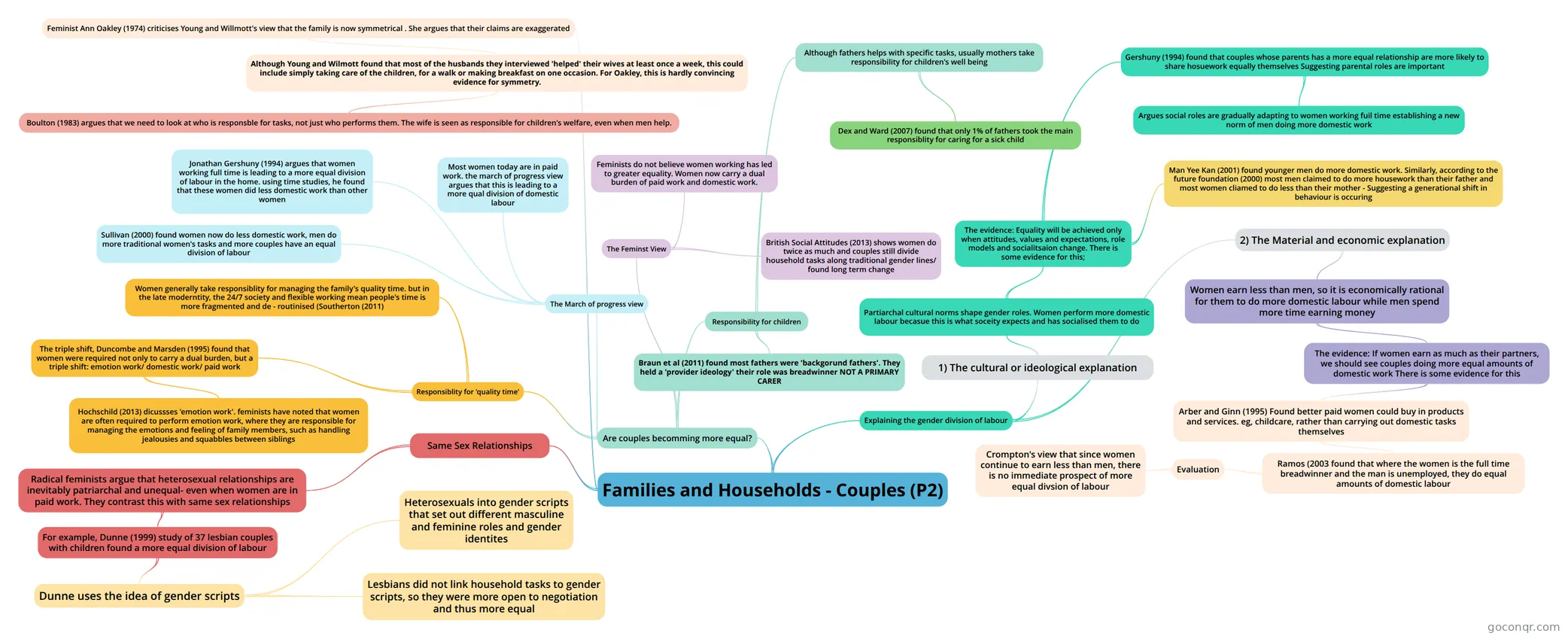
Mind map: Families and households couples
Map content
Families and Households - Couples (P2)
Feminist Ann Oakley (1974) criticises Young and Willmott's view that the family is now symmetrical . She argues that their claims are exaggerated
- Although Young and Wilmott found that most of the husbands they interviewed 'helped' their wives at least once a week, this could include simply taking care of the children, for a walk or making breakfast on one occasion. For Oakley, this is hardly convincing evidence for symmetry.
- Boulton (1983) argues that we need to look at who is responsble for tasks, not just who performs them. The wife is seen as responsible for children's welfare, even when men help.
- Although Young and Wilmott found that most of the husbands they interviewed 'helped' their wives at least once a week, this could include simply taking care of the children, for a walk or making breakfast on one occasion. For Oakley, this is hardly convincing evidence for symmetry.
Are couples becomming more equal?
- The March of progress view
- Most women today are in paid work. the march of progress view argues that this is leading to a more qual division of domestic labour
- Sullivan (2000) found women now do less domestic work, men do more traditional women's tasks and more couples have an equal division of labour
- Jonathan Gershuny (1994) argues that women working full time is leading to a more equal division of labour in the home. using time studies, he found that these women did less domestic work than other women
- The Feminst View
- Feminists do not believe women working has led to greater equality. Women now carry a dual burden of paid work and domestic work.
- British Social Attitudes (2013) shows women do twice as much and couples still divide household tasks along traditional gender lines/ found long term change
- Responsibility for children
- Although fathers helps with specific tasks, usually mothers take responsibility for children's well being
- Dex and Ward (2007) found that only 1% of fathers took the main responsiblity for caring for a sick child
- Braun et al (2011) found most fathers were 'backgorund fathers'. They held a 'provider ideology' their role was breadwinner NOT A PRIMARY CARER
- Although fathers helps with specific tasks, usually mothers take responsibility for children's well being
- Responsiblity for 'quality time'
- Women generally take responsiblity for managing the family's quality time. but in the late moderntity, the 24/7 society and flexible working mean people's time is more fragmented and de - routinised (Southerton (2011)
- The triple shift, Duncombe and Marsden (1995) found that women were required not only to carry a dual burden, but a triple shift: emotion work/ domestic work/ paid work
- Hochschild (2013) dicussses 'emotion work'. feminists have noted that women are often required to perform emotion work, where they are responsible for managing the emotions and feeling of family members, such as handling jealousies and squabbles between siblings
- The March of progress view
Explaining the gender division of labour
- 1) The cultural or ideological explanation
- Partiarchal cultural norms shape gender roles. Women perform more domestic labour becasue this is what soceity expects and has socialised them to do
- The evidence: Equality will be achieved only when attitudes, values and expectations, role models and socialitsaion change. There is some evidence for this;
- Gershuny (1994) found that couples whose parents has a more equal relationship are more likely to share hosuework equally themselves Suggesting parental roles are important
- Argues social roles are gradually adapting to women working fuil time establishing a new norm of men doing more domestic work
- Man Yee Kan (2001) found younger men do more domestic work. Similarly, according to the future foundation (2000) most men claimed to do more housework than their father and most women cliamed to do less than their mother - Suggesting a generational shift in behaviour is occuring
- Gershuny (1994) found that couples whose parents has a more equal relationship are more likely to share hosuework equally themselves Suggesting parental roles are important
- The evidence: Equality will be achieved only when attitudes, values and expectations, role models and socialitsaion change. There is some evidence for this;
- Partiarchal cultural norms shape gender roles. Women perform more domestic labour becasue this is what soceity expects and has socialised them to do
- 2) The Material and economic explanation
- Women earn less than men, so it is economically rational for them to do more domestic labour while men spend more time earning money
- The evidence: If women earn as much as their partners, we should see couples doing more equal amounts of domestic work There is some evidence for this
- Arber and Ginn (1995) Found better paid women could buy in products and services. eg, childcare, rather than carrying out domestic tasks themselves
- Ramos (2003 found that where the women is the full time breadwinner and the man is unemployed, they do equal amounts of domestic labour
- Evaluation
- Crompton's view that since women continue to earn less than men, there is no immediate prospect of more equal divsion of labour
- Evaluation
- Ramos (2003 found that where the women is the full time breadwinner and the man is unemployed, they do equal amounts of domestic labour
- Arber and Ginn (1995) Found better paid women could buy in products and services. eg, childcare, rather than carrying out domestic tasks themselves
- The evidence: If women earn as much as their partners, we should see couples doing more equal amounts of domestic work There is some evidence for this
- Women earn less than men, so it is economically rational for them to do more domestic labour while men spend more time earning money
- 1) The cultural or ideological explanation
Same Sex Relationships
- Radical feminists argue that heterosexual relationships are inevitably patriarchal and unequal- even when women are in paid work. They contrast this with same sex relationships
- For example, Dunne (1999) study of 37 lesbian couples with children found a more equal division of labour
- Dunne uses the idea of gender scripts
- Heterosexuals into gender scripts that set out different masculine and feminine roles and gender identites
- Lesbians did not link household tasks to gender scripts, so they were more open to negotiation and thus more equal
- Dunne uses the idea of gender scripts
- For example, Dunne (1999) study of 37 lesbian couples with children found a more equal division of labour
- Radical feminists argue that heterosexual relationships are inevitably patriarchal and unequal- even when women are in paid work. They contrast this with same sex relationships
Information
- Description
- AS level Sociology Mind Map on Families and Households - Couples (P2), created by Laiba Sheeraz on 05/03/2018.
- Created by
- Laiba Sheeraz
- Views
- 11
- Rating