
Mind map
SCOTUS Court Cases
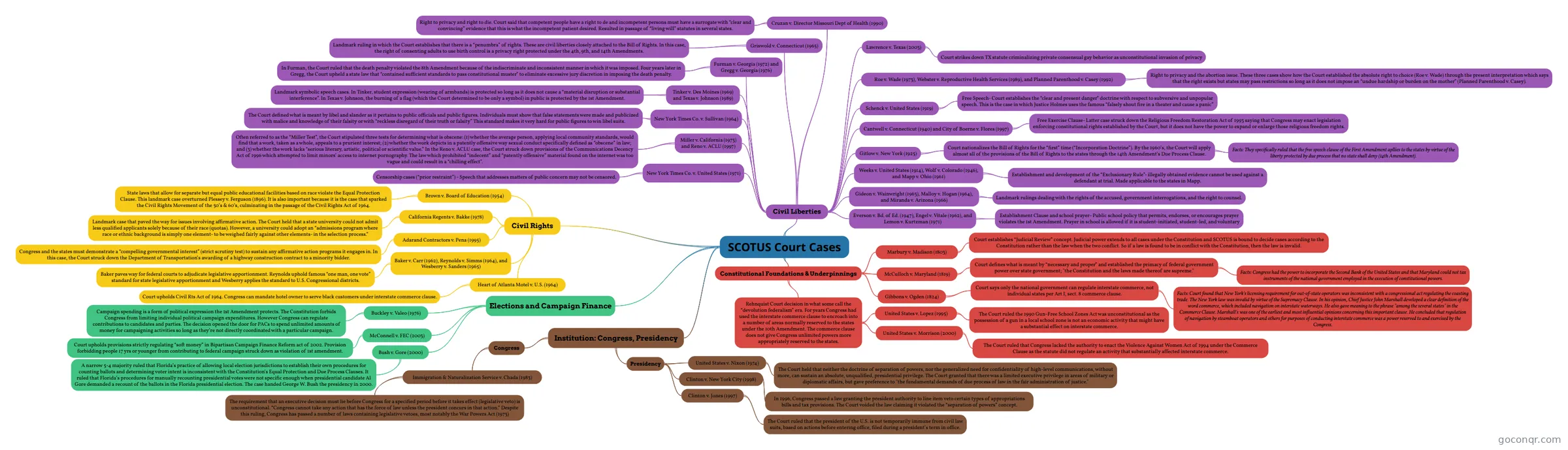
Mind map: SCOTUS court cases
Map content
SCOTUS Court Cases
Constitutional Foundations & Underpinnings
- Marbury v. Madison (1803)
- Court establishes “Judicial Review” concept. Judicial power extends to all cases under the Constitution and SCOTUS is bound to decide cases according to the Constitution rather than the law when the two conflict. So if a law is found to be in conflict with the Constitution, then the law is invalid.
- McCulloch v. Maryland (1819)
- Court defines what is meant by “necessary and proper” and established the primacy of federal government power over state government; "the Constitution and the laws made thereof are supreme."
- Facts: Congress had the power to incorporate the Second Bank of the United States and that Maryland could not tax instruments of the national government employed in the execution of constitutional powers.
- Court defines what is meant by “necessary and proper” and established the primacy of federal government power over state government; "the Constitution and the laws made thereof are supreme."
- Gibbons v. Ogden (1824)
- Court says only the national government can regulate interstate commerce, not individual states per Art I, sect. 8 commerce clause.
- Facts: Court found that New York's licensing requirement for out-of-state operators was inconsistent with a congressional act regulating the coasting trade. The New York law was invalid by virtue of the Supremacy Clause. In his opinion, Chief Justice John Marshall developed a clear definition of the word commerce, which included navigation on interstate waterways. He also gave meaning to the phrase "among the several states" in the Commerce Clause. Marshall's was one of the earliest and most influential opinions concerning this important clause. He concluded that regulation of navigation by steamboat operators and others for purposes of conducting interstate commerce was a power reserved to and exercised by the Congress.
- Court says only the national government can regulate interstate commerce, not individual states per Art I, sect. 8 commerce clause.
- Rehnquist Court decision in what some call the “devolution federalism” era. For years Congress had used the interstate commerce clause to encroach into a number of areas normally reserved to the states under the 10th Amendment. The commerce clause does not give Congress unlimited powers more appropriately reserved to the states.
- United States v. Lopez (1995)
- The Court ruled the 1990 Gun-Free School Zones Act was unconstitutional as the possession of a gun in a local school zone is not an economic activity that might have a substantial effect on interstate commerce.
- United States v. Morrison (2000)
- The Court ruled that Congress lacked the authority to enact the Violence Against Women Act of 1994 under the Commerce Clause as the statute did not regulate an activity that substantially affected interstate commerce.
- United States v. Lopez (1995)
- Marbury v. Madison (1803)
Civil Liberties
- Gitlow v. New York (1925)
- Court nationalizes the Bill of Rights for the “first” time (“Incorporation Doctrine”). By the 1960’s, the Court will apply almost all of the provisions of the Bill of Rights to the states through the 14th Amendment’s Due Process Clause.
- Facts: They specifically ruled that the free speech clause of the First Amendment apllies to the states by virtue of the liberty protected by due process that no state shall deny (14th Amendment).
- Court nationalizes the Bill of Rights for the “first” time (“Incorporation Doctrine”). By the 1960’s, the Court will apply almost all of the provisions of the Bill of Rights to the states through the 14th Amendment’s Due Process Clause.
- Weeks v. United States (1914), Wolf v. Colorado (1946), and Mapp v. Ohio (1961)
- Establishment and development of the “Exclusionary Rule”- illegally obtained evidence cannot be used against a defendant at trial. Made applicable to the states in Mapp.
- Gideon v. Wainwright (1963), Malloy v. Hogan (1964), and Miranda v. Arizona (1966)
- Landmark rulings dealing with the rights of the accused, government interrogations, and the right to counsel.
- Everson v. Bd. of Ed. (1947), Engel v. Vitale (1962), and Lemon v. Kurtzman (1971)
- Establishment Clause and school prayer- Public school policy that permits, endorses, or encourages prayer violates the 1st Amendment. Prayer in school is allowed if it is student-initiated, student-led, and voluntary
- Cantwell v. Connecticut (1940) and City of Boerne v. Flores (1997)
- Free Exercise Clause- Latter case struck down the Religious Freedom Restoration Act of 1993 saying that Congress may enact legislation enforcing constitutional rights established by the Court, but it does not have the power to expand or enlarge those religious freedom rights.
- Schenck v. United States (1919)
- Free Speech- Court establishes the “clear and present danger” doctrine with respect to subversive and unpopular speech. This is the case in which Justice Holmes uses the famous “falsely shout fire in a theater and cause a panic”
- New York Times Co. v. United States (1971)
- Censorship cases (“prior restraint”) - Speech that addresses matters of public concern may not be censored.
- Miller v. California (1973) and Reno v. ACLU (1997)
- Often referred to as the “Miller Test”, the Court stipulated three tests for determining what is obscene: (1) whether the average person, applying local community standards, would find that a work, taken as a whole, appeals to a prurient interest; (2) whether the work depicts in a patently offensive way sexual conduct specifically defined as “obscene” in law; and (3) whether the work lacks “serious literary, artistic, political or scientific value.” In the Reno v. ACLU case, the Court struck down provisions of the Communications Decency Act of 1996 which attempted to limit minors’ access to internet pornography. The law which prohibited “indecent” and “patently offensive” material found on the internet was too vague and could result in a “chilling effect”.
- New York Times Co. v. Sullivan (1964)
- The Court defined what is meant by libel and slander as it pertains to public officials and public figures. Individuals must show that false statements were made and publicized with malice and knowledge of their falsity or with “reckless disregard of their truth or falsity” This standard makes it very hard for public figures to win libel suits.
- Tinker v. Des Moines (1969) and Texas v. Johnson (1989)
- Landmark symbolic speech cases. In Tinker, student expression (wearing of armbands) is protected so long as it does not cause a “material disruption or substantial interference”. In Texas v. Johnson, the burning of a flag (which the Court determined to be only a symbol) in public is protected by the 1st Amendment.
- Furman v. Georgia (1972) and Gregg v. Georgia (1976)
- In Furman, the Court ruled that the death penalty violated the 8th Amendment because of the indiscriminate and inconsistent manner in which it was imposed. Four years later in Gregg, the Court upheld a state law that “contained sufficient standards to pass constitutional muster” to eliminate excessive jury discretion in imposing the death penalty.
- Griswold v. Connecticut (1965)
- Landmark ruling in which the Court establishes that there is a “penumbra” of rights. These are civil liberties closely attached to the Bill of Rights. In this case, the right of consenting adults to use birth control is a privacy right protected under the 4th, 9th, and 14th Amendments.
- Roe v. Wade (1973), Webster v. Reproductive Health Services (1989), and Planned Parenthood v. Casey (1992)
- Right to privacy and the abortion issue. These three cases show how the Court established the absolute right to choice (Roe v. Wade) through the present interpretation which says that the right exists but states may pass restrictions so long as it does not impose an “undue hardship or burden on the mother” (Planned Parenthood v. Casey).
- Cruzan v. Director Missouri Dept of Health (1990)
- Right to privacy and right to die. Court said that competent people have a right to de and incompetent persons must have a surrogate with “clear and convincing” evidence that this is what the incompetent patient desired. Resulted in passage of “living will” statutes in several states.
- Lawrence v. Texas (2003)
- Court strikes down TX statute criminalizing private consensual gay behavior as unconstitutional invasion of privacy
- Gitlow v. New York (1925)
Elections and Campaign Finance
- Buckley v. Valeo (1976)
- Campaign spending is a form of political expression the 1st Amendment protects. The Constitution forbids Congress from limiting individual political campaign expenditures. However Congress can regulate contributions to candidates and parties. The decision opened the door for PACs to spend unlimited amounts of money for campaigning activities so long as they’re not directly coordinated with a particular campaign.
- McConnell v. FEC (2003)
- Court upholds provisions strictly regulating “soft money” in Bipartisan Campaign Finance Reform act of 2002. Provision forbidding people 17 yrs or younger from contributing to federal campaign struck down as violation of 1st amendment.
- Bush v. Gore (2000)
- A narrow 5-4 majority ruled that Florida’s practice of allowing local election jurisdictions to establish their own procedures for counting ballots and determining voter intent is inconsistent with the Constitution’s Equal Protection and Due Process Clauses. It ruled that Florida’s procedures for manually recounting presidential votes were not specific enough when presidential candidate Al Gore demanded a recount of the ballots in the Florida presidential election. The case handed George W. Bush the presidency in 2000.
- Buckley v. Valeo (1976)
Civil Rights
- Brown v. Board of Education (1954)
- State laws that allow for separate but equal public educational facilities based on race violate the Equal Protection Clause. This landmark case overturned Plessey v. Ferguson (1896). It is also important because it is the case that sparked the Civil Rights Movement of the 50’s & 60’s, culminating in the passage of the Civil Rights Act of 1964.
- California Regents v. Bakke (1978)
- Landmark case that paved the way for issues involving affirmative action. The Court held that a state university could not admit less qualified applicants solely because of their race (quotas). However, a university could adopt an “admissions program where race or ethnic background is simply one element- to be weighed fairly against other elements- in the selection process.”
- Adarand Contractors v. Pena (1995)
- Congress and the states must demonstrate a “compelling governmental interest” (strict scrutiny test) to sustain any affirmative action programs it engages in. In this case, the Court struck down the Department of Transportation’s awarding of a highway construction contract to a minority bidder.
- Baker v. Carr (1962), Reynolds v. Simms (1964), and Wesberry v. Sanders (1965)
- Baker paves way for federal courts to adjudicate legislative apportionment. Reynolds uphold famous “one man, one vote” standard for state legislative apportionment and Wesberry applies the standard to U.S. Congressional districts.
- Heart of Atlanta Motel v. U.S. (1964)
- Court upholds Civil Rts Act of 1964. Congress can mandate hotel owner to serve black customers under interstate commerce clause.
- Brown v. Board of Education (1954)
Institution: Congress, Presidency
- Congress
- Immigration & Naturalization Service v. Chada (1983)
- The requirement that an executive decision must lie before Congress for a specified period before it takes effect (legislative veto) is unconstitutional. “Congress cannot take any action that has the force of law unless the president concurs in that action.” Despite this ruling, Congress has passed a number of laws containing legislative vetoes, most notably the War Powers Act (1973)
- Immigration & Naturalization Service v. Chada (1983)
- Presidency
- United States v. Nixon (1974)
- The Court held that neither the doctrine of separation of powers, nor the generalized need for confidentiality of high-level communications, without more, can sustain an absolute, unqualified, presidential privilege. The Court granted that there was a limited executive privilege in areas of military or diplomatic affairs, but gave preference to "the fundamental demands of due process of law in the fair administration of justice."
- Clinton v. New York City (1998)
- In 1996, Congress passed a law granting the president authority to line item veto certain types of appropriations bills and tax provisions. The Court voided the law claiming it violated the “separation of powers” concept.
- Clinton v. Jones (1997)
- The Court ruled that the president of the U.S. is not temporarily immune from civil law suits, based on actions before entering office, filed during a president’s term in office.
- United States v. Nixon (1974)
- Congress
Information
- Description
- All the key court cases to know for AP Government.
- Created by
- Sebastian Anastasi
- Views
- 2
- Rating
More on Landmark Supreme Court Cases