
Mind map
Cranial Nerves IX, X, XI, XII Summary
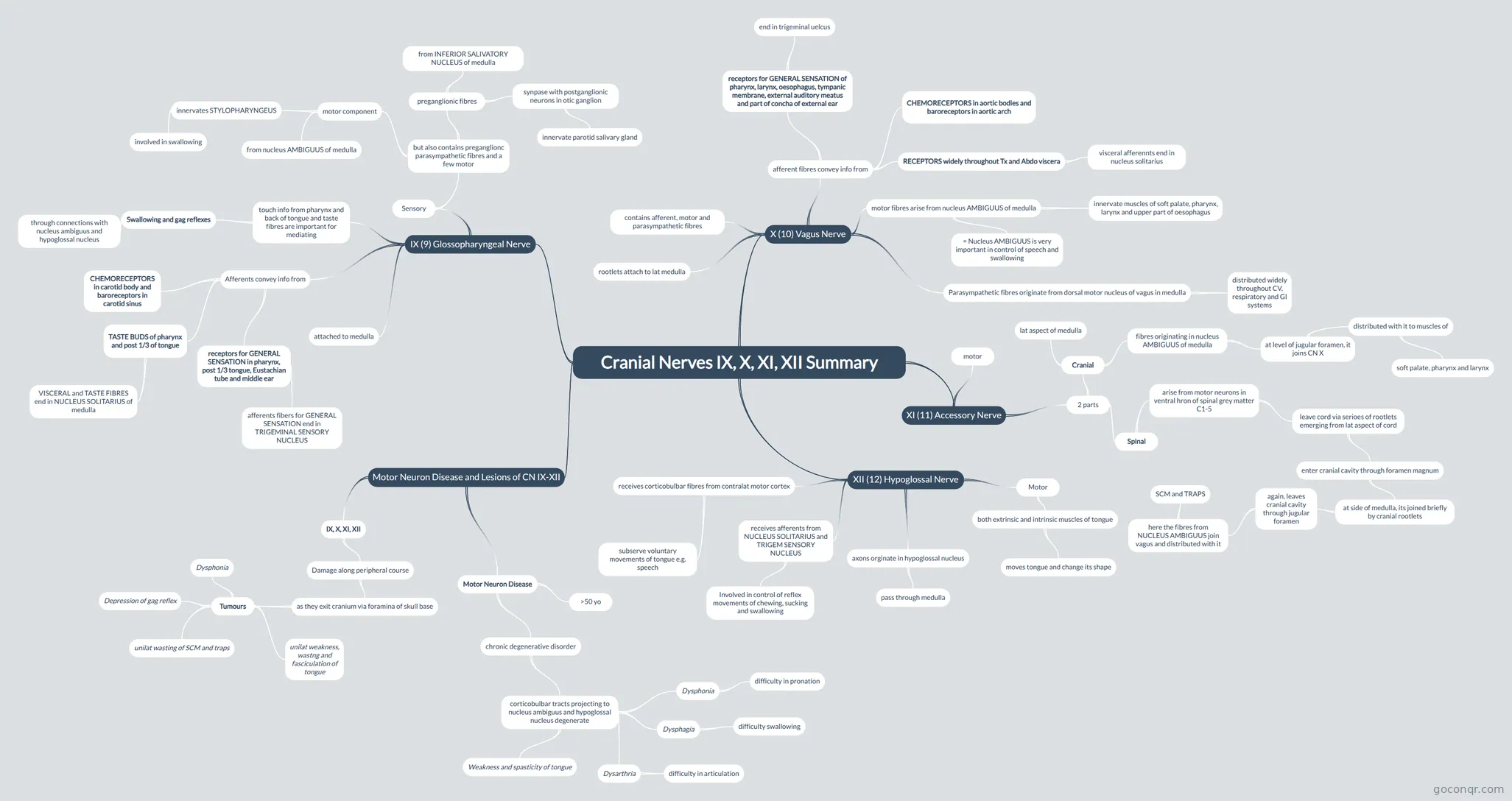
Mind map: Cranial nerves IX, X, XI, XII summary
Map content
Cranial Nerves IX, X, XI, XII Summary
IX (9) Glossopharyngeal Nerve
- Sensory
- but also contains preganglionc parasympathetic fibres and a few motor
- motor component
- from nucleus AMBIGUUS of medulla
- innervates STYLOPHARYNGEUS
- involved in swallowing
- preganglionic fibres
- from INFERIOR SALIVATORY NUCLEUS of medulla
- synpase with postganglionic neurons in otic ganglion
- innervate parotid salivary gland
- motor component
- but also contains preganglionc parasympathetic fibres and a few motor
- attached to medulla
- Afferents convey info from
- receptors for GENERAL SENSATION in pharynx, post 1/3 tongue, Eustachian tube and middle ear
- afferents fibers for GENERAL SENSATION end in TRIGEMINAL SENSORY NUCLEUS
- TASTE BUDS of pharynx and post 1/3 of tongue
- VISCERAL and TASTE FIBRES end in NUCLEUS SOLITARIUS of medulla
- CHEMORECEPTORS in carotid body and baroreceptors in carotid sinus
- receptors for GENERAL SENSATION in pharynx, post 1/3 tongue, Eustachian tube and middle ear
- touch info from pharynx and back of tongue and taste fibres are important for mediating
- Swallowing and gag reflexes
- through connections with nucleus ambiguus and hypoglossal nucleus
- Swallowing and gag reflexes
- Sensory
X (10) Vagus Nerve
- rootlets attach to lat medulla
- contains afferent, motor and parasympathetic fibres
- afferent fibres convey info from
- receptors for GENERAL SENSATION of pharynx, larynx, oesophagus, tympanic membrane, external auditory meatus and part of concha of external ear
- end in trigeminal uelcus
- CHEMORECEPTORS in aortic bodies and baroreceptors in aortic arch
- RECEPTORS widely throughout Tx and Abdo viscera
- visceral afferennts end in nucleus solitarius
- receptors for GENERAL SENSATION of pharynx, larynx, oesophagus, tympanic membrane, external auditory meatus and part of concha of external ear
- motor fibres arise from nucleus AMBIGUUS of medulla
- innervate muscles of soft palate, pharynx, larynx and upper part of oesophagus
- = Nucleus AMBIGUUS is very important in control of speech and swallowing
- Parasympathetic fibres originate from dorsal motor nucleus of vagus in medulla
- distributed widely throughout CV, respiratory and GI systems
XI (11) Accessory Nerve
- motor
- 2 parts
- Cranial
- lat aspect of medulla
- fibres originating in nucleus AMBIGUUS of medulla
- at level of jugular foramen, it joins CN X
- distributed with it to muscles of
- soft palate, pharynx and larynx
- distributed with it to muscles of
- at level of jugular foramen, it joins CN X
- Spinal
- arise from motor neurons in ventral hron of spinal grey matter C1-5
- leave cord via serioes of rootlets emerging from lat aspect of cord
- enter cranial cavity through foramen magnum
- at side of medulla, its joined briefly by cranial rootlets
- again, leaves cranial cavity through jugular foramen
- here the fibres from NUCLEUS AMBIGUUS join vagus and distributed with it
- SCM and TRAPS
- here the fibres from NUCLEUS AMBIGUUS join vagus and distributed with it
- again, leaves cranial cavity through jugular foramen
- at side of medulla, its joined briefly by cranial rootlets
- enter cranial cavity through foramen magnum
- leave cord via serioes of rootlets emerging from lat aspect of cord
- arise from motor neurons in ventral hron of spinal grey matter C1-5
- Cranial
XII (12) Hypoglossal Nerve
- Motor
- both extrinsic and intrinsic muscles of tongue
- moves tongue and change its shape
- both extrinsic and intrinsic muscles of tongue
- axons orginate in hypoglossal nucleus
- pass through medulla
- receives afferents from NUCLEUS SOLITARIUS and TRIGEM SENSORY NUCLEUS
- Involved in control of reflex movements of chewing, sucking and swallowing
- receives corticobulbar fibres from contralat motor cortex
- subserve voluntary movements of tongue e.g. speech
- Motor
Motor Neuron Disease and Lesions of CN IX-XII
- Motor Neuron Disease
- chronic degenerative disorder
- corticobulbar tracts projecting to nucleus ambiguus and hypoglossal nucleus degenerate
- Dysphonia
- difficulty in pronation
- Dysphagia
- difficulty swallowing
- Dysarthria
- difficulty in articulation
- Weakness and spasticity of tongue
- Dysphonia
- corticobulbar tracts projecting to nucleus ambiguus and hypoglossal nucleus degenerate
- >50 yo
- chronic degenerative disorder
- IX, X, XI, XII
- Damage along peripheral course
- as they exit cranium via foramina of skull base
- Tumours
- Dysphonia
- Depression of gag reflex
- unilat wasting of SCM and traps
- unilat weakness, wastng and fasciculation of tongue
- Tumours
- as they exit cranium via foramina of skull base
- Damage along peripheral course
- Motor Neuron Disease
Information
- Description
- Anatomy Mind Map on Cranial Nerves IX, X, XI, XII Summary, created by Harriet Colquhoun on 05/05/2018.
- Created by
- Harriet Colquhoun
- Views
- 1
- Rating