
Mind map
GLOBAL ECONOMY
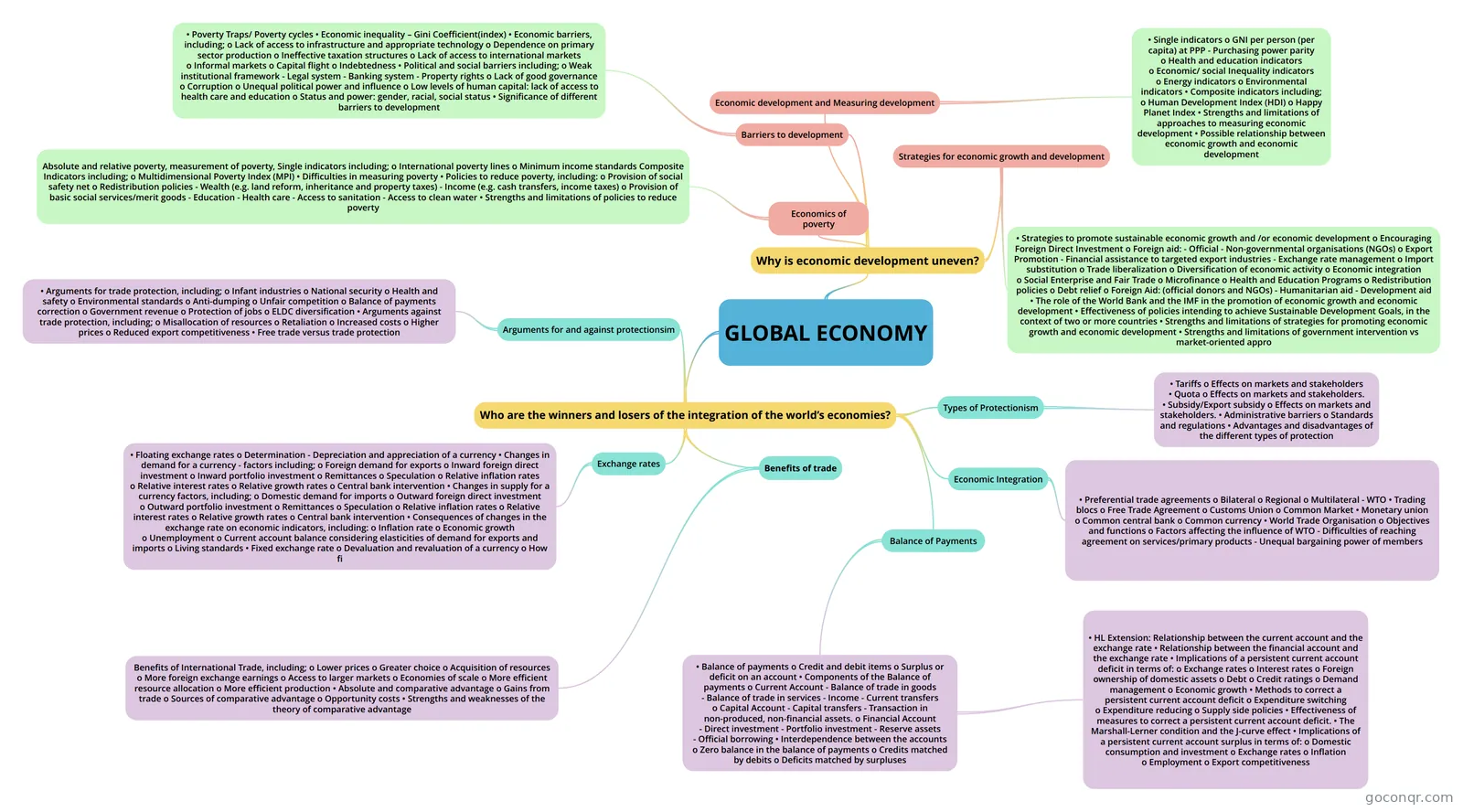
Mind map: Global economy
Map content
GLOBAL ECONOMY
Who are the winners and losers of the integration of the world’s economies?
- Benefits of trade
- Benefits of International Trade, including; o Lower prices o Greater choice o Acquisition of resources o More foreign exchange earnings o Access to larger markets o Economies of scale o More efficient resource allocation o More efficient production • Absolute and comparative advantage o Gains from trade o Sources of comparative advantage o Opportunity costs • Strengths and weaknesses of the theory of comparative advantage
- Types of Protectionism
- • Tariffs o Effects on markets and stakeholders • Quota o Effects on markets and stakeholders. • Subsidy/Export subsidy o Effects on markets and stakeholders. • Administrative barriers o Standards and regulations • Advantages and disadvantages of the different types of protection
- Arguments for and against protectionsim
- • Arguments for trade protection, including; o Infant industries o National security o Health and safety o Environmental standards o Anti-dumping o Unfair competition o Balance of payments correction o Government revenue o Protection of jobs o ELDC diversification • Arguments against trade protection, including; o Misallocation of resources o Retaliation o Increased costs o Higher prices o Reduced export competitiveness • Free trade versus trade protection
- Economic Integration
- • Preferential trade agreements o Bilateral o Regional o Multilateral - WTO • Trading blocs o Free Trade Agreement o Customs Union o Common Market • Monetary union o Common central bank o Common currency • World Trade Organisation o Objectives and functions o Factors affecting the influence of WTO - Difficulties of reaching agreement on services/primary products - Unequal bargaining power of members
- Exchange rates
- • Floating exchange rates o Determination - Depreciation and appreciation of a currency • Changes in demand for a currency - factors including; o Foreign demand for exports o Inward foreign direct investment o Inward portfolio investment o Remittances o Speculation o Relative inflation rates o Relative interest rates o Relative growth rates o Central bank intervention • Changes in supply for a currency factors, including; o Domestic demand for imports o Outward foreign direct investment o Outward portfolio investment o Remittances o Speculation o Relative inflation rates o Relative interest rates o Relative growth rates o Central bank intervention • Consequences of changes in the exchange rate on economic indicators, including: o Inflation rate o Economic growth o Unemployment o Current account balance considering elasticities of demand for exports and imports o Living standards • Fixed exchange rate o Devaluation and revaluation of a currency o How fi
- Balance of Payments
- • Balance of payments o Credit and debit items o Surplus or deficit on an account • Components of the Balance of payments o Current Account - Balance of trade in goods - Balance of trade in services - Income - Current transfers o Capital Account - Capital transfers - Transaction in non-produced, non-financial assets. o Financial Account - Direct investment - Portfolio investment - Reserve assets - Official borrowing • Interdependence between the accounts o Zero balance in the balance of payments o Credits matched by debits o Deficits matched by surpluses
- • HL Extension: Relationship between the current account and the exchange rate • Relationship between the financial account and the exchange rate • Implications of a persistent current account deficit in terms of: o Exchange rates o Interest rates o Foreign ownership of domestic assets o Debt o Credit ratings o Demand management o Economic growth • Methods to correct a persistent current account deficit o Expenditure switching o Expenditure reducing o Supply side policies • Effectiveness of measures to correct a persistent current account deficit. • The Marshall-Lerner condition and the J-curve effect • Implications of a persistent current account surplus in terms of: o Domestic consumption and investment o Exchange rates o Inflation o Employment o Export competitiveness
- • Balance of payments o Credit and debit items o Surplus or deficit on an account • Components of the Balance of payments o Current Account - Balance of trade in goods - Balance of trade in services - Income - Current transfers o Capital Account - Capital transfers - Transaction in non-produced, non-financial assets. o Financial Account - Direct investment - Portfolio investment - Reserve assets - Official borrowing • Interdependence between the accounts o Zero balance in the balance of payments o Credits matched by debits o Deficits matched by surpluses
- Benefits of trade
Why is economic development uneven?
- Economic development and Measuring development
- • Single indicators o GNI per person (per capita) at PPP - Purchasing power parity o Health and education indicators o Economic/ social Inequality indicators o Energy indicators o Environmental indicators • Composite indicators including; o Human Development Index (HDI) o Happy Planet Index • Strengths and limitations of approaches to measuring economic development • Possible relationship between economic growth and economic development
- Barriers to development
- • Poverty Traps/ Poverty cycles • Economic inequality – Gini Coefficient(index) • Economic barriers, including; o Lack of access to infrastructure and appropriate technology o Dependence on primary sector production o Ineffective taxation structures o Lack of access to international markets o Informal markets o Capital flight o Indebtedness • Political and social barriers including; o Weak institutional framework - Legal system - Banking system - Property rights o Lack of good governance o Corruption o Unequal political power and influence o Low levels of human capital: lack of access to health care and education o Status and power: gender, racial, social status • Significance of different barriers to development
- Economics of poverty
- Absolute and relative poverty, measurement of poverty, Single indicators including; o International poverty lines o Minimum income standards Composite Indicators including; o Multidimensional Poverty Index (MPI) • Difficulties in measuring poverty • Policies to reduce poverty, including: o Provision of social safety net o Redistribution policies - Wealth (e.g. land reform, inheritance and property taxes) - Income (e.g. cash transfers, income taxes) o Provision of basic social services/merit goods - Education - Health care - Access to sanitation - Access to clean water • Strengths and limitations of policies to reduce poverty
- Strategies for economic growth and development
- • Strategies to promote sustainable economic growth and /or economic development o Encouraging Foreign Direct Investment o Foreign aid: - Official - Non-governmental organisations (NGOs) o Export Promotion - Financial assistance to targeted export industries - Exchange rate management o Import substitution o Trade liberalization o Diversification of economic activity o Economic integration o Social Enterprise and Fair Trade o Microfinance o Health and Education Programs o Redistribution policies o Debt relief o Foreign Aid: (official donors and NGOs) - Humanitarian aid - Development aid • The role of the World Bank and the IMF in the promotion of economic growth and economic development • Effectiveness of policies intending to achieve Sustainable Development Goals, in the context of two or more countries • Strengths and limitations of strategies for promoting economic growth and economic development • Strengths and limitations of government intervention vs market-oriented appro
- Economic development and Measuring development
Information
- Description
- IB Economics Mind Map on GLOBAL ECONOMY, created by m a on 27/06/2018.
- Created by
- m a
- Views
- 0
- History
-
- Created by m a · Jun 27, 2018
- Copied by m a · Jun 27, 2018
- Rating