
Mind map
Chemistry topic 1: atomic structure and the periodic table
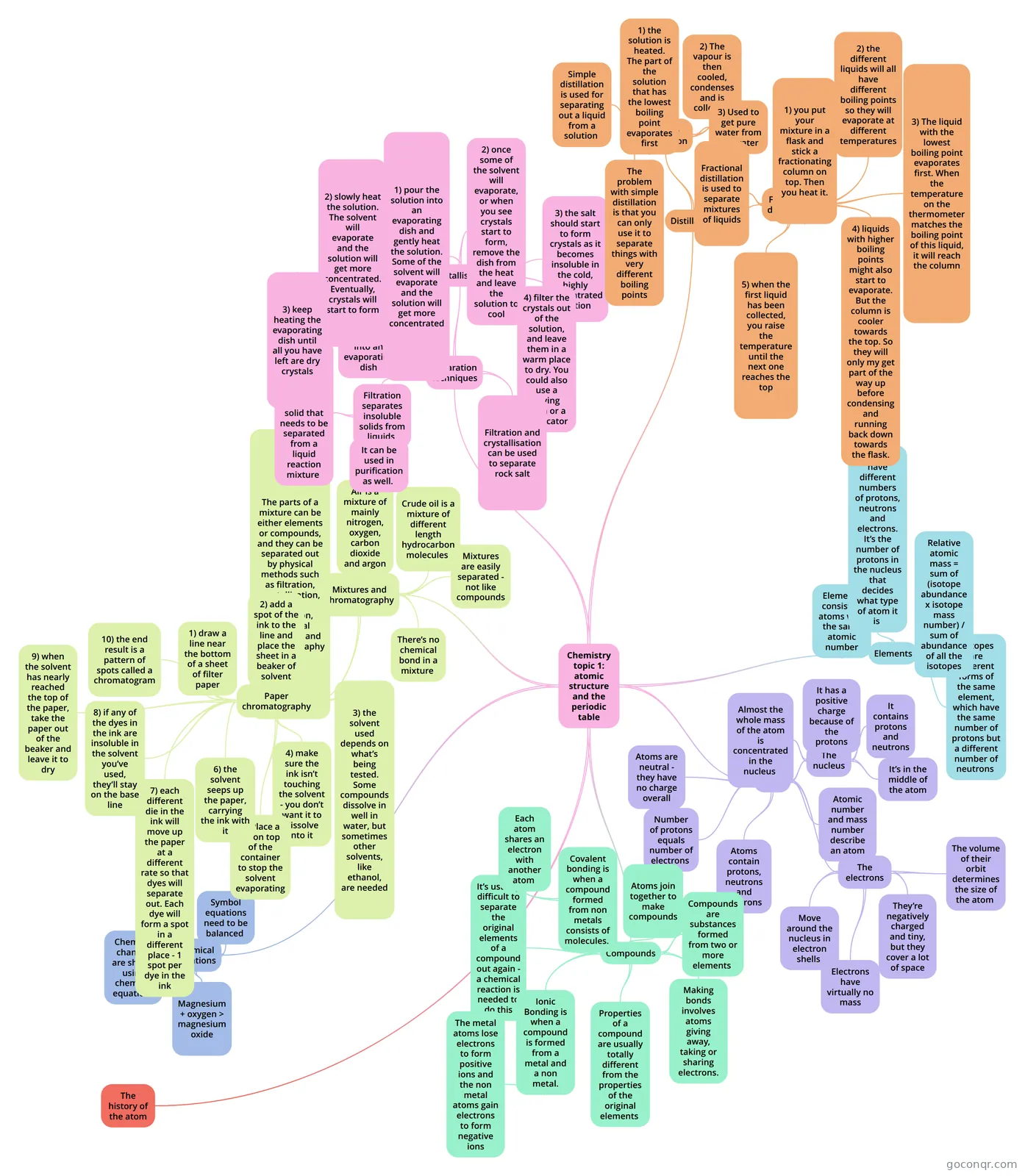
Mind map: Atomic structure and the periodic table
Map content
Chemistry topic 1: atomic structure and the periodic table
Atoms
- Atoms contain protons, neutrons and electrons
- The nucleus
- It’s in the middle of the atom
- It contains protons and neutrons
- It has a positive charge because of the protons
- Almost the whole mass of the atom is concentrated in the nucleus
- The electrons
- Move around the nucleus in electron shells
- They’re negatively charged and tiny, but they cover a lot of space
- The volume of their orbit determines the size of the atom
- Electrons have virtually no mass
- Atoms are neutral - they have no charge overall
- Number of protons equals number of electrons
- Atomic number and mass number describe an atom
Elements
- Elements consist of atoms with the same atomic number
- Atoms can have different numbers of protons, neutrons and electrons. It’s the number of protons in the nucleus that decides what type of atom it is
- Isotopes are different forms of the same element, which have the same number of protons but a different number of neutrons
- Relative atomic mass = sum of (isotope abundance x isotope mass number) / sum of abundance of all the isotopes
Compounds
- Atoms join together to make compounds
- Compounds are substances formed from two or more elements
- Making bonds involves atoms giving away, taking or sharing electrons.
- It’s usually difficult to separate the original elements of a compound out again - a chemical reaction is needed to do this
- Ionic Bonding is when a compound is formed from a metal and a non metal.
- The metal atoms lose electrons to form positive ions and the non metal atoms gain electrons to form negative ions
- Covalent bonding is when a compound formed from non metals consists of molecules.
- Each atom shares an electron with another atom
- Properties of a compound are usually totally different from the properties of the original elements
Chemical equations
- Chemical changes are shown using chemical equations
- Magnesium + oxygen > magnesium oxide
- Symbol equations need to be balanced
Mixtures and chromatography
- Mixtures are easily separated - not like compounds
- There’s no chemical bond in a mixture
- The parts of a mixture can be either elements or compounds, and they can be separated out by physical methods such as filtration, crystallisation, simple distillation, fractional distillation and chromotography
- Air is a mixture of mainly nitrogen, oxygen, carbon dioxide and argon
- Crude oil is a mixture of different length hydrocarbon molecules
- Paper chromatography
- 1) draw a line near the bottom of a sheet of filter paper
- 2) add a spot of the ink to the line and place the sheet in a beaker of solvent
- 3) the solvent used depends on what’s being tested. Some compounds dissolve in well in water, but sometimes other solvents, like ethanol, are needed
- 4) make sure the ink isn’t touching the solvent - you don’t want it to dissolve into it
- 5) Place a lid on top of the container to stop the solvent evaporating
- 6) the solvent seeps up the paper, carrying the ink with it
- 7) each different die in the ink will move up the paper at a different rate so that dyes will separate out. Each dye will form a spot in a different place - 1 spot per dye in the ink
- 8) if any of the dyes in the ink are insoluble in the solvent you’ve used, they’ll stay on the base line
- 9) when the solvent has nearly reached the top of the paper, take the paper out of the beaker and leave it to dry
- 10) the end result is a pattern of spots called a chromatogram
Separation techniques
- Filtration separates insoluble solids from liquids
- Filtration can be used your product is an insoluble solid that needs to be separated from a liquid reaction mixture
- It can be used in purification as well.
- Evaporation
- 1) Pour the solution into an evaporating dish
- 2) slowly heat the solution. The solvent will evaporate and the solution will get more concentrated. Eventually, crystals will start to form
- 3) keep heating the evaporating dish until all you have left are dry crystals
- Crystallisation
- 1) pour the solution into an evaporating dish and gently heat the solution. Some of the solvent will evaporate and the solution will get more concentrated
- 2) once some of the solvent will evaporate, or when you see crystals start to form, remove the dish from the heat and leave the solution to cool
- 3) the salt should start to form crystals as it becomes insoluble in the cold, highly concentrated solution
- 4) filter the crystals out of the solution, and leave them in a warm place to dry. You could also use a drying oven or a desiccator
- Filtration and crystallisation can be used to separate rock salt
- Filtration separates insoluble solids from liquids
Distillation
- Simple distillation
- Simple distillation is used for separating out a liquid from a solution
- 1) the solution is heated. The part of the solution that has the lowest boiling point evaporates first
- 2) The vapour is then cooled, condenses and is collected
- 3) Used to get pure water from sea water
- The problem with simple distillation is that you can only use it to separate things with very different boiling points
- Fractional distillation
- Fractional distillation is used to separate mixtures of liquids
- 1) you put your mixture in a flask and stick a fractionating column on top. Then you heat it.
- 2) the different liquids will all have different boiling points so they will evaporate at different temperatures
- 3) The liquid with the lowest boiling point evaporates first. When the temperature on the thermometer matches the boiling point of this liquid, it will reach the column
- 4) liquids with higher boiling points might also start to evaporate. But the column is cooler towards the top. So they will only my get part of the way up before condensing and running back down towards the flask.
- 5) when the first liquid has been collected, you raise the temperature until the next one reaches the top
- Simple distillation
The history of the atom
Information
- Description
- GCSE Chemistry Mind Map on Chemistry topic 1: atomic structure and the periodic table, created by lara Chaplin on 06/02/2019.
- Created by
- lara Chaplin
- Views
- 4
- Rating
More on Periodic Table and Trends