
Mind map
FAMILIES AND HOUSEHOLDS- TOPIC 1 COUPLES
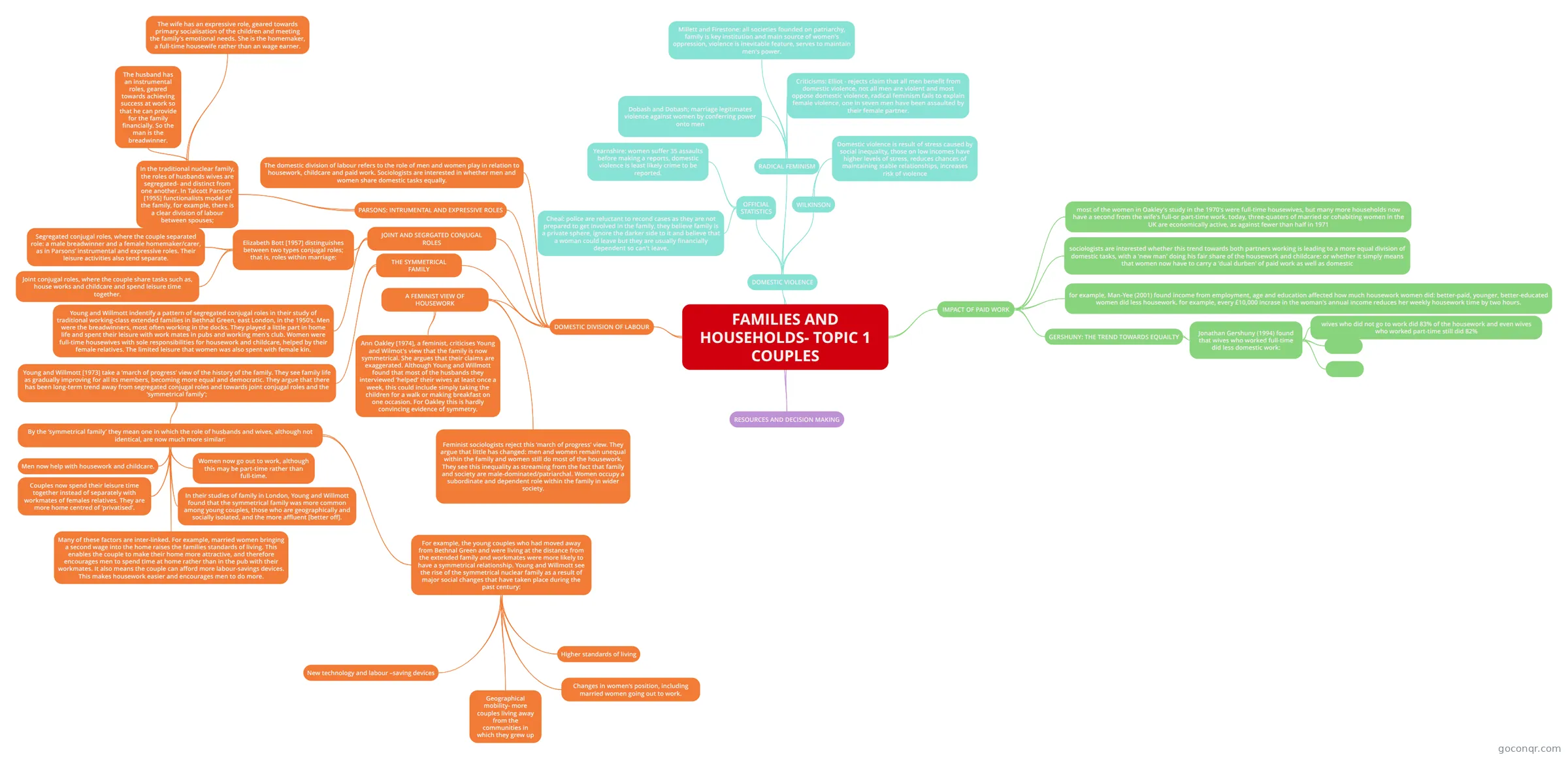
Mind map: families and households couples
Map content
FAMILIES AND HOUSEHOLDS- TOPIC 1 COUPLES
DOMESTIC VIOLENCE
- RADICAL FEMINISM
- Dobash and Dobash; marriage legitimates violence against women by conferring power onto men
- Millett and Firestone: all societies founded on patriarchy, family is key institution and main source of women's oppression, violence is inevitable feature, serves to maintain men's power.
- Criticisms: Elliot - rejects claim that all men benefit from domestic violence, not all men are violent and most oppose domestic violence, radical feminism fails to explain female violence, one in seven men have been assaulted by their female partner.
- WILKINSON
- Domestic violence is result of stress caused by social inequality, those on low incomes have higher levels of stress, reduces chances of maintaining stable relationships, increases risk of violence
- OFFICIAL STATISTICS
- Yearnshire: women suffer 35 assaults before making a reports, domestic violence is least likely crime to be reported.
- Cheal: police are reluctant to recond cases as they are not prepared to get involved in the family, they believe family is a private sphere, ignore the darker side to it and believe that a woman could leave but they are usually financially dependent so can't leave.
- RADICAL FEMINISM
RESOURCES AND DECISION MAKING
DOMESTIC DIVISION OF LABOUR
- The domestic division of labour refers to the role of men and women play in relation to housework, childcare and paid work. Sociologists are interested in whether men and women share domestic tasks equally.
- PARSONS: INTRUMENTAL AND EXPRESSIVE ROLES
- In the traditional nuclear family, the roles of husbands wives are segregated- and distinct from one another. In Talcott Parsons’ [1955] functionalists model of the family, for example, there is a clear division of labour between spouses;
- The wife has an expressive role, geared towards primary socialisation of the children and meeting the family’s emotional needs. She is the homemaker, a full-time housewife rather than an wage earner.
- The husband has an instrumental roles, geared towards achieving success at work so that he can provide for the family financially. So the man is the breadwinner.
- In the traditional nuclear family, the roles of husbands wives are segregated- and distinct from one another. In Talcott Parsons’ [1955] functionalists model of the family, for example, there is a clear division of labour between spouses;
- JOINT AND SEGRGATED CONJUGAL ROLES
- Elizabeth Bott [1957] distinguishes between two types conjugal roles; that is, roles within marriage:
- Segregated conjugal roles, where the couple separated role: a male breadwinner and a female homemaker/carer, as in Parsons’ instrumental and expressive roles. Their leisure activities also tend separate.
- Joint conjugal roles, where the couple share tasks such as, house works and childcare and spend leisure time together.
- Young and Willmott indentify a pattern of segregated conjugal roles in their study of traditional working-class extended families in Bethnal Green, east London, in the 1950’s. Men were the breadwinners, most often working in the docks. They played a little part in home life and spent their leisure with work mates in pubs and working men's club. Women were full-time housewives with sole responsibilities for housework and childcare, helped by their female relatives. The limited leisure that women was also spent with female kin.
- Elizabeth Bott [1957] distinguishes between two types conjugal roles; that is, roles within marriage:
- THE SYMMETRICAL FAMILY
- Young and Willmott [1973] take a ‘march of progress’ view of the history of the family. They see family life as gradually improving for all its members, becoming more equal and democratic. They argue that there has been long-term trend away from segregated conjugal roles and towards joint conjugal roles and the ‘symmetrical family’;
- By the ‘symmetrical family’ they mean one in which the role of husbands and wives, although not identical, are now much more similar:
- Women now go out to work, although this may be part-time rather than full-time.
- Men now help with housework and childcare.
- Couples now spend their leisure time together instead of separately with workmates of females relatives. They are more home centred of ‘privatised’.
- In their studies of family in London, Young and Willmott found that the symmetrical family was more common among young couples, those who are geographically and socially isolated, and the more affluent [better off].
- For example, the young couples who had moved away from Bethnal Green and were living at the distance from the extended family and workmates were more likely to have a symmetrical relationship. Young and Willmott see the rise of the symmetrical nuclear family as a result of major social changes that have taken place during the past century:
- Changes in women’s position, including married women going out to work.
- Geographical mobility- more couples living away from the communities in which they grew up
- New technology and labour –saving devices
- Higher standards of living
- Many of these factors are inter-linked. For example, married women bringing a second wage into the home raises the families standards of living. This enables the couple to make their home more attractive, and therefore encourages men to spend time at home rather than in the pub with their workmates. It also means the couple can afford more labour-savings devices. This makes housework easier and encourages men to do more.
- By the ‘symmetrical family’ they mean one in which the role of husbands and wives, although not identical, are now much more similar:
- Young and Willmott [1973] take a ‘march of progress’ view of the history of the family. They see family life as gradually improving for all its members, becoming more equal and democratic. They argue that there has been long-term trend away from segregated conjugal roles and towards joint conjugal roles and the ‘symmetrical family’;
- A FEMINIST VIEW OF HOUSEWORK
- Feminist sociologists reject this ‘march of progress’ view. They argue that little has changed: men and women remain unequal within the family and women still do most of the housework. They see this inequality as streaming from the fact that family and society are male-dominated/patriarchal. Women occupy a subordinate and dependent role within the family in wider society.
- Ann Oakley [1974], a feminist, criticises Young and Wilmot's view that the family is now symmetrical. She argues that their claims are exaggerated. Although Young and Willmott found that most of the husbands they interviewed ‘helped’ their wives at least once a week, this could include simply taking the children for a walk or making breakfast on one occasion. For Oakley this is hardly convincing evidence of symmetry.
IMPACT OF PAID WORK
- most of the women in Oakley's study in the 1970's were full-time housewives, but many more households now have a second from the wife's full-or part-time work. today, three-quaters of married or cohabiting women in the UK are economically active, as against fewer than half in 1971
- sociologists are interested whether this trend towards both partners working is leading to a more equal division of domestic tasks, with a 'new man' doing his fair share of the housework and childcare: or whether it simply means that women now have to carry a 'dual durben' of paid work as well as domestic
- for example, Man-Yee (2001) found income from employment, age and education affected how much housework women did: better-paid, younger, better-educated women did less housework. for example, every £10,000 incrase in the woman's annual income reduces her weekly housework time by two hours.
- GERSHUNY: THE TREND TOWARDS EQUAILTY
- Jonathan Gershuny (1994) found that wives who worked full-time did less domestic work:
- wives who did not go to work did 83% of the housework and even wives who worked part-time still did 82%
- Jonathan Gershuny (1994) found that wives who worked full-time did less domestic work:
Information
- Description
- GCSE Sociology Mind Map on FAMILIES AND HOUSEHOLDS- TOPIC 1 COUPLES, created by yamz.x on 19/11/2014.
- Created by
- yamz.x
- Views
- 40
- Rating