
Mind map
(The Sales Process and Customer Service 4.3) E-Commerce
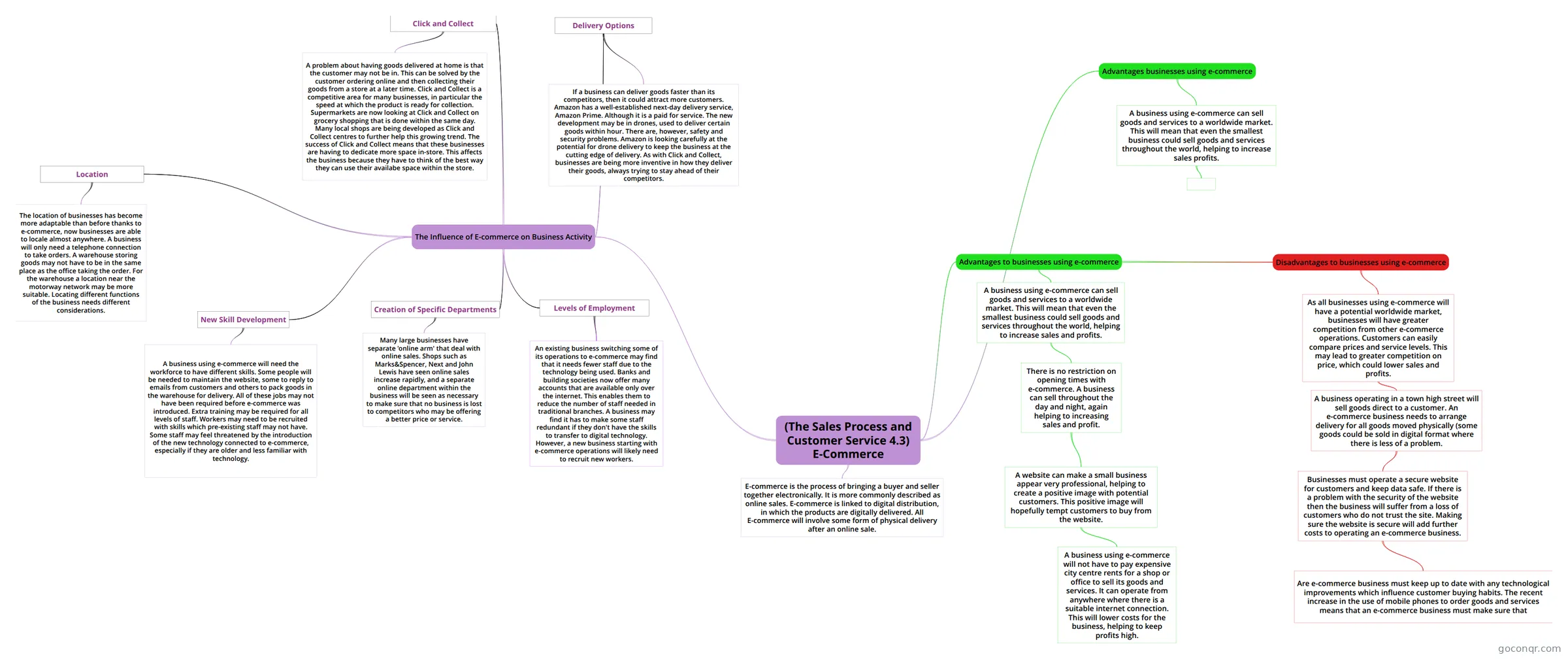
Mind map: E-commerce
Map content
(The Sales Process and Customer Service 4.3) E-Commerce
E-commerce is the process of bringing a buyer and seller together electronically. It is more commonly described as online sales. E-commerce is linked to digital distribution, in which the products are digitally delivered. All E-commerce will involve some form of physical delivery after an online sale.
The Influence of E-commerce on Business Activity
- Click and Collect
- A problem about having goods delivered at home is that the customer may not be in. This can be solved by the customer ordering online and then collecting their goods from a store at a later time. Click and Collect is a competitive area for many businesses, in particular the speed at which the product is ready for collection. Supermarkets are now looking at Click and Collect on grocery shopping that is done within the same day. Many local shops are being developed as Click and Collect centres to further help this growing trend. The success of Click and Collect means that these businesses are having to dedicate more space in-store. This affects the business because they have to think of the best way they can use their availabe space within the store.
- Location
- The location of businesses has become more adaptable than before thanks to e-commerce, now businesses are able to locale almost anywhere. A business will only need a telephone connection to take orders. A warehouse storing goods may not have to be in the same place as the office taking the order. For the warehouse a location near the motorway network may be more suitable. Locating different functions of the business needs different considerations.
- New Skill Development
- A business using e-commerce will need the workforce to have different skills. Some people will be needed to maintain the website, some to reply to emails from customers and others to pack goods in the warehouse for delivery. All of these jobs may not have been required before e-commerce was introduced. Extra training may be required for all levels of staff. Workers may need to be recruited with skills which pre-existing staff may not have. Some staff may feel threatened by the introduction of the new technology connected to e-commerce, especially if they are older and less familiar with technology.
- Creation of Specific Departments
- Many large businesses have separate 'online arm' that deal with online sales. Shops such as Marks&Spencer, Next and John Lewis have seen online sales increase rapidly, and a separate online department within the business will be seen as necessary to make sure that no business is lost to competitors who may be offering a better price or service.
- Levels of Employment
- An existing business switching some of its operations to e-commerce may find that it needs fewer staff due to the technology being used. Banks and building societies now offer many accounts that are available only over the internet. This enables them to reduce the number of staff needed in traditional branches. A business may find it has to make some staff redundant if they don't have the skills to transfer to digital technology. However, a new business starting with e-commerce operations will likely need to recruit new workers.
- Delivery Options
- If a business can deliver goods faster than its competitors, then it could attract more customers. Amazon has a well-established next-day delivery service, Amazon Prime. Although it is a paid for service. The new development may be in drones, used to deliver certain goods within hour. There are, however, safety and security problems. Amazon is looking carefully at the potential for drone delivery to keep the business at the cutting edge of delivery. As with Click and Collect, businesses are being more inventive in how they deliver their goods, always trying to stay ahead of their competitors.
- Click and Collect
Advantages businesses using e-commerce
- A business using e-commerce can sell goods and services to a worldwide market. This will mean that even the smallest business could sell goods and services throughout the world, helping to increase sales profits.
- A business using e-commerce can sell goods and services to a worldwide market. This will mean that even the smallest business could sell goods and services throughout the world, helping to increase sales profits.
Advantages to businesses using e-commerce
- A business using e-commerce can sell goods and services to a worldwide market. This will mean that even the smallest business could sell goods and services throughout the world, helping to increase sales and profits.
- There is no restriction on opening times with e-commerce. A business can sell throughout the day and night, again helping to increasing sales and profit.
- A website can make a small business appear very professional, helping to create a positive image with potential customers. This positive image will hopefully tempt customers to buy from the website.
- A business using e-commerce will not have to pay expensive city centre rents for a shop or office to sell its goods and services. It can operate from anywhere where there is a suitable internet connection. This will lower costs for the business, helping to keep profits high.
- A website can make a small business appear very professional, helping to create a positive image with potential customers. This positive image will hopefully tempt customers to buy from the website.
- There is no restriction on opening times with e-commerce. A business can sell throughout the day and night, again helping to increasing sales and profit.
- Disadvantages to businesses using e-commerce
- As all businesses using e-commerce will have a potential worldwide market, businesses will have greater competition from other e-commerce operations. Customers can easily compare prices and service levels. This may lead to greater competition on price, which could lower sales and profits.
- A business operating in a town high street will sell goods direct to a customer. An e-commerce business needs to arrange delivery for all goods moved physically (some goods could be sold in digital format where there is less of a problem.
- Businesses must operate a secure website for customers and keep data safe. If there is a problem with the security of the website then the business will suffer from a loss of customers who do not trust the site. Making sure the website is secure will add further costs to operating an e-commerce business.
- Are e-commerce business must keep up to date with any technological improvements which influence customer buying habits. The recent increase in the use of mobile phones to order goods and services means that an e-commerce business must make sure that
- Businesses must operate a secure website for customers and keep data safe. If there is a problem with the security of the website then the business will suffer from a loss of customers who do not trust the site. Making sure the website is secure will add further costs to operating an e-commerce business.
- A business operating in a town high street will sell goods direct to a customer. An e-commerce business needs to arrange delivery for all goods moved physically (some goods could be sold in digital format where there is less of a problem.
- As all businesses using e-commerce will have a potential worldwide market, businesses will have greater competition from other e-commerce operations. Customers can easily compare prices and service levels. This may lead to greater competition on price, which could lower sales and profits.
- A business using e-commerce can sell goods and services to a worldwide market. This will mean that even the smallest business could sell goods and services throughout the world, helping to increase sales and profits.
Information
- Description
- GCSE Business Studies (Paper 2- Operations) Mind Map on (The Sales Process and Customer Service 4.3) E-Commerce, created by Vineishir Lawrence on 03/09/2019.
- Created by
- Vineishir Lawrence
- Views
- 8
- Rating