
Mind map
Cell Membrane
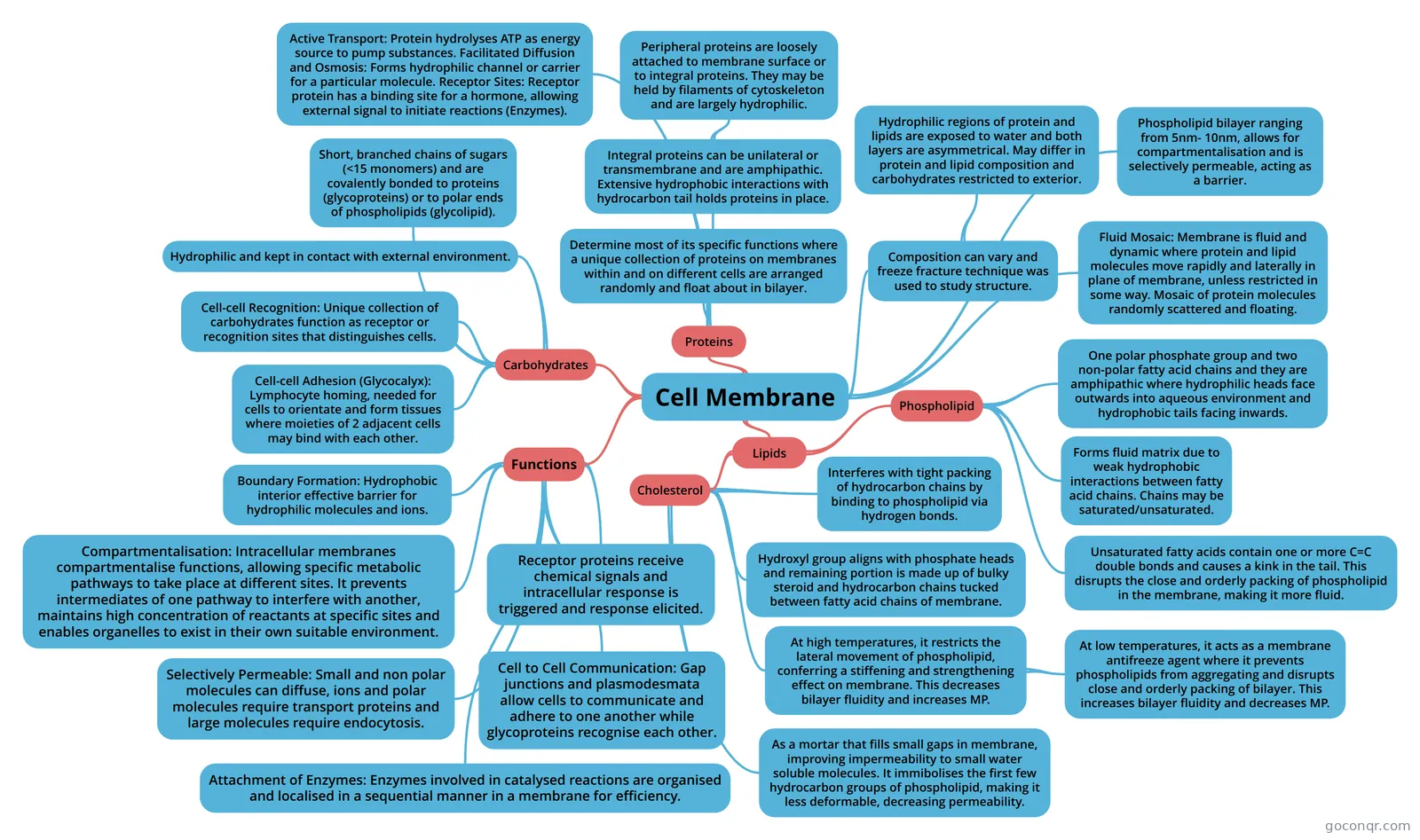
Mind map: Cell membrane
Map content
Cell Membrane
Phospholipid bilayer ranging from 5nm- 10nm, allows for compartmentalisation and is selectively permeable, acting as a barrier.
Composition can vary and freeze fracture technique was used to study structure.
- Hydrophilic regions of protein and lipids are exposed to water and both layers are asymmetrical. May differ in protein and lipid composition and carbohydrates restricted to exterior.
Fluid Mosaic: Membrane is fluid and dynamic where protein and lipid molecules move rapidly and laterally in plane of membrane, unless restricted in some way. Mosaic of protein molecules randomly scattered and floating.
Lipids
- Phospholipid
- One polar phosphate group and two non-polar fatty acid chains and they are amphipathic where hydrophilic heads face outwards into aqueous environment and hydrophobic tails facing inwards.
- Forms fluid matrix due to weak hydrophobic interactions between fatty acid chains. Chains may be saturated/unsaturated.
- Unsaturated fatty acids contain one or more C=C double bonds and causes a kink in the tail. This disrupts the close and orderly packing of phospholipid in the membrane, making it more fluid.
- Cholesterol
- Hydroxyl group aligns with phosphate heads and remaining portion is made up of bulky steroid and hydrocarbon chains tucked between fatty acid chains of membrane.
- Interferes with tight packing of hydrocarbon chains by binding to phospholipid via hydrogen bonds.
- At high temperatures, it restricts the lateral movement of phospholipid, conferring a stiffening and strengthening effect on membrane. This decreases bilayer fluidity and increases MP.
- At low temperatures, it acts as a membrane antifreeze agent where it prevents phospholipids from aggregating and disrupts close and orderly packing of bilayer. This increases bilayer fluidity and decreases MP.
- As a mortar that fills small gaps in membrane, improving impermeability to small water soluble molecules. It immibolises the first few hydrocarbon groups of phospholipid, making it less deformable, decreasing permeability.
- Phospholipid
Proteins
- Determine most of its specific functions where a unique collection of proteins on membranes within and on different cells are arranged randomly and float about in bilayer.
- Integral proteins can be unilateral or transmembrane and are amphipathic. Extensive hydrophobic interactions with hydrocarbon tail holds proteins in place.
- Peripheral proteins are loosely attached to membrane surface or to integral proteins. They may be held by filaments of cytoskeleton and are largely hydrophilic.
- Active Transport: Protein hydrolyses ATP as energy source to pump substances. Facilitated Diffusion and Osmosis: Forms hydrophilic channel or carrier for a particular molecule. Receptor Sites: Receptor protein has a binding site for a hormone, allowing external signal to initiate reactions (Enzymes).
Carbohydrates
- Short, branched chains of sugars (<15 monomers) and are covalently bonded to proteins (glycoproteins) or to polar ends of phospholipids (glycolipid).
- Hydrophilic and kept in contact with external environment.
- Cell-cell Recognition: Unique collection of carbohydrates function as receptor or recognition sites that distinguishes cells.
- Cell-cell Adhesion (Glycocalyx): Lymphocyte homing, needed for cells to orientate and form tissues where moieties of 2 adjacent cells may bind with each other.
Functions
- Boundary Formation: Hydrophobic interior effective barrier for hydrophilic molecules and ions.
- Compartmentalisation: Intracellular membranes compartmentalise functions, allowing specific metabolic pathways to take place at different sites. It prevents intermediates of one pathway to interfere with another, maintains high concentration of reactants at specific sites and enables organelles to exist in their own suitable environment.
- Selectively Permeable: Small and non polar molecules can diffuse, ions and polar molecules require transport proteins and large molecules require endocytosis.
- Receptor proteins receive chemical signals and intracellular response is triggered and response elicited.
- Cell to Cell Communication: Gap junctions and plasmodesmata allow cells to communicate and adhere to one another while glycoproteins recognise each other.
- Attachment of Enzymes: Enzymes involved in catalysed reactions are organised and localised in a sequential manner in a membrane for efficiency.
Information
- Description
- Mind Map on Cell Membrane, created by Biology Mindmaps on 08/02/2015.
- Created by
- Biology Mindmaps
- Views
- 0
- Rating