
Mind map
GCSE AQA Chemistry Atomic Structure and Bonding
Map content
GCSE AQA Chemistry Atomic Structure and Bonding
Atoms
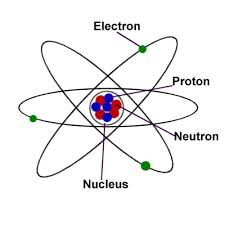
- Atoms consist of a nucleus orbited by electrons
- Protons, neutrons and electrons are sub-atomic particles
- Protons
- The number of protons determines the element
- If an element has only 1 proton it is hydrogen
- If an element has 2 protons it is helium etc....
- Protons have a relative charge of +
- Protons have a relative atomic mass of 1
- The number of protons determines the element
- Neutrons
- Neutrons have a relative charge of 0
- Neutrons have a relative atomic mass of 1
- Electrons
- Electrons have a relative charge of -
- Electrons have a relative atomic mass of 0
- Protons
- The nucleus is made up of protons and neutrons
- An atom contains the same number of protons as electrons
- The relative atomic mass is determined by the number of protons added to the number of neutrons
The Periodic Table
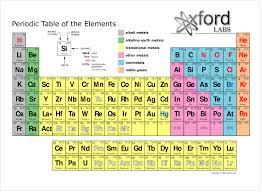
- The periodic table is an information source that displays various properties of different elements and groups them accordingly
- Elements are listed with symbols that represent them and are used in all formulas
- Hydrogen's symbol is H
- These can be one or two letters, the first always capitalised
- Helium's symbol is He
- These symbols are usually either taken directly from the name or from the same name in a different language
- Gold is Au taken from its Latin name aurum
- Hydrogen is H taken from he start of the word
- Groups
- Groups on the periodic table are columns
- Groups of elements have similar properties because they have the same number of outer shell electrons
- Group 8/0 the Noble Gases
- Helium
- Argon
- Krypton
- Radon
- Xenon
- Neon
- These are unreactive because they have a full outer shell of electrons
- Group 1 the Alkali Metals
- Potassium
- Francium
- Caesium
- Hydrogen (technically)
- Rubidium
- Lithium
- Sodium
- These are very reactive as they only have one electron in their outer shell
- The group number is the number of electrons in the outer shell
- Periods
- Periods are rows on the periodic table
- The period is the number of energy shells or layers an atom has
Electron shells
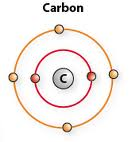
- Electrons orbit the nucleus in energy layers or shells
- The shells can only contain a certain amount of electrons
- The first shell can contain 2 electrons
- The second shell can only contain 8 electrons
- The third shell can hold more than 8 electrons but at GCSE level you only need to know it can hold 8
- Energy shells are filled from the lowest level upwards
- Atoms want to gain a full outer shell of electrons and so this is why they react
- Electronic Structure
- Electronic structures are diagrams of the energy shells of an atom
- The diagram is then described by a series of numbers that show the electron is each shell
- Carbon is 2.4
- Method 1
- Draw a nucleus, no detail is necessary
- To calculate the electronic structure find the number of protons as this is equal to the number of electrons
- Look at the number of electrons each shell can hold and calculate how many shells you need
- Look at the number of electrons each shell can hold and place accordingly filling from the lowest shell
- Look at the number of electrons each shell can hold and calculate how many shells you need
- To calculate the electronic structure find the number of protons as this is equal to the number of electrons
- Draw a nucleus, no detail is necessary
- Method 2
- Draw the nucleus, no detail is necessary
- Look at the period of the atom and draw that many of energy shells
- Look at the group number and fill all the other energy shells up to the outer shell which you put the group number of electrons in
- Look at the period of the atom and draw that many of energy shells
- Draw the nucleus, no detail is necessary
Ionic Bonding
- Ions give or take electrons
- This is held together by electromagnetic forces
- This is between metals and non-metals
- Giant Ionic Lattices
- An ion is a charged particle
- High melting point
- High Boiling Point
- Will carry a current in solution and melted
Covalent Bonding
- This is between non-metals
- Atoms share electrons
- Molecules
- Giant Structure
- High Melting Point
- High Boiling Point
- No conduction of electricity (except graphite)
- Strong covalent bonds
- Simple Structure
- Low Melting Points
- Low Boiling Points
- No conduction of electricity
- Weak intermolecular bonds
Images and files in the map
Information
- Description
- A mixture of Unit 1 and Unit 2 AQA Chemistry for GCSE level
- Created by
- mustafizk · Feb 2015
- Updated
- Dec 31, 2018
- Views
- 1,087
- Tags
- History
-
- Created by Joseph Tedds · Feb 27, 2015
- Copied by mustafizk · Feb 27, 2015
- Rating