
Mind map
Freud's (1900) dream theory
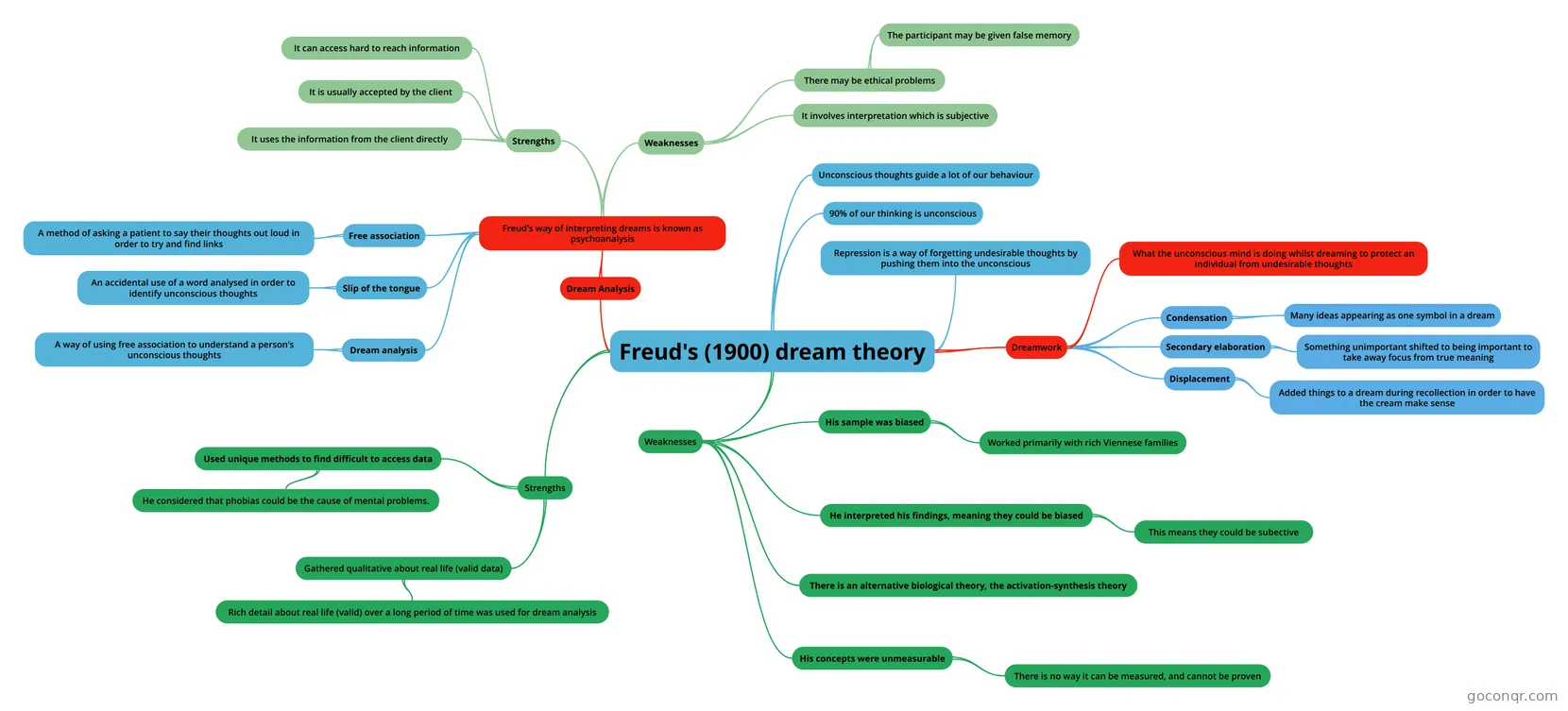
Mind map: Freud's 1900 dream theory
Map content
Freud's (1900) dream theory
Unconscious thoughts guide a lot of our behaviour
90% of our thinking is unconscious
Dreamwork
- What the unconscious mind is doing whilst dreaming to protect an individual from undesirable thoughts
- Condensation
- Many ideas appearing as one symbol in a dream
- Secondary elaboration
- Something unimportant shifted to being important to take away focus from true meaning
- Displacement
- Added things to a dream during recollection in order to have the cream make sense
Repression is a way of forgetting undesirable thoughts by pushing them into the unconscious
Strengths
- Used unique methods to find difficult to access data
- He considered that phobias could be the cause of mental problems.
- Gathered qualitative about real life (valid data)
- Rich detail about real life (valid) over a long period of time was used for dream analysis
- Used unique methods to find difficult to access data
Weaknesses
- His sample was biased
- Worked primarily with rich Viennese families
- His concepts were unmeasurable
- There is no way it can be measured, and cannot be proven
- He interpreted his findings, meaning they could be biased
- This means they could be subective
- There is an alternative biological theory, the activation-synthesis theory
- His sample was biased
Dream Analysis
- Freud's way of interpreting dreams is known as psychoanalysis
- Free association
- A method of asking a patient to say their thoughts out loud in order to try and find links
- Slip of the tongue
- An accidental use of a word analysed in order to identify unconscious thoughts
- Dream analysis
- A way of using free association to understand a person's unconscious thoughts
- Strengths
- It can access hard to reach information
- It is usually accepted by the client
- It uses the information from the client directly
- Weaknesses
- There may be ethical problems
- The participant may be given false memory
- It involves interpretation which is subjective
- There may be ethical problems
- Free association
- Freud's way of interpreting dreams is known as psychoanalysis
Information
- Description
- GCSE Psychology (Is dreaming meaningful?) Mind Map on Freud's (1900) dream theory, created by lickerhowes on 11/03/2015.
- Created by
- lickerhowes
- Views
- 72
- Rating