
Mind map
The Cradles of Child Development
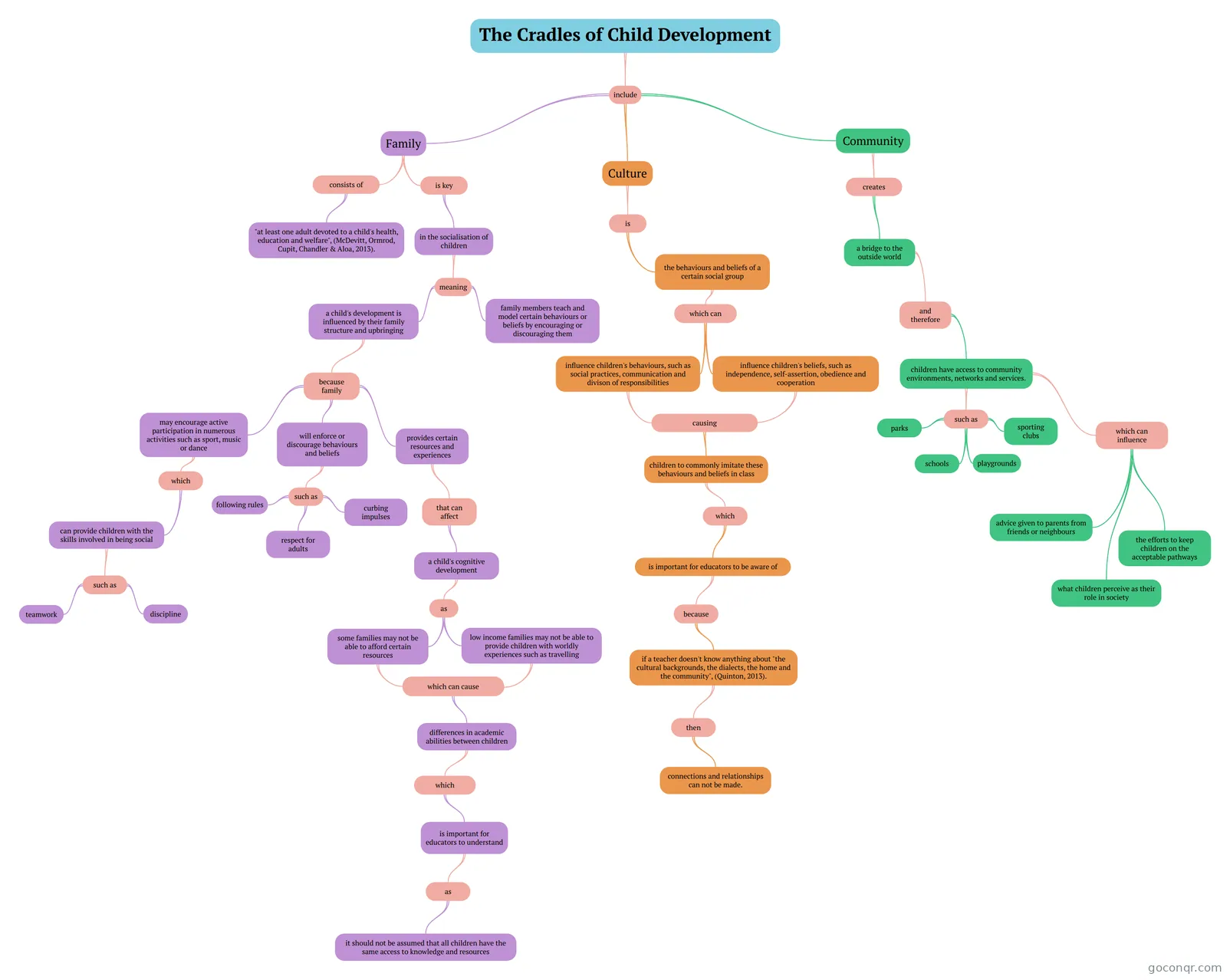
Mind map: cradles of child development
Map content
The Cradles of Child Development
include
- Family
- consists of
- "at least one adult devoted to a child's health, education and welfare", (McDevitt, Ormrod, Cupit, Chandler & Aloa, 2013).
- is key
- in the socialisation of children
- meaning
- family members teach and model certain behaviours or beliefs by encouraging or discouraging them
- a child's development is influenced by their family structure and upbringing
- because family
- will enforce or discourage behaviours and beliefs
- such as
- curbing impulses
- following rules
- respect for adults
- such as
- may encourage active participation in numerous activities such as sport, music or dance
- which
- can provide children with the skills involved in being social
- such as
- teamwork
- discipline
- such as
- can provide children with the skills involved in being social
- which
- provides certain resources and experiences
- that can affect
- a child's cognitive development
- as
- some families may not be able to afford certain resources
- which can cause
- differences in academic abilities between children
- which
- is important for educators to understand
- as
- it should not be assumed that all children have the same access to knowledge and resources
- as
- is important for educators to understand
- which
- differences in academic abilities between children
- which can cause
- low income families may not be able to provide children with worldly experiences such as travelling
- some families may not be able to afford certain resources
- as
- a child's cognitive development
- that can affect
- will enforce or discourage behaviours and beliefs
- because family
- meaning
- in the socialisation of children
- consists of
- Culture
- is
- the behaviours and beliefs of a certain social group
- which can
- influence children's behaviours, such as social practices, communication and divison of responsibilities
- causing
- children to commonly imitate these behaviours and beliefs in class
- which
- is important for educators to be aware of
- because
- if a teacher doesn't know anything about "the cultural backgrounds, the dialects, the home and the community", (Quinton, 2013).
- then
- connections and relationships can not be made.
- then
- if a teacher doesn't know anything about "the cultural backgrounds, the dialects, the home and the community", (Quinton, 2013).
- because
- is important for educators to be aware of
- which
- children to commonly imitate these behaviours and beliefs in class
- causing
- influence children's beliefs, such as independence, self-assertion, obedience and cooperation
- influence children's behaviours, such as social practices, communication and divison of responsibilities
- which can
- the behaviours and beliefs of a certain social group
- is
- Community
- creates
- a bridge to the outside world
- and therefore
- children have access to community environments, networks and services.
- such as
- schools
- playgrounds
- sporting clubs
- parks
- which can influence
- advice given to parents from friends or neighbours
- the efforts to keep children on the acceptable pathways
- what children perceive as their role in society
- such as
- children have access to community environments, networks and services.
- and therefore
- a bridge to the outside world
- creates
- Family