
Mind map
Bio 150 mindmap
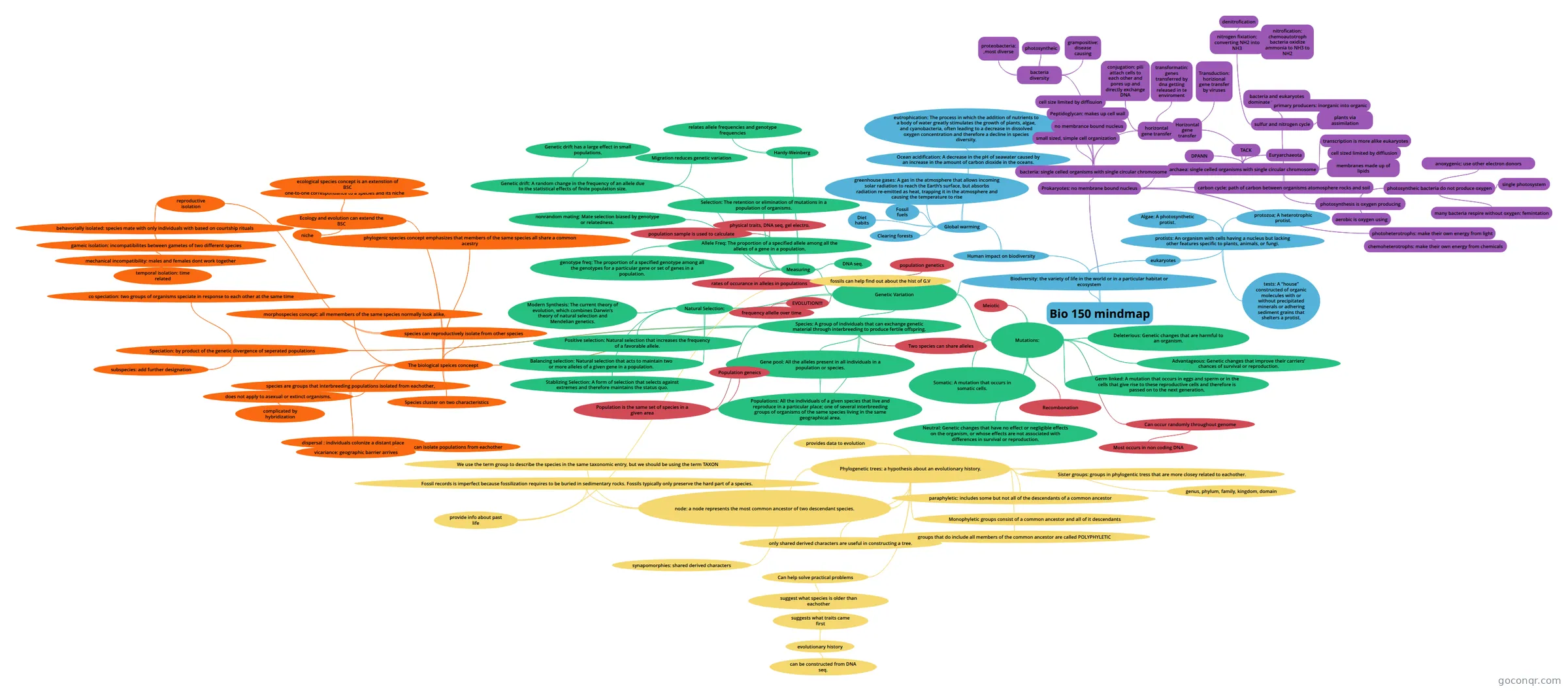
Mind map: Biodiversity and Prokaryotes
Map content
Bio 150 mindmap
Biodiversity: the variety of life in the world or in a particular habitat or ecosystem
- Human impact on biodiversity
- Global warming
- Clearing forests
- Fossil fuels
- Diet habits
- greenhouse gases: A gas in the atmosphere that allows incoming solar radiation to reach the Earth’s surface, but absorbs radiation re-emitted as heat, trapping it in the atmosphere and causing the temperature to rise
- Ocean acidification: A decrease in the pH of seawater caused by an increase in the amount of carbon dioxide in the oceans.
- eutrophication: The process in which the addition of nutrients to a body of water greatly stimulates the growth of plants, algae, and cyanobacteria, often leading to a decrease in dissolved oxygen concentration and therefore a decline in species diversity.
- Global warming
- eukaryotes
- protists: An organism with cells having a nucleus but lacking other features specific to plants, animals, or fungi.
- Algae: A photosynthetic protist.
- protozoa; A heterotrophic protist.
- tests: A “house” constructed of organic molecules with or without precipitated minerals or adhering sediment grains that shelters a protist.
- protists: An organism with cells having a nucleus but lacking other features specific to plants, animals, or fungi.
- Genetic Variation
- Species: A group of individuals that can exchange genetic material through interbreeding to produce fertile offspring.
- Gene pool: All the alleles present in all individuals in a population or species.
- Populations: All the individuals of a given species that live and reproduce in a particular place; one of several interbreeding groups of organisms of the same species living in the same geographical area.
- Two species can share alleles
- Population is the same set of species in a given area
- Population geneics
- node: a node represents the most common ancestor of two descendant species.
- Phylogenetic trees: a hypothesis about an evolutionary history.
- Sister groups: groups in phylogentic tress that are more closey related to eachother.
- Monophyletic groups consist of a common ancestor and all of it descendants
- paraphyletic: includes some but not all of the descendants of a common ancestor
- groups that do include all members of the common ancestor are called POLYPHYLETIC
- genus, phylum, family, kingdom, domain
- only shared derived characters are useful in constructing a tree.
- provides data to evolution
- synapomorphies: shared derived characters
- Can help solve practical problems
- suggest what species is older than eachother
- suggests what traits came first
- evolutionary history
- can be constructed from DNA seq.
- evolutionary history
- suggests what traits came first
- suggest what species is older than eachother
- We use the term group to describe the species in the same taxonomic entry, but we should be using the term TAXON
- Fossil records is imperfect because fossilization requires to be buried in sedimentary rocks. Fossils typically only preserve the hard part of a species.
- provide info about past life
- fossils can help find out about the hist of G.V
- provide info about past life
- Phylogenetic trees: a hypothesis about an evolutionary history.
- The biological speices conceept
- species can reproductively isolate from other species
- reproductive isolation
- behavorially isolated: species mate with only individuals with based on courtship rituals
- gameic isolation: incompatibilites between gametes of two different species
- mechanical incompatibility: males and females dont work together
- temporal isolation: time related
- mechanical incompatibility: males and females dont work together
- gameic isolation: incompatibilites between gametes of two different species
- behavorially isolated: species mate with only individuals with based on courtship rituals
- reproductive isolation
- Species cluster on two characteristics
- species are groups that interbreeding populations isolated from eachother,
- dispersal : individuals colonize a distant place
- vicariance: geographic barrier arrives
- can isolate populations from eachother
- vicariance: geographic barrier arrives
- dispersal : individuals colonize a distant place
- morphospecies concept: all memembers of the same species normally look alike,
- does not apply to asexual or extinct organisms.
- complicated by hybridization
- Ecology and evolution can extend the BSC
- niche
- one-to-one correspondance to a species and its niche
- ecological species concept is an extenstion of BSC
- phylogenic species concept emphasizes that members of the same species all share a common acestry
- species can reproductively isolate from other species
- Speciation: by product of the genetic divergence of seperated populations
- subspecies: add further designation
- co speciation: two groups of organisms speciate in response to each other at the same time
- Gene pool: All the alleles present in all individuals in a population or species.
- Mutations:
- Somatic: A mutation that occurs in somatic cells.
- Germ linked: A mutation that occurs in eggs and sperm or in the cells that give rise to these reproductive cells and therefore is passed on to the next generation.
- Neutral: Genetic changes that have no effect or negligible effects on the organism, or whose effects are not associated with differences in survival or reproduction.
- Deleterious: Genetic changes that are harmful to an organism.
- Advantageous: Genetic changes that improve their carriers’ chances of survival or reproduction.
- Recombonation
- Meiotic
- Can occur randomly throughout genome
- Most occurs in non coding DNA
- Measuring
- Allele Freq: The proportion of a specified allele among all the alleles of a gene in a population.
- genotype freq: The proportion of a specified genotype among all the genotypes for a particular gene or set of genes in a population.
- physical traits, DNA seq, gel electro.
- population sample is used to calculate
- DNA seq.
- Selection: The retention or elimination of mutations in a population of organisms.
- Genetic drift: A random change in the frequency of an allele due to the statistical effects of finite population size.
- Genetic drift has a large effect in small populations.
- Migration reduces genetic variation
- nonrandom mating: Mate selection biased by genotype or relatedness.
- Hardy-Weinberg
- relates allele frequencies and genotype frequencies
- rates of occurance in alleles in populations
- Allele Freq: The proportion of a specified allele among all the alleles of a gene in a population.
- Natural Selection:
- Modern Synthesis: The current theory of evolution, which combines Darwin’s theory of natural selection and Mendelian genetics.
- Positive selection: Natural selection that increases the frequency of a favorable allele.
- Balancing selection: Natural selection that acts to maintain two or more alleles of a given gene in a population.
- Stablizing Selection: A form of selection that selects against extremes and therefore maintains the status quo.
- population genetics
- EVOLUTION!!!
- frequency allelle over time
- Species: A group of individuals that can exchange genetic material through interbreeding to produce fertile offspring.
- Human impact on biodiversity
Prokaryotes: no membrane bound nucleus
- bacteria: single celled organisms with single circular chromosome
- small sized, simple cell organization
- no membrance bound nucleus
- Peptidoglycan: makes up cell wall
- no membrance bound nucleus
- horizontal gene transfer
- conjugation: pili attach cells to each other and pores up and directly exchange DNA
- transformatin: genes transferred by dna getting released in te enviroment
- Transduction: horizional gene transfer by viruses
- cell size limited by diffisuion
- bacteria diversity
- proteobacteria: ,most diverse
- photosyntheic
- grampositive: disease causing
- small sized, simple cell organization
- archaea: single celled organisms with single circular chromosome
- Horizontal gene transfer
- membranes made up of lipids
- cell sized limited by diffiusion
- transcription is more alike eukaryotes
- DPANN
- TACK
- Euryarchaeota
- carbon cycle: path of carbon between organisms atomosphere rocks and soil
- photosynthesis is oxygen producing
- aerobic is oxygen using
- photosyntheic bacteria do not produce oxygen
- anoxygenic: use other electron donors
- single photosystem
- many bacteria respire without oxygen: femintation
- sulfur and nitrogen cycle
- bacteria and eukaryotes dominate the sulfur cycle
- primary producers: inorganic into organic
- plants via assimilation
- nitrogen fixiation: converting NH2 into NH3
- nitrofication: chemoautotroph bacteria oxidize ammonia to NH3 to NH2
- denitrofication
- photosynthesis is oxygen producing
- photoheterotrophs: make their own energy from light
- chemoheterotrophs: make their own energy from chemicals
- bacteria: single celled organisms with single circular chromosome
Information
- Description
- Biology Mind Map on Bio 150 mindmap, created by Kari Cronrath on 28/08/2020.
- Created by
- Kari Cronrath
- Views
- 7
- Rating
More on Human impact and threats to biodiversity