
Mind map
BIOLOGICAL PSYCHOLOGY
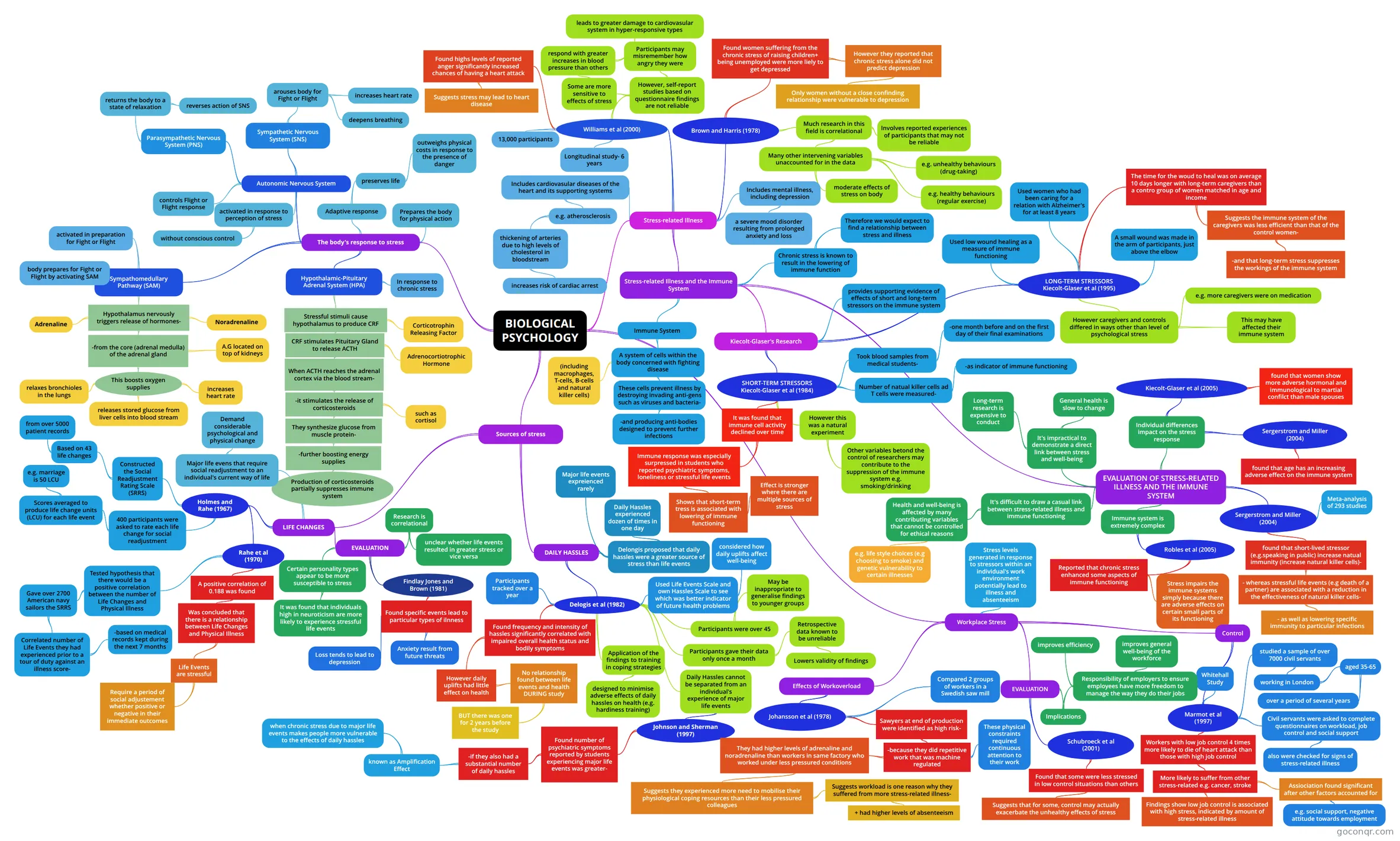
Mind map: Biological psychology
Map content
BIOLOGICAL PSYCHOLOGY
The body's response to stress
- Prepares the body for physical action
- Adaptive response
- preserves life
- outweighs physical costs in response to the presence of danger
- preserves life
- Autonomic Nervous System
- Sympathetic Nervous System (SNS)
- arouses body for Fight or Flight
- increases heart rate
- deepens breathing
- arouses body for Fight or Flight
- Parasympathetic Nervous System (PNS)
- returns the body to a state of relaxation
- reverses action of SNS
- returns the body to a state of relaxation
- activated in response to perception of stress
- without conscious control
- controls Flight or Flight response
- Sympathetic Nervous System (SNS)
- Sympathomedullary Pathway (SAM)
- Hypothalamus nervously triggers release of hormones-
- Adrenaline
- Noradrenaline
- -from the core (adrenal medulla) of the adrenal gland
- A.G located on top of kidneys
- This boosts oxygen supplies
- increases heart rate
- relaxes bronchioles in the lungs
- releases stored glucose from liver cells into blood stream
- body prepares for Fight or Flight by activating SAM
- activated in preparation for Fight or Flight
- Hypothalamus nervously triggers release of hormones-
- Hypothalamic-Pituitary Adrenal System (HPA)
- Stressful stimuli cause hypothalamus to produce CRF
- CRF stimulates Pituitary Gland to release ACTH
- Adrenocortiotrophic Hormone
- When ACTH reaches the adrenal cortex via the blood stream-
- -it stimulates the release of corticosteroids
- such as cortisol
- They synthesize glucose from muscle protein-
- -further boosting energy supplies
- Production of corticosteroids partially suppresses immune system
- -further boosting energy supplies
- -it stimulates the release of corticosteroids
- Corticotrophin Releasing Factor
- CRF stimulates Pituitary Gland to release ACTH
- In response to chronic stress
- Stressful stimuli cause hypothalamus to produce CRF
Stress-related Illness
- Includes cardiovasular diseases of the heart and its supporting systems
- e.g. atherosclerosis
- thickening of arteries due to high levels of cholesterol in bloodstream
- increases risk of cardiac arrest
- thickening of arteries due to high levels of cholesterol in bloodstream
- e.g. atherosclerosis
- Williams et al (2000)
- 13,000 participants
- Longitudinal study- 6 years
- Found highs levels of reported anger significantly increased chances of having a heart attack
- Suggests stress may lead to heart disease
- However, self-report studies based on questionnaire findings are not reliable
- Participants may misremember how angry they were
- Some are more sensitive to effects of stress
- respond with greater increases in blood pressure than others
- leads to greater damage to cardiovasular system in hyper-responsive types
- respond with greater increases in blood pressure than others
- Includes mental illness, including depression
- a severe mood disorder resulting from prolonged anxiety and loss
- Brown and Harris (1978)
- Found women suffering from the chronic stress of raising children+ being unemployed were more liely to get depressed
- However they reported that chronic stress alone did not predict depression
- Only women without a close confinding relationship were vulnerable to depression
- However they reported that chronic stress alone did not predict depression
- Much research in this field is correlational
- Involves reported experiences of participants that may not be reliable
- Many other intervening variables unaccounted for in the data
- e.g. unhealthy behaviours (drug-taking)
- e.g. healthy behaviours (regular exercise)
- moderate effects of stress on body
- Found women suffering from the chronic stress of raising children+ being unemployed were more liely to get depressed
- Stress-related Illness and the Immune System
- Chronic stress is known to result in the lowering of immune function
- Therefore we would expect to find a relationship between stress and illness
- Immune System
- A system of cells within the body concerned with fighting disease
- These cells prevent illness by destroying invading anti-gens such as viruses and bacteria-
- -and producing anti-bodies designed to prevent further infections
- (including macrophages, T-cells, B-cells and natural killer cells)
- These cells prevent illness by destroying invading anti-gens such as viruses and bacteria-
- A system of cells within the body concerned with fighting disease
- Kiecolt-Glaser's Research
- provides supporting evidence of effects of short and long-term stressors on the immune system
- SHORT-TERM STRESSORS Kiecolt-Glaser et al (1984)
- Took blood samples from medical students-
- -one month before and on the first day of their final examinations
- Number of natual killer cells ad T cells were measured-
- -as indicator of immune functioning
- It was found that immune cell activity declined over time
- Immune response was especially surpressed in students who reported psychiatric symptoms, loneliness or stressful life events
- Shows that short-term tress is associated with lowering of immune functioning
- Effect is stronger where there are multiple sources of stress
- Shows that short-term tress is associated with lowering of immune functioning
- Immune response was especially surpressed in students who reported psychiatric symptoms, loneliness or stressful life events
- However this was a natural experiment
- Other variables betond the control of researchers may contribute to the suppression of the immune system e.g. smoking/drinking
- Took blood samples from medical students-
- LONG-TERM STRESSORS Kiecolt-Glaser et al (1995)
- Used low wound healing as a measure of immune functioning
- Used women who had been caring for a relation with Alzheimer's for at least 8 years
- A small wound was made in the arm of participants, just above the elbow
- The time for the woud to heal was on average 10 days longer with long-term caregivers than a contro group of women matched in age and income
- Suggests the immune system of the caregivers was less efficient than that of the control women-
- -and that long-term stress suppresses the workings of the immune system
- Suggests the immune system of the caregivers was less efficient than that of the control women-
- However caregivers and controls differed in ways other than level of psychological stress
- e.g. more caregivers were on medication
- This may have affected their immune system
- EVALUATION OF STRESS-RELATED ILLNESS AND THE IMMUNE SYSTEM
- It's impractical to demonstrate a direct link between stress and well-being
- General health is slow to change
- Long-term research is expensive to conduct
- It's difficult to draw a casual link between stress-related illness and immune functioning
- Health and well-being is affected by many contributing variables that cannot be controlled for ethical reasons
- e.g. life style choices (e.g choosing to smoke) and genetic vulnerability to certain illnesses
- Health and well-being is affected by many contributing variables that cannot be controlled for ethical reasons
- Individual differences impact on the stress response
- Kiecolt-Glaser et al (2005)
- found that women show more adverse hormonal and immunological to martial confilct than male spouses
- Sergerstrom and Miller (2004)
- found that age has an increasing adverse effect on the immune system
- Kiecolt-Glaser et al (2005)
- Sergerstrom and Miller (2004)
- Meta-analysis of 293 studies
- found that short-lived stressor (e.g.speaking in public) increase natual immunity (increase natural killer cells)-
- - whereas stressful life events (e.g death of a partner) are associated with a reduction in the effectiveness of natural killer cells-
- - as well as lowering specific immunity to particular infections
- - whereas stressful life events (e.g death of a partner) are associated with a reduction in the effectiveness of natural killer cells-
- Immune system is extremely complex
- Robles et al (2005)
- Reported that chronic stress enhanced some aspects of immune functioning
- Stress impairs the immune systems simply because there are adverse effects on certain small parts of its functioning
- Reported that chronic stress enhanced some aspects of immune functioning
- Robles et al (2005)
- It's impractical to demonstrate a direct link between stress and well-being
- Chronic stress is known to result in the lowering of immune function
- Includes cardiovasular diseases of the heart and its supporting systems
Sources of stress
- LIFE CHANGES
- Major life evens that require social readjustment to an individual's current way of life
- Demand considerable psychological and physical change
- Holmes and Rahe (1967)
- Constructed the Social Readjustment Rating Scale (SRRS)
- Based on 43 life changes
- from over 5000 patient records
- Based on 43 life changes
- 400 participants were asked to rate each life change for social readjustment
- Scores averaged to produce life change units (LCU) for each life event
- e.g. marriage is 50 LCU
- Scores averaged to produce life change units (LCU) for each life event
- Rahe et al (1970)
- Tested hypothesis that there would be a positive correlation between the number of Life Changes and Physical Illness
- Gave over 2700 American navy sailors the SRRS
- Correlated number of Life Events they had experienced prior to a tour of duty against an illness score-
- -based on medical records kept during the next 7 months
- Correlated number of Life Events they had experienced prior to a tour of duty against an illness score-
- Gave over 2700 American navy sailors the SRRS
- A positive correlation of 0.188 was found
- Was concluded that there is a relationship between Life Changes and Physical Illness
- Life Events are stressful
- Require a period of social adjustement whether positive or negative in their immediate outcomes
- Life Events are stressful
- Was concluded that there is a relationship between Life Changes and Physical Illness
- Tested hypothesis that there would be a positive correlation between the number of Life Changes and Physical Illness
- Constructed the Social Readjustment Rating Scale (SRRS)
- EVALUATION
- Research is correlational
- unclear whether life events resulted in greater stress or vice versa
- Certain personality types appear to be more susceptible to stress
- It was found that individuals high in neuroticism are more likely to experience stressful life events
- Findlay Jones and Brown (1981)
- Found specific events lead to particular types of ilnness
- Loss tends to lead to depression
- Anxiety result from future threats
- Found specific events lead to particular types of ilnness
- Research is correlational
- Major life evens that require social readjustment to an individual's current way of life
- DAILY HASSLES
- Delongis proposed that daily hassles were a greater source of stress than life events
- Major life events expreienced rarely
- Daily Hassles experienced dozen of times in one day
- Delogis et al (1982)
- Used Life Events Scale and own Hassles Scale to see which was better indicator of future health problems
- considered how daily uplifts affect well-being
- Participants tracked over a year
- Found frequency and intensity of hassles significantly correlated with impaired overall health status and bodily symptoms
- However daily uplifts had little effect on health
- No relationship found between life events and health DURING study
- BUT there was one for 2 years before the study
- No relationship found between life events and health DURING study
- However daily uplifts had little effect on health
- Participants were over 45
- May be inappropriate to generalise findings to younger groups
- Participants gave their data only once a month
- Retrospective data known to be unreliable
- Lowers validity of findings
- Retrospective data known to be unreliable
- Application of the findings to training in coping strategies
- designed to minimise adverse effects of daily hassles on health (e.g. hardiness training)
- Daily Hassles cannot be separated from an individual's experience of major life events
- Johnson and Sherman (1997)
- Found number of psychiatric symptoms reported by students experiencing major life events was greater-
- -if they also had a substantial number of daily hassles
- known as Amplification Effect
- when chronic stress due to major life events makes people more vulnerable to the effects of daily hassles
- known as Amplification Effect
- -if they also had a substantial number of daily hassles
- Found number of psychiatric symptoms reported by students experiencing major life events was greater-
- Johnson and Sherman (1997)
- Used Life Events Scale and own Hassles Scale to see which was better indicator of future health problems
- Delongis proposed that daily hassles were a greater source of stress than life events
- LIFE CHANGES
Workplace Stress
- Effects of Workoverload
- Johansson et al (1978)
- Compared 2 groups of workers in a Swedish saw mill
- Sawyers at end of production were identified as high risk-
- -because they did repetitive work that was machine regulated
- These physical constraints required continuous attention to their work
- They had higher levels of adrenaline and noradrenaline than workers in same factory who worked under less pressured conditions
- Suggests they experienced more need to mobilise their physiological coping resources than their less pressured colleagues
- Suggests workload is one reason why they suffered from more stress-related illness-
- + had higher levels of absenteeism
- Suggests workload is one reason why they suffered from more stress-related illness-
- Suggests they experienced more need to mobilise their physiological coping resources than their less pressured colleagues
- -because they did repetitive work that was machine regulated
- Johansson et al (1978)
- Control
- Marmot et al (1997)
- Whitehall Study
- studied a sample of over 7000 civil servants
- working in London
- aged 35-65
- over a period of several years
- aged 35-65
- working in London
- Civil servants were asked to complete questionnaires on workload, job control and social support
- also were checked for signs of stress-related illness
- Workers with low job control 4 times more likely to die of heart attack than those with high job control
- More likely to suffer from other stress-related e.g. cancer, stroke
- Findings show low job control is associated with high stress, indicated by amount of stress-related illness
- Assiociation found significant after other factors accounted for
- e.g. social support, negative attitude towards employment
- More likely to suffer from other stress-related e.g. cancer, stroke
- Marmot et al (1997)
- Stress levels generated in response to stressors within an individual's work environment potentially lead to illness and absenteeism
- EVALUATION
- Implications
- Responsibility of employers to ensure employees have more freedom to manage the way they do their jobs
- improves efficiency
- improves general well-being of the workforce
- Responsibility of employers to ensure employees have more freedom to manage the way they do their jobs
- Schubroeck et al (2001)
- Found that some were less stressed in low control situations than others
- Suggests that for some, control may actually exacerbate the unhealthy effects of stress
- Found that some were less stressed in low control situations than others
- Implications
- Effects of Workoverload
·
Information
- Description
- Mind Map on BIOLOGICAL PSYCHOLOGY, created by pancake1w1 on 16/05/2015.
- Created by
- pancake1w1
- Views
- 1
- Rating