
Mind map
stages of attachment
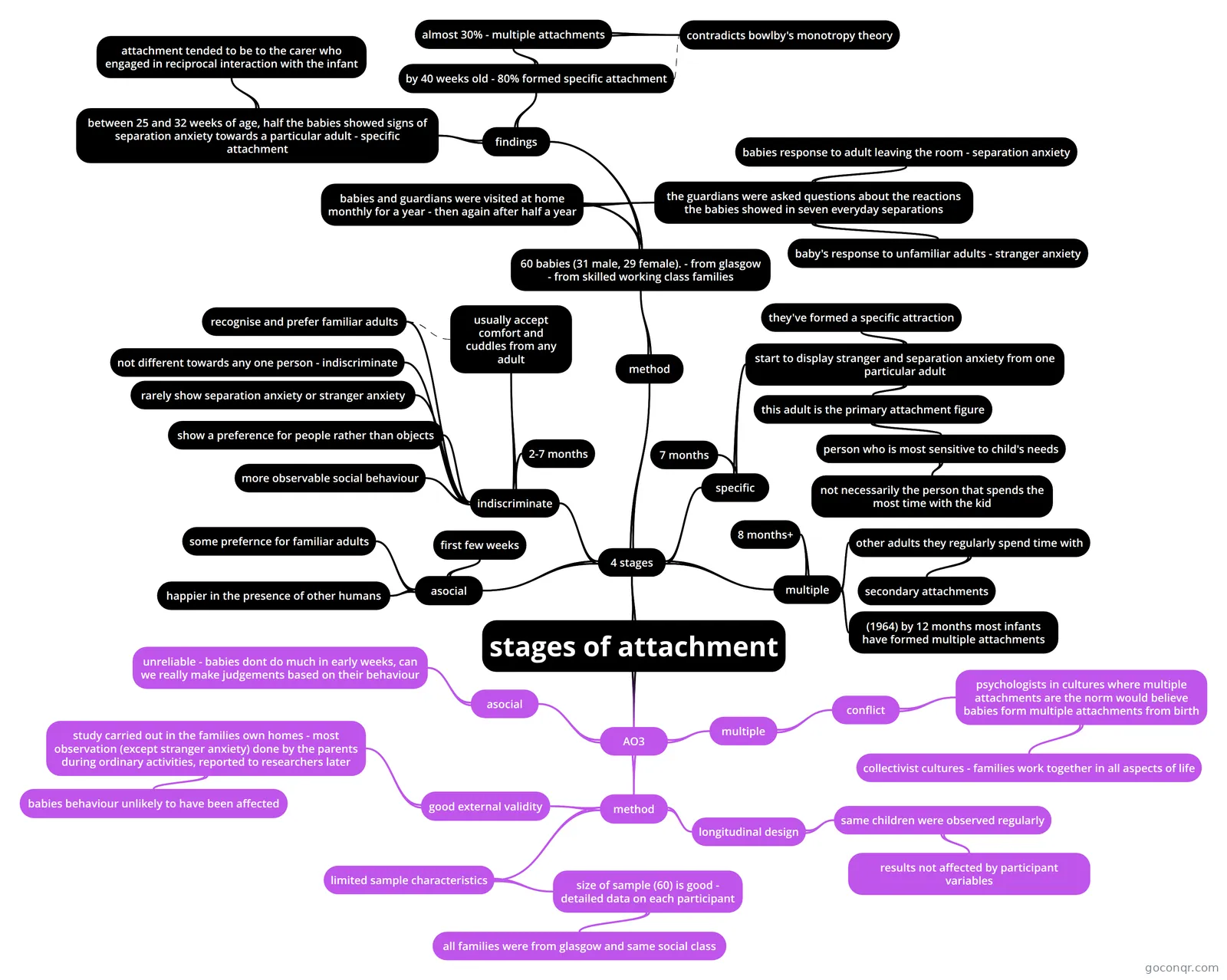
Mind map: stages of attachment
Map content
stages of attachment
4 stages
- asocial
- first few weeks
- happier in the presence of other humans
- some prefernce for familiar adults
- indiscriminate
- more observable social behaviour
- show a preference for people rather than objects
- recognise and prefer familiar adults
- usually accept comfort and cuddles from any adult
- rarely show separation anxiety or stranger anxiety
- not different towards any one person - indiscriminate
- 2-7 months
- specific
- 7 months
- start to display stranger and separation anxiety from one particular adult
- they've formed a specific attraction
- this adult is the primary attachment figure
- person who is most sensitive to child's needs
- not necessarily the person that spends the most time with the kid
- person who is most sensitive to child's needs
- multiple
- 8 months+
- other adults they regularly spend time with
- secondary attachments
- (1964) by 12 months most infants have formed multiple attachments
- method
- 60 babies (31 male, 29 female). - from glasgow - from skilled working class families
- babies and guardians were visited at home monthly for a year - then again after half a year
- the guardians were asked questions about the reactions the babies showed in seven everyday separations
- babies response to adult leaving the room - separation anxiety
- baby's response to unfamiliar adults - stranger anxiety
- the guardians were asked questions about the reactions the babies showed in seven everyday separations
- findings
- between 25 and 32 weeks of age, half the babies showed signs of separation anxiety towards a particular adult - specific attachment
- attachment tended to be to the carer who engaged in reciprocal interaction with the infant
- by 40 weeks old - 80% formed specific attachment
- almost 30% - multiple attachments
- contradicts bowlby's monotropy theory
- almost 30% - multiple attachments
- between 25 and 32 weeks of age, half the babies showed signs of separation anxiety towards a particular adult - specific attachment
- babies and guardians were visited at home monthly for a year - then again after half a year
- 60 babies (31 male, 29 female). - from glasgow - from skilled working class families
- asocial
AO3
- asocial
- unreliable - babies dont do much in early weeks, can we really make judgements based on their behaviour
- multiple
- conflict
- psychologists in cultures where multiple attachments are the norm would believe babies form multiple attachments from birth
- collectivist cultures - families work together in all aspects of life
- psychologists in cultures where multiple attachments are the norm would believe babies form multiple attachments from birth
- conflict
- method
- good external validity
- study carried out in the families own homes - most observation (except stranger anxiety) done by the parents during ordinary activities, reported to researchers later
- babies behaviour unlikely to have been affected
- study carried out in the families own homes - most observation (except stranger anxiety) done by the parents during ordinary activities, reported to researchers later
- longitudinal design
- same children were observed regularly
- results not affected by participant variables
- same children were observed regularly
- limited sample characteristics
- size of sample (60) is good - detailed data on each participant
- all families were from glasgow and same social class
- size of sample (60) is good - detailed data on each participant
- good external validity
- asocial
Information
- Description
- Mind Map on stages of attachment, created by Declan Gough on 17/11/2020.
- Created by
- Declan Gough
- Views
- 1
- Rating