
Mind map
Nuclear Radiation
Map content
Nuclear Radiation
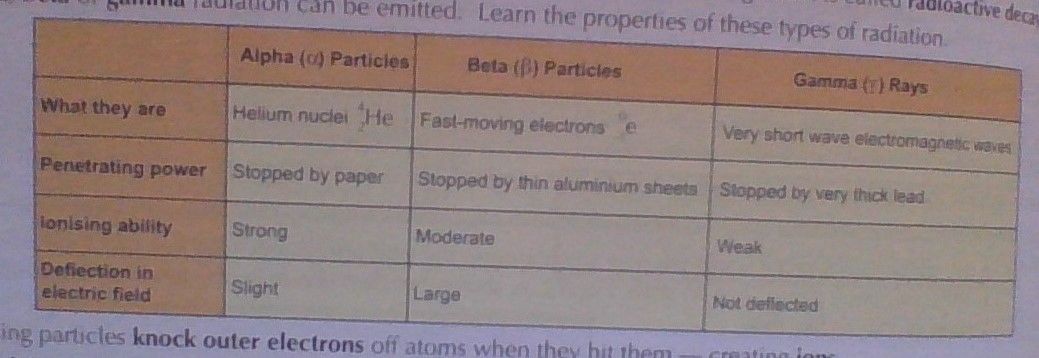
Nuclear Radiation - Alpha, Beta and Gamma
- Alpha particles are strongly positive - so they can remove electrons from atoms.
- The alpha particle quickly ionises lots of atoms an dloses all its energy.
- When an alph particle hits an atom, it trensfers some of its energy to the atom.
- Beta particles have lower changes then alpha particles, but higher speeds.
- Beta particles can still knock electrons off atoms, but they hit atoms less frequently than alpha particles because they're smaller, so they hane better penetrating power.
- Alpha particles are strongly positive - so they can remove electrons from atoms.
Nuclear Equations - Balance the Mass and Atomic Numbers
Half-Life - The Time Taken for Half the Atoms in a Sample to Decay
- Radioactive decay is random - this means it's impossible to know when a single atom will decay. But if you look at large numbers of atoms, then a pattern does become clear.
- For radioactive atoms, the pattern is best described using the idea of half-life. The half - life is the average time taken for half of the atoms in a sample to dicay. It has a constant walue for any particular isotope.
- For exaple, an isotope of radon has a half-life of about 4 days. This means that if you had 20g of it now, in 4 days' time there will be only 10g left. After 8 days there would be only 5g, and after 12 days, 2.5g, and so on.
Radioactive Isotopes can be Used as Tracers
- Because it's easy to detect radiation given out by radioactive isotopes, they're wsed as tracers - chemicals taht can be tracked. This can be used to check how well parts of the body (or industrial equipment) are working
- Medical tracers can be given to a person, and as they move aroundthe body their position can be detected. For example, radioactive iodine-131 is used to check hhow well a person's thyroid gland is functioning.
- Only isotopes with suitable half-lives can be used as medical tracers - not too long and not too short:
- a very long half-life is dangerous - the patient could be exposed to radiation for a long time
- A very short half-life is inconvenient - the tracers have to be prepared, administered, and then be allowed to make their way around the body, so a tracer with a half-life of a few seconds isn't going to be much good.
- And alpha emitters are no good - they'd cause damage by ionising atoms inside the body, and anyway, they wouldn't be detectable outside the body.
Radioactive isotopes can be used to find out how old stuff is
- Radioactive isotopes can be used to determine the age of rocks and archaeological finds.
- Radiocarbon dating involves measuring how much of a particular isotope of carbon there is in plant or animal remains (including things made of wood, lether or bone - like arrowheads, axe handles, and so on).
- The idea behind the technique is this ...
- all living things contain the same percentage of carbon-14:
- When plants photoynthesise, they absorb carbon (in CO2) from the asmosphere - including a small percentage of carbon-14
- as the carbon - 14 atoms decay, they're replaced by more carbon-14 from the atmosphere.
- Animals eat plants (or other animals that have eaten plants).
- and the upshot is that all living things are constantly replenishing their levels of carbon-14 to match the atmosphere.
- But as soon as they die, this percentage starts to decrease - because the carbon-14 atoms decay.
- So the less carbon-14 in a sample of organic material, the older it mut be
- all living things contain the same percentage of carbon-14:
- You can then find the approximate age of the animal or plant( and therefore the arrowhead, axe handle ...) with a calculation like the one onthe previous page.
Nuclear Fusion - Forming elements in stars
- Complete of track now ... enough of breaking nuclei apart - this next bit is about putting nuclei together.
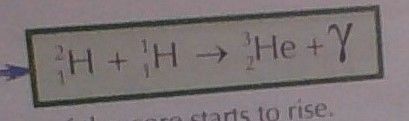
- Nuclear fusion is when two small nuclei combine under high temperature to make one larger nucleus. It happens naturally all the time inside stars.
- In stars, hydrogen nuclei combine to make helium nuclei, releasing huge amounts of energy. This is happening inside our Sun's core.
- When the hydrogen in a star's core runs out, the temperature and pressure of the core starts to rise. In a big enough star it'll get hot enough to fuse heavier elements, starting with helium.
- In fact, large nuclei can only be made by stars (either inside them, or as a 'dead' star explodes as a supermova
- Complete of track now ... enough of breaking nuclei apart - this next bit is about putting nuclei together.
Images and files in the map

Information
- Description
- A levels Chemistry Mind Map on Nuclear Radiation, created by nicola.batty100 on 19/05/2015.
- Created by
- nicola.batty100 · May 2015
- Updated
- Mar 13, 2016
- Views
- 1
- Rating