
Mind map
Key concepts edexcel chemisty
Map content
Key concepts edexcel chemisty
Chemical Equations
- can write them using words or symbols
- methane burning in oxygen makes carbon dioxide and water: methane + oxygen -> carbon dioxide + water
- magnesium and oxygen react to make magnesium oxide : 2Mg + O2 -> 2MgO
- these must be balanced so they need to have the same number of atoms for each element
- state symbols can be used next to each substance to see the physical state it is in
- solid - (s)
- liquid - (l)
- gas - (g)
- aqueous(dissolved in water) - (aq)
- different ions and different formulas
- ammonium - NH4^+
- nitrate - NO3^-
- sulfate - SO4^2-
- hydroxide - OH^-
- carbonate - CO3^2-
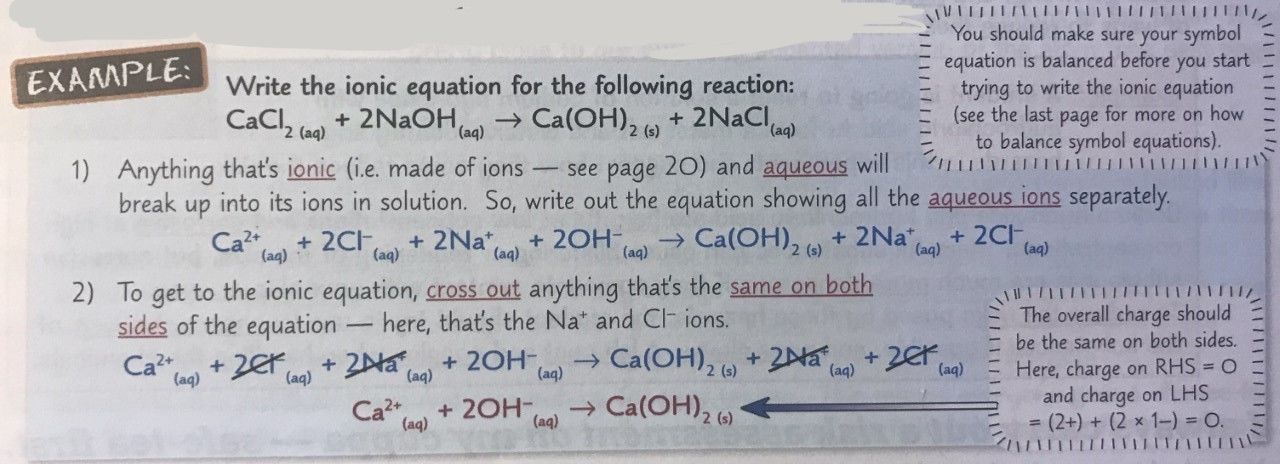
- ionic equations just show the useful bits
- they only show the reacting particles
- to write an ionic equations just look at the balanced equation and take out any aqueous ions on both sides
- example:
- can write them using words or symbols
Hazards and Risks
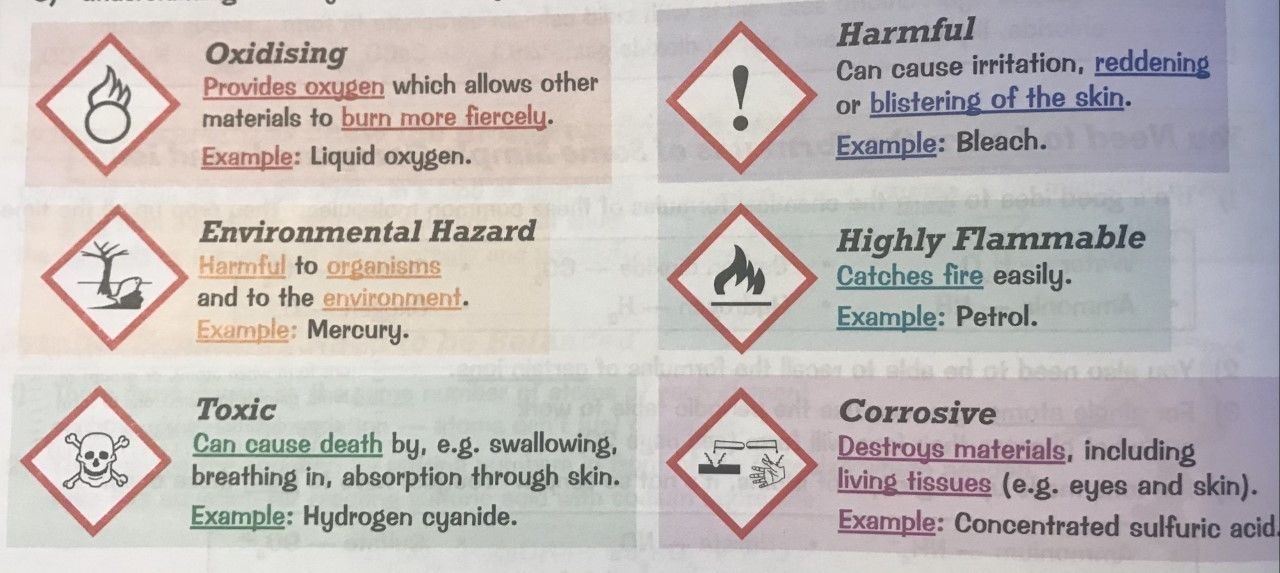
- a hazard is anything that has the potential to cause harm. the risk is the probability of someone getting hurt
- hazards can come from equipment used or chemicals used
- a hazard is anything that has the potential to cause harm. the risk is the probability of someone getting hurt
history of the atom
- first atom structure
- found by John Dalton at the start of the 19the century
- described it as a solid sphere that is made up of different elements
- second atom structure
- found by JJ Thomas in 1897
- he found out that atoms weren't solid spheres and contained smaller, negatively charged particels
- know as the "plum pubbing model
- third atom structure
- found by Rutherford in 1909
- they fired positively charged alpha particles at an extremely thin piece of gold
- they where expecting it to travel straight through or be partially deflected,
- more particles then expected where deflected and some where deflected backward so the plum pudding could be right
- he came up with the nuclear atom, where there is a tiny positively charged nucleus surrounded by a "cloud" of negative electrons
- fourth atom structure
- found by Bohr
- he realised that if the electrons where in a cloud they would be attracted to the nucleus and the atom would collapse
- therefore electrons could only exist in fixed orbits, or shells and each shell has a fixed energy
- out current view on the atom
- last atom
- found by James Chadwick
- found the neutron
- found in 1932
- first atom structure
the atom
- contains protons neutrons and electrons
- protons
- have a relative mass of 1 and a positive charge
- neutrons
- have a relative mass of 1 and a charge of 0
- electrons
- have a relative mass of 0 and a charge of -1
- protons
- the nucleus
- in the middle
- contains protons and neutrons
- has a positive charge
- holds the mass
- atomic and mass number
- atomic number- tells you how many protons the atom has
- mass number tells you the total number to protons and nuetrons
- isotopes
- these are different forms of the same element , they have the same number of protons but different number of neutrons
- is an element has more then 1 isotope then the Ar is the average of the mass numbers of all the different isotopes
- multiply each relative isotopic mass number by its isotopic abundance and add up results: boron-10 and boron-11 have an abundance of 4 and 16. (10x4)+(11x16)
- then you divide this by the sum of the isotopic abundances. 216/(16+4)
- multiply each relative isotopic mass number by its isotopic abundance and add up results: boron-10 and boron-11 have an abundance of 4 and 16. (10x4)+(11x16)
- contains protons neutrons and electrons
Images and files in the map
Information
- Description
- Year 9 Chemistry Mind Map on Key concepts edexcel chemisty, created by Emily Cosh on 03/03/2021.
- Created by
- Emily Cosh
- Views
- 0
- Rating