
Mind map
Redox and Electrode Potentials
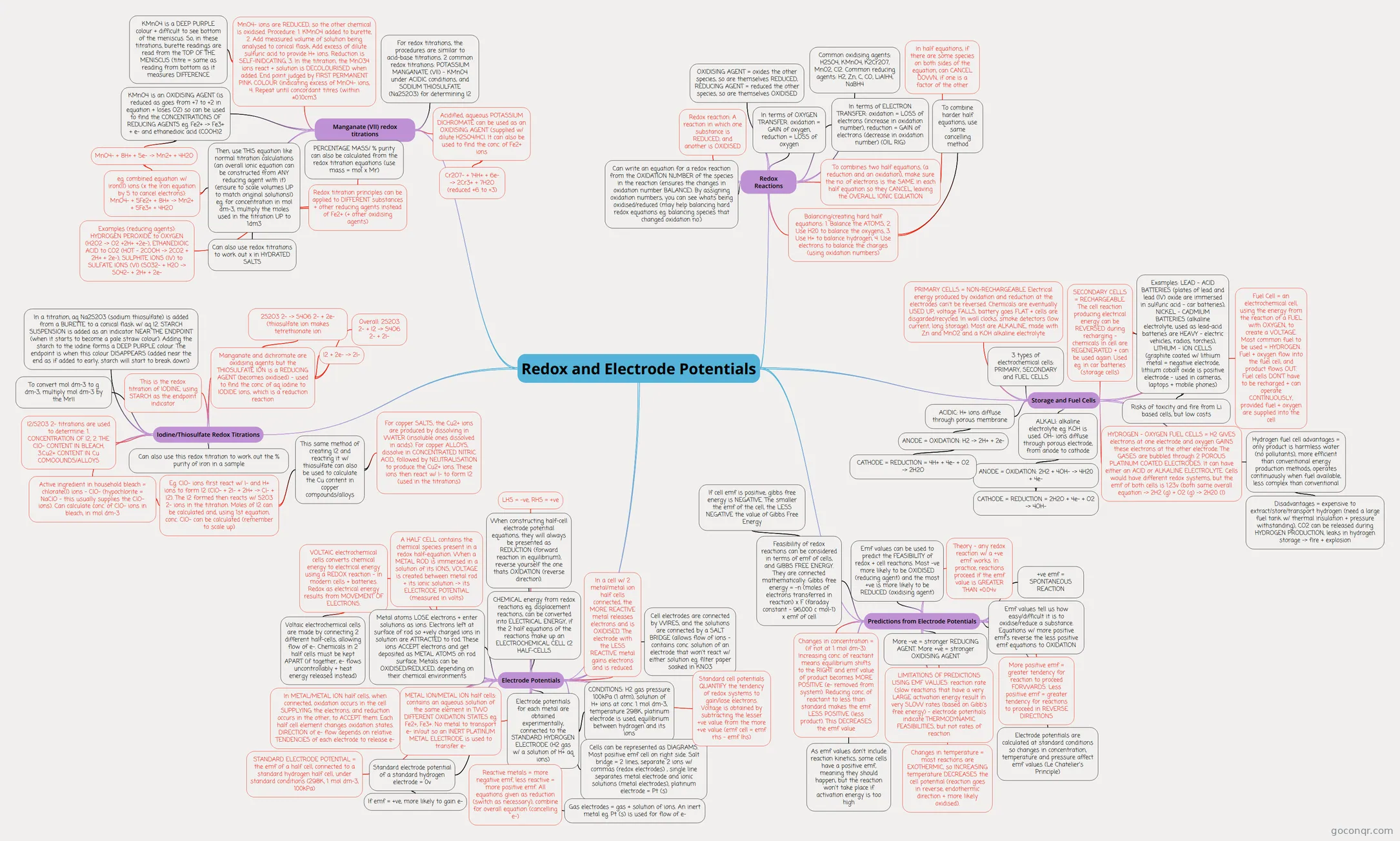
Mind map: Redox and Electrode Potentials
Map content
Redox and Electrode Potentials
Redox Reactions
- Redox reaction: A reaction in which one substance is REDUCED, and another is OXIDISED
- In terms of OXYGEN TRANSFER: oxidation = GAIN of oxygen, reduction = LOSS of oxygen
- In terms of ELECTRON TRANSFER: oxidation = LOSS of electrons (increase in oxidation number), reduction = GAIN of electrons (decrease in oxidation number) (OIL RIG)
- OXIDISING AGENT = oxides the other species, so are themselves REDUCED, REDUCING AGENT = reduced the other species, so are themselves OXIDISED
- Common oxidising agents: H2SO4, KMnO4, K2Cr2O7, MnO2, Cl2. Common reducing agents: H2, Zn, C, CO, LiAlH4, NaBH4
- To combines two half equations, (a reduction and an oxidation), make sure the no. of electrons is the SAME in each half equation so they CANCEL, leaving the OVERALL IONIC EQUATION
- In half equations, if there are some species on both sides of the equation, can CANCEL DOWN, if one is a factor of the other
- Can write an equation for a redox reaction from the OXIDATION NUMBER of the species in the reaction (ensures the changes in oxidation number BALANCE). By assigning oxidation numbers, you can see whats being oxidised/reduced (may help balancing hard redox equations eg. balancing species that changed oxidation no.)
- Balancing/creating hard half equations: 1. Balance the ATOMS, 2. Use H20 to balance the oxygens, 3. Use H+ to balance hydrogen, 4. Use electrons to balance the charges (using oxidation numbers)
- To combine harder half equations, use same cancelling method
Manganate (VII) redox titrations
- For redox titrations, the procedures are similar to acid-base titrations. 2 common redox titrations: POTASSIUM MANGANATE (VII) - KMnO4 under ACIDIC conditions, and SODIUM THIOSULFATE (Na2S2O3) for determining I2
- MnO4- ions are REDUCED, so the other chemical is oxidised. Procedure: 1. KMnO4 added to burette, 2. Add measured volume of solution being analysed to conical flask. Add excess of dilute sulfuric acid to provide H+ ions. Reduction is SELF-INIDCATING, 3. In the titration, the MnO34 ions react + solution is DECOLOURISED when added. End point judged by FIRST PERMANENT PINK COLOUR (indicating excess of MnO4- ions, 4. Repeat until concordant titres (within ±0.10cm3
- KMnO4 is a DEEP PURPLE colour + difficult to see bottom of the meniscus. So, in these titrations, burette readings are read from the TOP OF THE MENISCUS (titre = same as reading from bottom as it measures DIFFERENCE
- KMnO4 is an OXIDISING AGENT (is reduced as goes from +7 to +2 in equation + loses O2) so can be used to find the CONCENTRATIONS OF REDUCING AGENTS eg. Fe2+ -> Fe3+ + e- and ethanedioic acid (COOH)2
- MnO4- + 8H+ + 5e- -> Mn2+ + 4H2O
- eg. combined equation w/ iron(II) ions (x the iron equation by 5 to cancel electrons): MnO4- + 5Fe2+ + 8H+ -> Mn2+ + 5Fe3+ + 4H2O
- Then, use THIS equation like normal titration calculations (an overall ionic equation can be constructed from ANY reducing agent with it) (ensure to scale volumes UP to match original solutions!) eg. for concentration in mol dm-3, multiply the moles used in the titration UP to 1dm3
- eg. combined equation w/ iron(II) ions (x the iron equation by 5 to cancel electrons): MnO4- + 5Fe2+ + 8H+ -> Mn2+ + 5Fe3+ + 4H2O
- MnO4- + 8H+ + 5e- -> Mn2+ + 4H2O
- PERCENTAGE MASS/ % purity can also be calculated from the redox titration equations (use mass = mol x Mr)
- Redox titration principles can be applied to DIFFERENT substances + other reducing agents instead of Fe2+ (+ other oxidising agents)
- Examples (reducing agents): HYDROGEN PEROXIDE to OXYGEN (H2O2 -> O2 +2H+ +2e-), ETHANEDIOIC ACID to CO2 (HOT - 2COOH -> 2CO2 + 2H+ + 2e-), SULPHITE IONS (IV) to SULFATE IONS (VI) (SO32- + H2O -> SO42- + 2H+ + 2e-
- Can also use redox titrations to work out x in HYDRATED SALTS
- Acidified, aqueous POTASSIUM DICHROMATE can be used as an OXIDISING AGENT (supplied w/ dilute H2SO4/HCl. It can also be used to find the conc. of Fe2+ ions
- Cr2O7- + 14H+ + 6e- -> 2Cr3+ + 7H2O (reduced +6 to +3)
Iodine/Thiosulfate Redox Titrations
- This is the redox titration of IODINE, using STARCH as the endpoint indicator
- Manganate and dichromate are oxidising agents but the THIOSULFATE ION is a REDUCING AGENT (becomes oxidised) - used to find the conc. of aq iodine to IODIDE ions, which is a reduction reaction
- 2S2O3 2- -> S4O6 2- + 2e- (thiosulfate ion makes tetrethionate ion
- I2 + 2e- -> 2I-
- Overall: 2S2O3 2- + I2 -> S4O6 2- + 2I-
- In a titration, aq Na2S2O3 (sodium thiosulfate) is added from a BURETTE to a conical flask w/ aq I2. STARCH SUSPENSION is added as an indicator NEAR THE ENDPOINT (when it starts to become a pale straw colour). Adding the starch to the iodine forms a DEEP PURPLE colour. The endpoint is when this colour DISAPPEARS (added near the end as if added to early, starch will start to break down)
- To convert mol dm-3 to g dm-3, multiply mol dm-3 by the Mr!!
- I2/S2O3 2- titrations are used to determine: 1. CONCENTRATION OF I2, 2. THE ClO- CONTENT IN BLEACH, 3.Cu2+ CONTENT IN Cu COMOOUNDS/ALLOYS
- Can also use this redox titration to work out the % purity of iron in a sample
- Active ingredient in household bleach = chlorate(I) ions - ClO- (hypochlorite = NaClO - this usually supplies the ClO- ions). Can calculate conc. of ClO- ions in bleach, in mol dm-3
- Eg. ClO- ions first react w/ I- and H+ ions to form I2 (ClO- + 2I- + 2H+ -> Cl- + I2). The I2 formed then reacts w/ S2O3 2- ions in the titration. Moles of I2 can be calculated and, using 1st equation, conc. ClO- can be calculated (remember to scale up)
- This same method of creating I2 and reacting it w/ thiosulfate can also be used to calculate the Cu content in copper compounds/alloys
- For copper SALTS, the Cu2+ ions are produced by dissolving in WATER (insoluble ones dissolved in acids). For copper ALLOYS, dissolve in CONCENTRATED NITRIC ACID, followed by NEUTRALISATION to produce the Cu2+ ions. These ions then react w/ I- to form I2 (used in the titrations)
- This same method of creating I2 and reacting it w/ thiosulfate can also be used to calculate the Cu content in copper compounds/alloys
- Eg. ClO- ions first react w/ I- and H+ ions to form I2 (ClO- + 2I- + 2H+ -> Cl- + I2). The I2 formed then reacts w/ S2O3 2- ions in the titration. Moles of I2 can be calculated and, using 1st equation, conc. ClO- can be calculated (remember to scale up)
Electrode Potentials
- CHEMICAL energy from redox reactions eg. displacement reactions, can be converted into ELECTRICAL ENERGY, if the 2 half equations of the reactions make up an ELECTROCHEMICAL CELL (2 HALF-CELLS
- A HALF CELL contains the chemical species present in a redox half-equation. When a METAL ROD is immersed in a solution of its IONS, VOLTAGE is created between metal rod + its ionic solution -> its ELECTRODE POTENTIAL (measured in volts)
- When constructing half-cell electrode potential equations, they will always be presented as REDUCTION (forward reaction in equilibrium), reverse yourself the one thats OXIDATION (reverse direction).
- VOLTAIC electrochemical cells converts chemical energy to electrical energy using a REDOX reaction - in modern cells + batteries. Redox as electrical energy results from MOVEMENT OF ELECTRONS.
- Voltaic electrochemical cells are made by connecting 2 different half-cells, allowing flow of e-. Chemicals in 2 half cells must be kept APART (if together, e- flows uncontrollably + heat energy released instead)
- Metal atoms LOSE electrons + enter solutions as ions. Electrons left at surface of rod so +vely charged ions in solution are ATTRACTED to rod. These ions ACCEPT electrons and get deposited as METAL ATOMS on rod surface. Metals can be OXIDISED/REDUCED, depending on their chemical environments
- In METAL/METAL ION half cells, when connected, oxidation occurs in the cell SUPPLYING the electrons, and reduction occurs in the other, to ACCEPT them. Each half cell element changes oxidation states. DIRECTION of e- flow depends on relative TENDENCIES of each electrode to release e-
- LHS = -ve, RHS = +ve
- METAL ION/METAL ION half cells: contains an aqueous solution of the same element in TWO DIFFERENT OXIDATION STATES eg. Fe2+, Fe3+. No metal to transport e- in/out so an INERT PLATINUM METAL ELECTRODE is used to transfer e-
- In a cell w/ 2 metal/metal ion half cells connected, the MORE REACTIVE metal releases electrons and is OXIDISED. The electrode with the LESS REACTIVE metal gains electrons and is reduced.
- Electrode potentials for each metal are obtained experimentally, connected to the STANDARD HYDROGEN ELECTRODE (H2 gas w/ a solution of H+ aq ions)
- CONDITIONS: H2 gas pressure 100kPa (1 atm), solution of H+ ions at conc. 1 mol dm-3, temperature 298K, platinum electrode is used, equilibrium between hydrogen and its ions
- STANDARD ELECTRODE POTENTIAL = the emf of a half cell, connected to a standard hydrogen half cell, under standard conditions (298K, 1 mol dm-3, 100kPa)
- Standard electrode potential of a standard hydrogen electrode = 0v
- If emf = +ve, more likely to gain e-
- Cell electrodes are connected by WIRES, and the solutions are connected by a SALT BRIDGE (allows flow of ions - contains conc. solution of an electrode that won't react w/ either solution eg. filter paper soaked in KNO3
- Reactive metals = more negative emf, less reactive = more positive emf. All equations given as reduction (switch as necessary), combine for overall equation (cancelling e-)
- Cells can be represented as DIAGRAMS. Most positive emf cell on right side. Salt bridge = 2 lines, separate 2 ions w/ commas (redox electrodes) , single line separates metal electrode and ionic solutions (metal electrodes), platinum electrode = Pt (s)
- Gas electrodes = gas + solution of ions. An inert metal eg. Pt (s) is used for flow of e-
- Standard cell potentials QUANTIFY the tendency of redox systems to gain/lose electrons. Voltage is obtained by subtracting the lesser +ve value from the more +ve value (emf cell = emf rhs - emf lhs)
Predictions from Electrode Potentials
- Emf values can be used to predict the FEASIBILITY of redox + cell reactions. Most -ve more likely to be OXIDISED (reducing agent) and the most +ve is more likely to be REDUCED (oxidising agent)
- Theory - any redox reaction w/ a +ve emf works. In practice, reactions proceed if the emf value is GREATER THAN +0.04v
- Emf values tell us how easy/difficult it is to oxidise/reduce a substance. Equations w/ more positive emf's reverse the less positive emf equations to OXIDATION
- +ve emf = SPONTANEOUS REACTION
- More positive emf = greater tendency for reaction to proceed FORWARDS. Less positive emf = greater tendency for reactions to proceed in REVERSE DIRECTIONS
- More -ve = stronger REDUCING AGENT. More +ve = stronger OXIDISING AGENT
- LIMITATIONS OF PREDICTIONS USING EMF VALUES: reaction rate (slow reactions that have a very LARGE activation energy result in very SLOW rates (based on Gibb's free energy) - electrode potentials indicate THERMODYNAMIC FEASIBILITIES, but not rates of reaction
- Electrode potentials are calculated at standard conditions so changes in concentration, temperature and pressure affect emf values (Le Chatelier's Principle)
- Changes in concentration = (if not at 1 mol dm-3). Increasing conc. of reactant means equilibrium shifts to the RIGHT and emf value of product becomes MORE POSITIVE (e- removed from system). Reducing conc. of reactant to less than standard makes the emf LESS POSITIVE (less product). This DECREASES the emf value
- Changes in temperature = most reactions are EXOTHERMIC, so INCREASING temperature DECREASES the cell potential (reaction goes in reverse, endothermic direction + more likely oxidised).
- As emf values don't include reaction kinetics, some cells have a positive emf, meaning they should happen, but the reaction won't take place if activation energy is too high
- Feasibility of redox reactions can be considered in terms of emf of cells, and GIBBS FREE ENERGY. They are connected mathematically: Gibbs free energy = -n (moles of electrons transferred in reaction) x F (faraday constant - 96,000 c mol-1) x emf of cell
- If cell emf is positive, gibbs free energy is NEGATIVE. The smaller the emf of the cell, the LESS NEGATIVE the value of Gibbs Free Energy
Storage and Fuel Cells
- 3 types of electrochemical cells: PRIMARY, SECONDARY and FUEL CELLS
- PRIMARY CELLS = NON-RECHARGEABLE Electrical energy produced by oxidation and reduction at the electrodes can't be reversed. Chemicals are eventually USED UP, voltage FALLS, battery goes FLAT + cells are disgarded/recycled. In wall clocks, smoke detectors (low current, long storage). Most are ALKALINE, made with Zn and MnO2 and a KOH alkaline electrolyte
- SECONDARY CELLS = RECHARGEABLE. The cell reaction producing electrical energy can be REVERSED during recharging - chemicals in cell are REGENERATED + can be used again. Used eg. in car batteries (storage cells)
- Examples: LEAD - ACID BATTERIES (plates of lead and lead (IV) oxide are immersed in sulfuric acid - car batteries), NICKEL - CADMIUM BATTERIES (alkaline electrolyte, used as lead-acid batteries are HEAVY - electric vehicles, radios, torches), LITHIUM - ION CELLS (graphite coated w/ lithium metal = negative electrode, lithium cobalt oxide is positive electrode - used in cameras, laptops + mobile phones)
- Risks of toxicity and fire from Li based cells, but low costs
- Examples: LEAD - ACID BATTERIES (plates of lead and lead (IV) oxide are immersed in sulfuric acid - car batteries), NICKEL - CADMIUM BATTERIES (alkaline electrolyte, used as lead-acid batteries are HEAVY - electric vehicles, radios, torches), LITHIUM - ION CELLS (graphite coated w/ lithium metal = negative electrode, lithium cobalt oxide is positive electrode - used in cameras, laptops + mobile phones)
- Fuel Cell = an electrochemical cell, using the energy from the reaction of a FUEL with OXYGEN, to create a VOLTAGE. Most common fuel to be used = HYDROGEN. Fuel + oxygen flow into the fuel cell, and product flows OUT. Fuel cells DON'T have to be recharged + can operate CONTINUOUSLY, provided fuel + oxygen are supplied into the cell
- HYDROGEN - OXYGEN FUEL CELLS = H2 GIVES electrons at one electrode and oxygen GAINS these electrons at the other electrode. The GASES are bubbled through 2 POROUS PLATINUM COATED ELECTRODES. It can have either an ACID or ALKALINE ELECTROLYTE. Cells would have different redox systems, but the emf of both cells is 1.23v (both same overall equation -> 2H2 (g) + O2 (g) -> 2H20 (l)
- ALKALI: alkaline electrolyte eg. KOH is used. OH- ions diffuse through porous electrode, from anode to cathode
- ANODE = OXIDATION: 2H2 + 4OH- -> 4H20 + 4e-
- CATHODE = REDUCTION = 2H2O + 4e- + O2 -> 4OH-
- ANODE = OXIDATION: 2H2 + 4OH- -> 4H20 + 4e-
- ACIDIC: H+ ions diffuse through porous membrane
- ANODE = OXIDATION: H2 -> 2H+ + 2e-
- CATHODE = REDUCTION = 4H+ + 4e- + O2 -> 2H2O
- ANODE = OXIDATION: H2 -> 2H+ + 2e-
- Hydrogen fuel cell advantages = only product is harmless water (no pollutants), more efficient than conventional energy production methods, operates continuously when fuel available, less complex than conventional
- Disadvantages = expensive to extract/store/transport hydrogen (need a large fuel tank w/ thermal insulation + pressure withstanding), CO2 can be released during HYDROGEN PRODUCTION, leaks in hydrogen storage -> fire + explosion
Information
- Description
- A level Chemistry Mind Map on Redox and Electrode Potentials, created by Rhea Sekhon on 16/04/2021.
- Created by
- Rhea Sekhon
- Views
- 1
- Rating