
Mind map
Native Americans
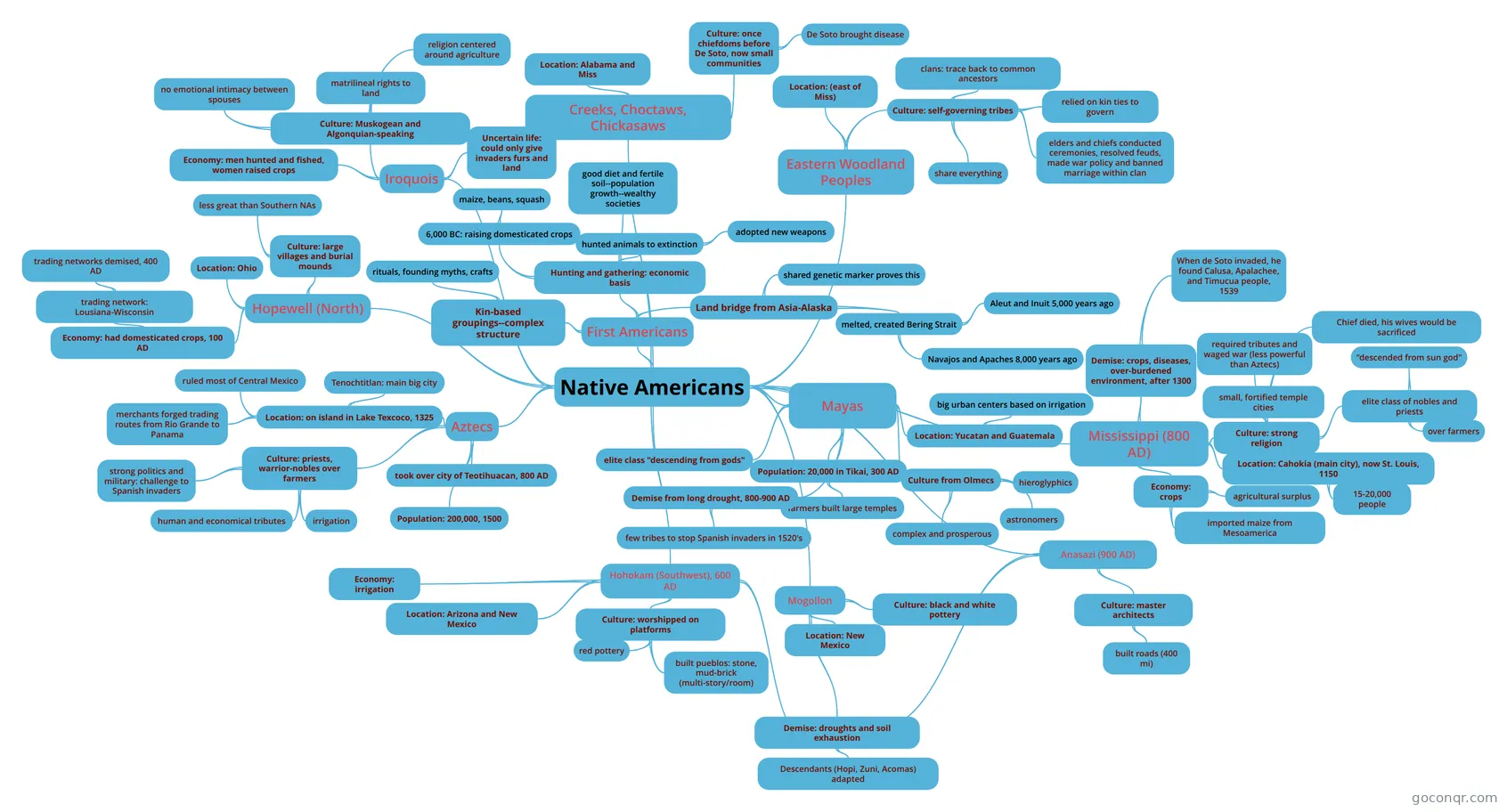
Mind map: Native Americans
Map content
Native Americans
First Americans
- Land bridge from Asia-Alaska
- shared genetic marker proves this
- melted, created Bering Strait
- Navajos and Apaches 8,000 years ago
- Aleut and Inuit 5,000 years ago
- Hunting and gathering: economic basis
- hunted animals to extinction
- adopted new weapons
- 6,000 BC: raising domesticated crops
- maize, beans, squash
- good diet and fertile soil--population growth--wealthy societies
- hunted animals to extinction
- Kin-based groupings--complex structure
- rituals, founding myths, crafts
- Land bridge from Asia-Alaska
Mayas
- Location: Yucatan and Guatemala
- big urban centers based on irrigation
- Population: 20,000 in Tikai, 300 AD
- farmers built large temples
- elite class "descending from gods"
- Culture from Olmecs
- astronomers
- hieroglyphics
- complex and prosperous
- Demise from long drought, 800-900 AD
- few tribes to stop Spanish invaders in 1520's
- Location: Yucatan and Guatemala
Aztecs
- took over city of Teotihuacan, 800 AD
- Location: on island in Lake Texcoco, 1325
- Tenochtitlan: main big city
- ruled most of Central Mexico
- merchants forged trading routes from Rio Grande to Panama
- Culture: priests, warrior-nobles over farmers
- irrigation
- human and economical tributes
- strong politics and military: challenge to Spanish invaders
- Population: 200,000, 1500
Hopewell (North)
- Location: Ohio
- Culture: large villages and burial mounds
- less great than Southern NAs
- Economy: had domesticated crops, 100 AD
- trading network: Lousiana-Wisconsin
- trading networks demised, 400 AD
- trading network: Lousiana-Wisconsin
Hohokam (Southwest), 600 AD
- Location: Arizona and New Mexico
- Culture: worshipped on platforms
- red pottery
- built pueblos: stone, mud-brick (multi-story/room)
- Economy: irrigation
Mogollon
- Location: New Mexico
- Culture: black and white pottery
- Demise: droughts and soil exhaustion
- Descendants (Hopi, Zuni, Acomas) adapted
Anasazi (900 AD)
- Culture: master architects
- built roads (400 mi)
- Culture: master architects
Mississippi (800 AD)
- Economy: crops
- imported maize from Mesoamerica
- agricultural surplus
- Culture: strong religion
- small, fortified temple cities
- elite class of nobles and priests
- "descended from sun god"
- over farmers
- required tributes and waged war (less powerful than Aztecs)
- Chief died, his wives would be sacrificed
- Location: Cahokia (main city), now St. Louis, 1150
- 15-20,000 people
- Demise: crops, diseases, over-burdened environment, after 1300
- When de Soto invaded, he found Calusa, Apalachee, and Timucua people, 1539
- Economy: crops
Eastern Woodland Peoples
- Location: (east of Miss)
- Culture: self-governing tribes
- clans: trace back to common ancestors
- elders and chiefs conducted ceremonies, resolved feuds, made war policy and banned marriage within clan
- relied on kin ties to govern
- share everything
Creeks, Choctaws, Chickasaws
- Location: Alabama and Miss
- Culture: once chiefdoms before De Soto, now small communities
- De Soto brought disease
Iroquois
- Culture: Muskogean and Algonquian-speaking
- matrilineal rights to land
- no emotional intimacy between spouses
- religion centered around agriculture
- Economy: men hunted and fished, women raised crops
- Uncertain life: could only give invaders furs and land
- Culture: Muskogean and Algonquian-speaking
Information
- Description
- Mind Map on Native Americans, created by carolinechurney on 06/09/2015.
- Created by
- carolinechurney
- Views
- 8
- Rating