
Mind map
#1 Membrane Transport
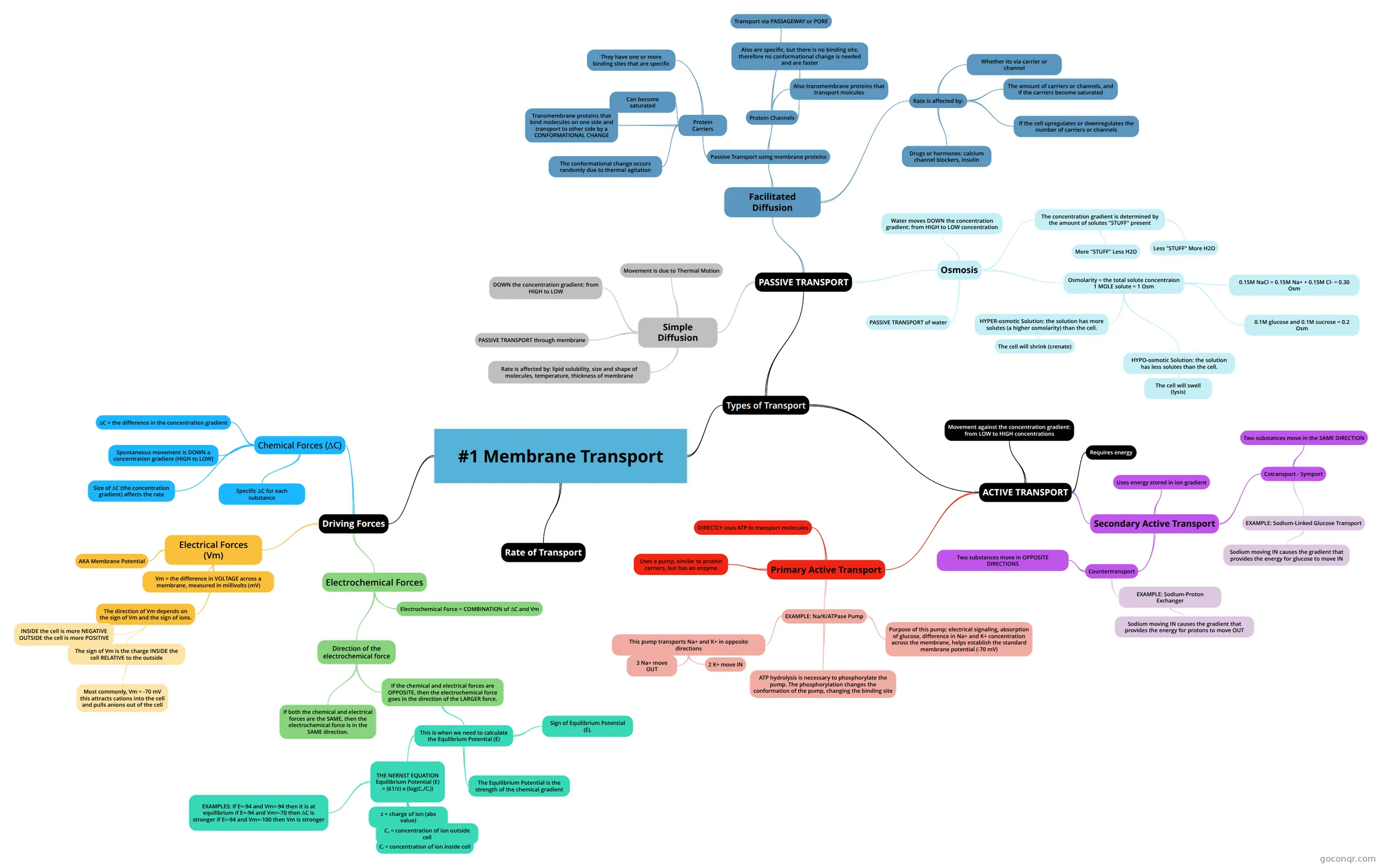
Mind map: membrane transport
Map content
#1 Membrane Transport
Driving Forces
- Chemical Forces (ΔC)
- ΔC = the difference in the concentration gradient
- Spontaneous movement is DOWN a concentration gradient (HIGH to LOW)
- Size of ΔC (the concentration gradient) affects the rate
- Specific ΔC for each substance
- Electrical Forces (Vm)
- AKA Membrane Potential
- Vm = the difference in VOLTAGE across a membrane, measured in millivolts (mV)
- The direction of Vm depends on the sign of Vm and the sign of ions.
- INSIDE the cell is more NEGATIVE OUTSIDE the cell is more POSITIVE
- The sign of Vm is the charge INSIDE the cell RELATIVE to the outside
- Most commonly, Vm = -70 mV this attracts cations into the cell and pulls anions out of the cell
- Electrochemical Forces
- Electrochemical Force = COMBINATION of ΔC and Vm
- Direction of the electrochemical force
- If both the chemical and electrical forces are the SAME, then the electrochemical force is in the SAME direction.
- If the chemical and electrical forces are OPPOSITE, then the electrochemical force goes in the direction of the LARGER force.
- This is when we need to calculate the Equlibrium Potential (E)
- THE NERNST EQUATION Equilibrium Potential (E) = (61/z) x (log(Cₒ/Cᵢ))
- z = charge of ion (abs value)
- Cₒ = concentration of ion outside cell
- Cᵢ = concentration of ion inside cell
- EXAMPLES: if E=-94 and Vm=-94 then it is at equilibrium if E=-94 and Vm=-70 then ΔC is stronger if E=-94 and Vm=-100 then Vm is stronger
- The Equilibrium Potential is the strength of the chemical gradient
- Sign of Equilibrium Potential (E).
- THE NERNST EQUATION Equilibrium Potential (E) = (61/z) x (log(Cₒ/Cᵢ))
- This is when we need to calculate the Equlibrium Potential (E)
- Chemical Forces (ΔC)
Rate of Transport
Types of Transport
- PASSIVE TRANSPORT
- Simple Diffusion
- PASSIVE TRANSPORT through membrane
- Movement is due to Thermal Motion
- DOWN the concentration gradient: from HIGH to LOW
- Rate is affected by: lipid solubility, size and shape of molecules, temperature, thickness of membrane
- Facilitated Diffusion
- Passive Transport using membrane proteins
- Protein Carriers
- Transmembrane proteins that bind molecules on one side and transport to other side by a CONFORMATIONAL CHANGE
- They have one or more binding sites that are specific
- The conformational change occurs randomly due to thermal agitation
- Can become saturated
- Protein Channels
- Also transmembrane proteins that transport molcules
- Transport via PASSAGEWAY or PORE
- Also are specific, but there is no binding site, therefore no conformational change is needed and are faster
- Protein Carriers
- Rate is affected by:
- Whether its via carrier or channel
- The amount of carriers or channels, and if the carriers become saturated
- If the cell upregulates or downregulates the number of carriers or channels
- Drugs or hormones: calcium channel blockers, insulin
- Passive Transport using membrane proteins
- Osmosis
- PASSIVE TRANSPORT of water
- Water moves DOWN the concentration gradient: from HIGH to LOW concentration
- The concentration gradient is determined by the amount of solutes "STUFF" present
- More "STUFF" Less H2O
- Less "STUFF" More H2O
- Osmolarity = the total solute concentraion 1 MOLE solute = 1 Osm
- 0.1M glucose and 0.1M sucrose = 0.2 Osm
- 0.15M NaCl = 0.15M Na+ + 0.15M Cl- = 0.30 Osm
- HYPER-osmotic Solution: the solution has more solutes (a higher osmolarity) than the cell.
- The cell will shrink (crenate)
- HYPO-osmotic Solution: the solution has less solutes than the cell.
- The cell will swell (lysis)
- Simple Diffusion
- ACTIVE TRANSPORT
- Primary Active Transport
- DIRECTLY uses ATP to transport molecules
- Uses a pump, similar to protein carriers, but has an enzyme
- EXAMPLE: Na/K/ATPase Pump
- This pump transports Na+ and K+ in opposite directions
- 3 Na+ move OUT
- 2 K+ move IN
- ATP hydrolysis is necessary to phosphorylate the pump. The phosphorylation changes the conformation of the pump, changing the binding site
- Purpose of this pump: electrical signaling, absorption of glucose, difference in Na+ and K+ concentration across the membrane, helps establish the standard membrane potential (-70 mV)
- This pump transports Na+ and K+ in opposite directions
- Secondary Active Transport
- Uses energy stored in ion gradient
- Cotransport - Symport
- Two substances move in the SAME DIRECTION
- EXAMPLE: Sodium-Linked Glucose Transport
- Sodium moving IN causes the gradient that provides the energy for glucose to move IN
- Countertransport
- Two substances move in OPPOSITE DIRECTIONS
- EXAMPLE: Sodium-Proton Exchanger
- Sodium moving IN causes the gradient that provides the energy for protons to move OUT
- Movement against the concentration gradient: from LOW to HIGH concentrations
- Requires energy
- Primary Active Transport
- PASSIVE TRANSPORT