
Mind map
Module 6: Genetics, Evolution and Ecosystems (6.1.1 - Cellular control) Mutations
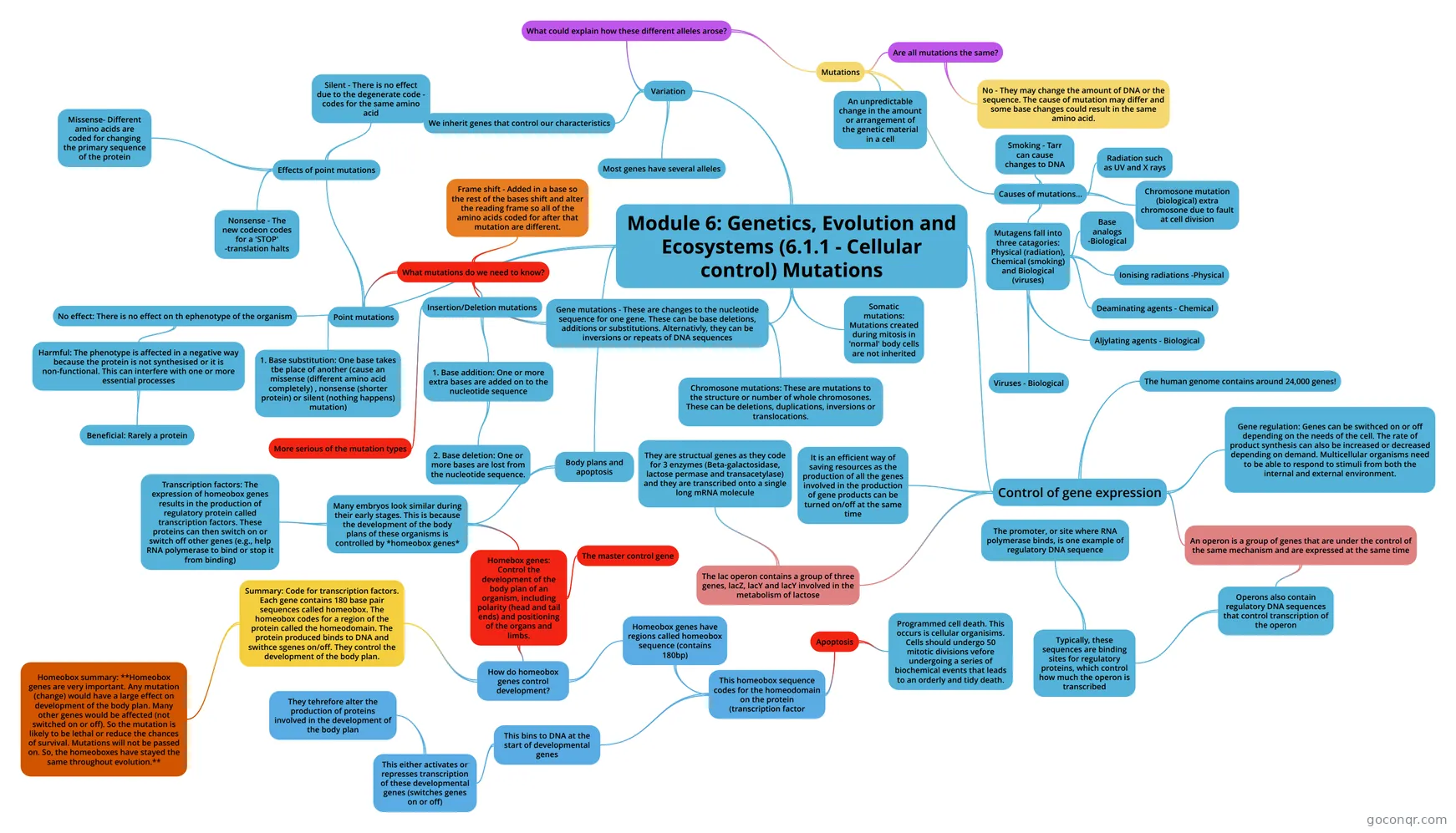
Mind map: Mutations and cellular control
Map content
Module 6: Genetics, Evolution and Ecosystems (6.1.1 - Cellular control) Mutations
Variation
- We inherit genes that control our characteristics
- Most genes have several alleles
- What could explain how these different alleles arose?
- Mutations
- An unpredictable change in the amount or arrangement of the genetic material in a cell
- Are all mutations the same?
- No - They may change the amount of DNA or the sequence. The cause of mutation may differ and some base changes could result in the same amino acid.
- Causes of mutations...
- Radiation such as UV and X rays
- Chromosone mutation (biological) extra chromosone due to fault at cell division
- Smoking - Tarr can cause changes to DNA
- Mutagens fall into three catagories: Physical (radiation), Chemical (smoking) and Biological (viruses)
- Ionising radiations -Physical
- Deaminating agents - Chemical
- Viruses - Biological
- Aljylating agents - Biological
- Base analogs -Biological
- Mutations
Gene mutations - These are changes to the nucleotide sequence for one gene. These can be base deletions, additions or substitutions. Alternativly, they can be inversions or repeats of DNA sequences
- Chromosone mutations: These are mutations to the structure or number of whole chromosones. These can be deletions, duplications, inversions or translocations.
- What mutations do we need to know?
- Point mutations
- 1. Base substitution: One base takes tbe place of another (cause an missense (different amino acid completely) , nonsense (shorter protein) or silent (nothing happens) mutation)
- Effects of point mutations
- Silent - There is no effect due to the degenerate code - codes for the same amino acid
- Nonsense - The new codeon codes for a 'STOP' -translation halts
- Missense- Different amino acids are coded for changing the primary sequence of the protein
- Insertion/Deletion mutations
- 1. Base addition: One or more extra bases are added on to the nucleotide sequence
- 2. Base deletion: One or more bases are lost from the nucleotide sequence.
- More serious of the mutation types
- 1. Base addition: One or more extra bases are added on to the nucleotide sequence
- Frame shift - Added in a base so the rest of the bases shift and alter the reading frame so all of the amino acids coded for after that mutation are different.
- Point mutations
Somatic mutations: Mutations created during mitosis in 'normal' body cells are not inherited
No effect: There is no effect on th ephenotype of the organism
- Harmful: The phenotype is affected in a negative way because the protein is not synthesised or it is non-functional. This can interfere with one or more essential processes
- Beneficial: Rarely a protein
- Harmful: The phenotype is affected in a negative way because the protein is not synthesised or it is non-functional. This can interfere with one or more essential processes
Control of gene expression
- The human genome contains around 24,000 genes!
- Gene regulation: Genes can be swithced on or off depending on the needs of the cell. The rate of product synthesis can also be increased or decreased depending on demand. Multicellular organisms need to be able to respond to stimuli from both the internal and external environment.
- An operon is a group of genes that are under the control of the same mechanism and are expressed at the same time
- Operons also contain regulatory DNA sequences that control transcription of the operon
- Typically, these sequences are binding sites for regulatory proteins, which control how much the operon is transcribed
- The promoter, or site where RNA polymerase binds, is one example of regulatory DNA sequence
- Typically, these sequences are binding sites for regulatory proteins, which control how much the operon is transcribed
- Operons also contain regulatory DNA sequences that control transcription of the operon
- It is an efficient way of saving resources as the production of all the genes involved in the production of gene products can be turned on/off at the same time
- The lac operon contains a group of three genes, lacZ, lacY and lacY involved in the metabolism of lactose
- They are structual genes as they code for 3 enzymes (Beta-galactosidase, lactose permase and transacetylase) and they are transcribed onto a single long mRNA molecule
Body plans and apoptosis
- Many embryos look similar during their early stages. This is because the development of the body plans of these organisms is controlled by *homeobox genes*
- Homebox genes: Control the development of the body plan of an organism, including polarity (head and tail ends) and positioning of the organs and limbs.
- The master control gene
- How do homeobox genes control development?
- Homeobox genes have regions called homeobox sequence (contains 180bp)
- This homeobox sequence codes for the homeodomain on the protein (transcription factor
- This bins to DNA at the start of developmental genes
- This either activates or represses transcription of these developmental genes (switches genes on or off)
- They tehrefore alter the production of proteins involved in the development of the body plan
- This either activates or represses transcription of these developmental genes (switches genes on or off)
- Apoptosis
- Programmed cell death. This occurs is cellular organisims. Cells should undergo 50 mitotic divisions vefore undergoing a series of biochemical events that leads to an orderly and tidy death.
- This bins to DNA at the start of developmental genes
- This homeobox sequence codes for the homeodomain on the protein (transcription factor
- Summary: Code for transcription factors. Each gene contains 180 base pair sequences called homeobox. The homeobox codes for a region of the protein called the homeodomain. The protein produced binds to DNA and swithce sgenes on/off. They control the development of the body plan.
- Homeobox summary: **Homeobox genes are very important. Any mutation (change) would have a large effect on development of the body plan. Many other genes would be affected (not switched on or off). So the mutation is likely to be lethal or reduce the chances of survival. Mutations will not be passed on. So, the homeoboxes have stayed the same throughout evolution.**
- Homeobox genes have regions called homeobox sequence (contains 180bp)
- Transcription factors: The expression of homeobox genes results in the production of regulatory protein called transcription factors. These proteins can then switch on or switch off other genes (e.g., help RNA polymerase to bind or stop it from binding)
- Homebox genes: Control the development of the body plan of an organism, including polarity (head and tail ends) and positioning of the organs and limbs.
- Many embryos look similar during their early stages. This is because the development of the body plans of these organisms is controlled by *homeobox genes*
Information
- Description
- A level Biology Mind Map on Module 6: Genetics, Evolution and Ecosystems (6.1.1 - Cellular control) Mutations, created by macey steff on 08/03/2022.
- Created by
- macey steff
- Views
- 0
- Rating