
Mind map
Fluid and Electrolytes
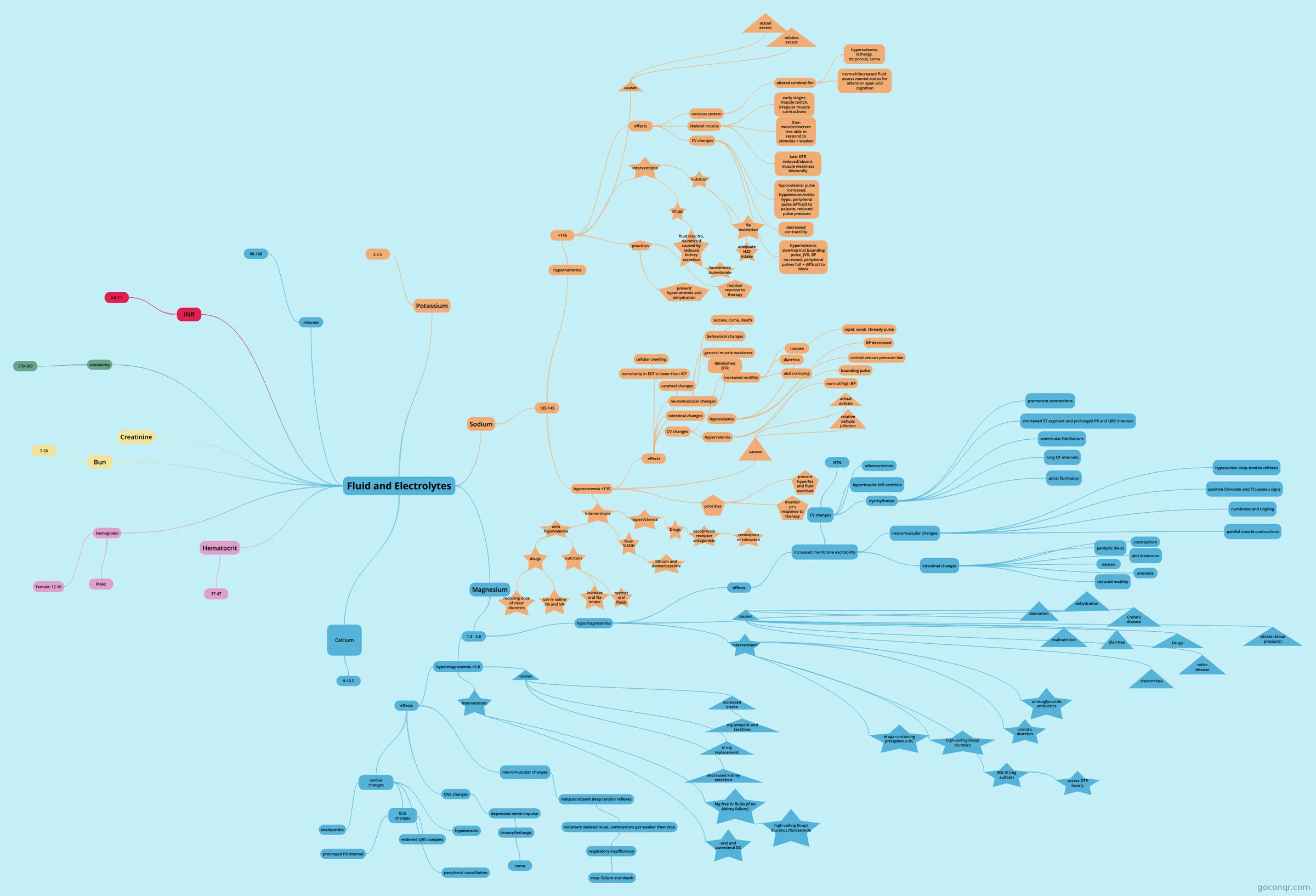
Mind map: Fluid and electrolytes
Map content
Fluid and Electrolytes
Calcium
- 9-10.5
Sodium
- 135-145
- hyponatremia <135
- effects
- osmolarity in ECF is lower than ICF
- cellular swelling
- cerebral changes
- behavioral changes
- seizure, coma, death
- behavioral changes
- neuromuscular changes
- general muscle weakness
- diminished DTR
- intestinal changes
- increased motility
- nausea
- diarrhea
- abd cramping
- increased motility
- CV changes
- hypovolemia
- rapid, weak, thready pulse
- BP decreased
- central venous pressure low
- hypervolemia
- bounding pulse
- normal/high BP
- hypovolemia
- osmolarity in ECF is lower than ICF
- causes
- actual deficits
- sweating diuretics wound drainage (GI especially) decreased aldosterone secretion hyperlipidemia kidney disease NPO low Na diet cerebral salt-wasting syndrome hyperglycemia
- relative deficits (dilution
- excess hypotonic fluids psychogenic polydipsia freshwater submersion accident kidney failure irrigation with hypotonic fluids SIADH HF
- actual deficits
- interventions
- with hypoVolemia
- drugs
- reducing dose of most diuretics
- use iv saline 3% and 5%
- nutrition
- increase oral Na intake
- restrict oral fluids
- drugs
- hyperVolemia
- Drugs
- vasopressin receptor antagonists
- conivaptan or tolvaptan
- vasopressin receptor antagonists
- Drugs
- from SIADH
- lithium and demeclocycline
- assess q1h for excess fluid loss, K loss, and increased Na levels
- lithium and demeclocycline
- with hypoVolemia
- priorities
- monitor pt's response to therapy
- prevent hyperNa and fluid overload
- effects
- hypernatremia
- >145
- effects
- nervous system
- altered cerebral fxn
- normal/decreased fluid: assess mental status for attention span and cognition
- hypervolemia: lethargy, stuporous, coma
- altered cerebral fxn
- skeletal muscle
- early stages: muscle twitch, irregular muscle contractions
- then muscles/nerves less able to respond to stimulus > weaker
- late: DTR reduced/absent, muscle weakness bilaterally
- CV changes
- decreased contractility
- hypovolemia: pulse increased, hypotension/ortho hypo, peripheral pulse difficult to palpate, reduced pulse pressure
- hypervolemia: slow/normal bounding pulse, JVD, BP increased, peripheral pulses full + difficult to block
- nervous system
- causes
- actual excess
- hyperaldosteronism kidney failure corticosteroids cushing's excess oral intake excess administration of Na IV fluids
- relative excess
- NPO increased metabolism fever hyperventilation infection excess diaphoresis watery diarrhea dehydration
- actual excess
- interventions
- drugs
- fluid loss: NS, diuretics if caused by reduced kidney excretion
- furosemide bumetanide
- fluid loss: NS, diuretics if caused by reduced kidney excretion
- nutrition
- adequate H20 intake
- Na restriction
- drugs
- priorities
- monitor reponse to therapy
- prevent hyponatremia and dehydration
- effects
- >145
- hyponatremia <135
- 135-145
Potassium
- 3.5-5
Bun
- 7-20
Creatinine
Hemoglobin
- Female: 12-16
- Male:
Hematocrit
- 37-47
INR
- 0.8-1.1
Magnesium
- 1.3 - 2.6
- hypermagnesemia >2.6
- Interventions
- oral and parenteral DC
- Mg free IV fluids (if no kidney failure)
- high-ceiling (loop) diuretics (furosemide
- effects
- cardiac changes
- bradycardia
- peripheral vasodilation
- hypotension
- ECG changes
- prolonged PR interval
- widened QRS complex
- CNS changes
- depressed nerve impulse
- drowsy/lethargic
- coma
- drowsy/lethargic
- depressed nerve impulse
- neuromuscular changes
- reduced/absent deep tendon reflexes
- voluntary skeletal musc. contractions get weaker then stop
- respiratory insufficiency
- resp. failure and death
- respiratory insufficiency
- voluntary skeletal musc. contractions get weaker then stop
- reduced/absent deep tendon reflexes
- cardiac changes
- causes
- increased intake
- mg antacids and laxatives
- iv mg replacement
- decreased kidney excretion
- increased intake
- Interventions
- hypomagnesemia
- causes
- malnutrition
- starvation
- dehydration
- diarrhea
- steatorrhea
- celiac disease
- Crohn's disease
- Drugs
- (diuretics, aminoglycoside antibiotics, cisplatin, ampho.b, cyclosporine)
- citrate (blood products)
- effects
- increased membrane excitability
- CV changes
- HTN
- atherosclerosis
- hypertrophic left ventricle
- dysrhythmias
- premature contractions
- atrial fibrillation
- ventricular fibrillations
- long QT intervals
- shortened ST segment and prolonged PR and QRS intervals
- neuromuscular changes
- hyperactive deep tendon reflexes
- numbness and tingling
- painful muscle contractions
- positive Chvostek and Trousseau signs
- intestinal changes
- reduced motility
- anorexia
- nausea
- constipation
- abd distension
- paralytic illeus
- CV changes
- increased membrane excitability
- interventions
- high-ceiling (loop) diuretics
- osmotic diuretics
- aminoglycoside antibiotics
- drugs containing phosphorus DC
- MG IV (mg sulfate)
- assess DTR hourly
- causes
- hypermagnesemia >2.6
- 1.3 - 2.6
chloride
- 98-106
osmolarity
- 270-300
Information
- Description
- Nursing Mind Map on Fluid and Electrolytes, created by Reagan Martin on 19/08/2022.
- Created by
- Reagan Martin
- Views
- 6
- Rating
More on Fluid and Electrolyte Imbalances