
Mind map
Democracy
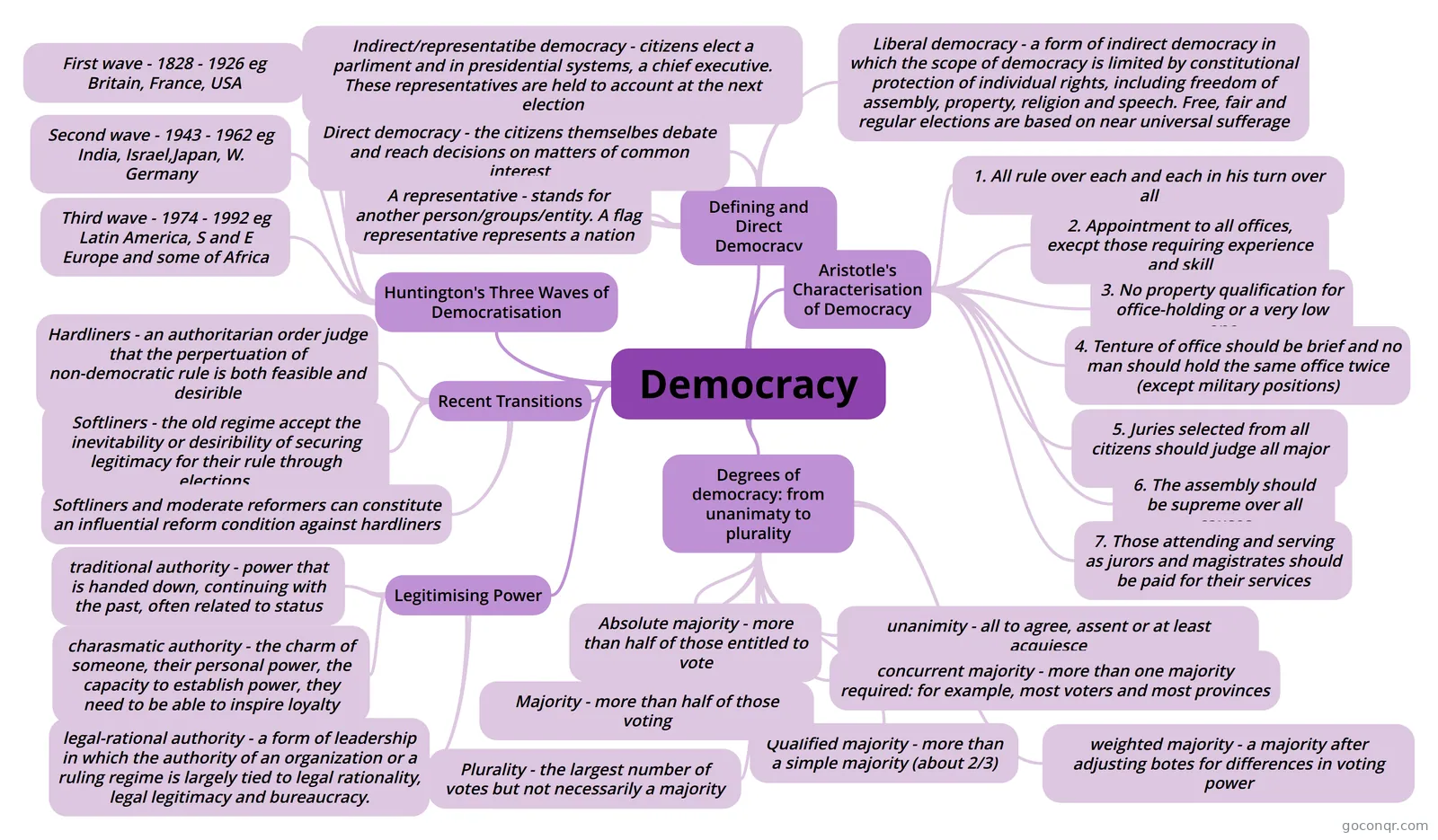
Mind map: democracy
Map content
Democracy
Defining and Direct Democracy
- Direct democracy - the citizens themselbes debate and reach decisions on matters of common interest
- Indirect/representatibe democracy - citizens elect a parliment and in presidential systems, a chief executive. These representatives are held to account at the next election
- Liberal democracy - a form of indirect democracy in which the scope of democracy is limited by constitutional protection of individual rights, including freedom of assembly, property, religion and speech. Free, fair and regular elections are based on near universal sufferage
- A representative - stands for another person/groups/entity. A flag representative represents a nation
Aristotle's Characterisation of Democracy
- 1. All rule over each and each in his turn over all
- 2. Appointment to all offices, execpt those requiring experience and skill
- 3. No property qualification for office-holding or a very low one
- 4. Tenture of office should be brief and no man should hold the same office twice (except military positions)
- 5. Juries selected from all citizens should judge all major causes
- 6. The assembly should be supreme over all causes
- 7. Those attending and serving as jurors and magistrates should be paid for their services
Degrees of democracy: from unanimaty to plurality
- unanimity - all to agree, assent or at least acquiesce
- concurrent majority - more than one majority required: for example, most voters and most provinces
- Qualified majority - more than a simple majority (about 2/3)
- weighted majority - a majority after adjusting botes for differences in voting power
- Absolute majority - more than half of those entitled to vote
- Majority - more than half of those voting
- Plurality - the largest number of votes but not necessarily a majority
Huntington's Three Waves of Democratisation
- First wave - 1828 - 1926 eg Britain, France, USA
- Second wave - 1943 - 1962 eg India, Israel,Japan, W. Germany
- Third wave - 1974 - 1992 eg Latin America, S and E Europe and some of Africa
Recent Transitions
- Hardliners - an authoritarian order judge that the perpertuation of non-democratic rule is both feasible and desirible
- Softliners - the old regime accept the inevitability or desiribility of securing legitimacy for their rule through elections.
- Softliners and moderate reformers can constitute an influential reform condition against hardliners
Legitimising Power
- traditional authority - power that is handed down, continuing with the past, often related to status
- charasmatic authority - the charm of someone, their personal power, the capacity to establish power, they need to be able to inspire loyalty
- legal-rational authority - a form of leadership in which the authority of an organization or a ruling regime is largely tied to legal rationality, legal legitimacy and bureaucracy.
Information
- Description
- Mind Map on Democracy, created by franvmiller on 08/12/2015.
- Created by
- franvmiller
- Views
- 2
- Rating