
Mind map
DNA and RNA: Biophysical Properties
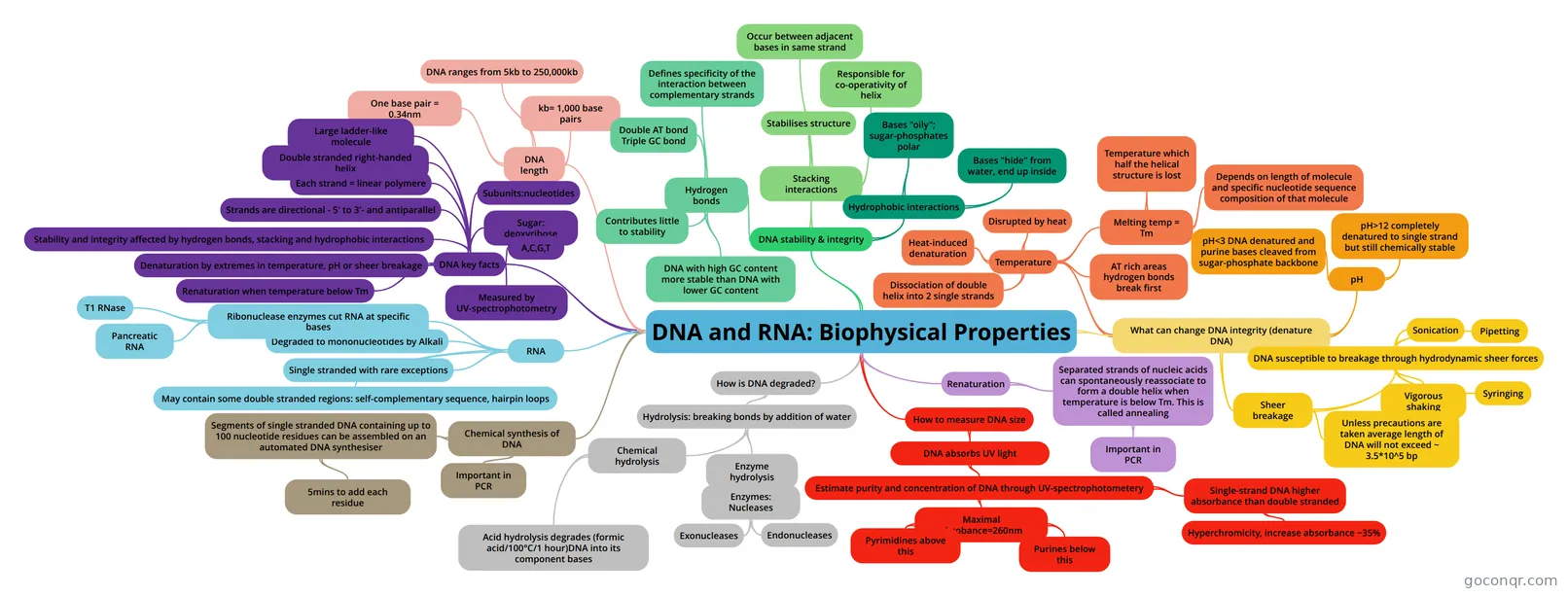
Mind map: DNA and RNA biophysical properties
Map content
DNA and RNA: Biophysical Properties
DNA length
- One base pair = 0.34nm
- DNA ranges from 5kb to 250,000kb
- kb= 1,000 base pairs
DNA stability & integrity
- Hydrogen bonds
- Double AT bond Triple GC bond
- DNA with high GC content more stable than DNA with lower GC content
- Contributes little to stability
- Defines specificity of the interaction between complementary strands
- Stacking interactions
- Occur between adjacent bases in same strand
- Stabilises structure
- Responsible for co-operativity of helix
- Hydrophobic interactions
- Bases "oily"; sugar-phosphates polar
- Bases "hide" from water, end up inside
- Hydrogen bonds
What can change DNA integrity (denature DNA)
- Temperature
- Disrupted by heat
- Dissociation of double helix into 2 single strands
- Heat-induced denaturation
- AT rich areas hydrogen bonds break first
- Melting temp = Tm
- Temperature which half the helical structure is lost
- Depends on length of molecule and specific nucleotide sequence composition of that molecule
- pH
- pH<3 DNA denatured and purine bases cleaved from sugar-phosphate backbone
- pH>12 completely denatured to single strand but still chemically stable
- Sheer breakage
- DNA susceptible to breakage through hydrodynamic sheer forces
- Sonication
- Pipetting
- Vigorous shaking
- Syringing
- Unless precautions are taken average length of DNA will not exceed ~ 3.5*10^5 bp
- DNA susceptible to breakage through hydrodynamic sheer forces
- Temperature
Renaturation
- Separated strands of nucleic acids can spontaneously reassociate to form a double helix when temperature is below Tm. This is called annealing
- Important in PCR
- Separated strands of nucleic acids can spontaneously reassociate to form a double helix when temperature is below Tm. This is called annealing
How to measure DNA size
- DNA absorbs UV light
- Estimate purity and concentration of DNA through UV-spectrophotometery
- Maximal absobance=260nm
- Purines below this
- Pyrimidines above this
- Single-strand DNA higher absorbance than double stranded
- Hyperchromicity, increase absorbance ~35%
- Maximal absobance=260nm
- Estimate purity and concentration of DNA through UV-spectrophotometery
- DNA absorbs UV light
How is DNA degraded?
- Hydrolysis: breaking bonds by addition of water
- Chemical hydrolysis
- Acid hydrolysis degrades (formic acid/100°C/1 hour)DNA into its component bases
- Enzyme hydrolysis
- Enzymes: Nucleases
- Exonucleases
- Endonucleases
- Enzymes: Nucleases
- Chemical hydrolysis
- Hydrolysis: breaking bonds by addition of water
Chemical synthesis of DNA
- Segments of single stranded DNA containing up to 100 nucleotide residues can be assembled on an automated DNA synthesiser
- 5mins to add each residue
- Important in PCR
- Segments of single stranded DNA containing up to 100 nucleotide residues can be assembled on an automated DNA synthesiser
RNA
- Single stranded with rare exceptions
- May contain some double stranded regions: self-complementary sequence, hairpin loops
- Degraded to mononucleotides by Alkali
- Ribonuclease enzymes cut RNA at specific bases
- Pancreatic RNA
- T1 RNase
DNA key facts
- Large ladder-like molecule
- Double stranded right-handed helix
- Each strand = linear polymere
- Strands are directional - 5' to 3'- and antiparallel
- Subunits:nucleotides
- Sugar: deoxyribose
- A,C,G,T
- Stability and integrity affected by hydrogen bonds, stacking and hydrophobic interactions
- Denaturation by extremes in temperature, pH or sheer breakage
- Renaturation when temperature below Tm
- Measured by UV-spectrophotometry
Information
- Description
- Bachelors Genetics Mind Map on DNA and RNA: Biophysical Properties, created by Colleen Curley on 03/01/2016.
- Created by
- Colleen Curley
- Views
- 0
- Rating
More on DNA and RNA Structure and Properties