
Mind map
Forced Loan and Five Knights Case
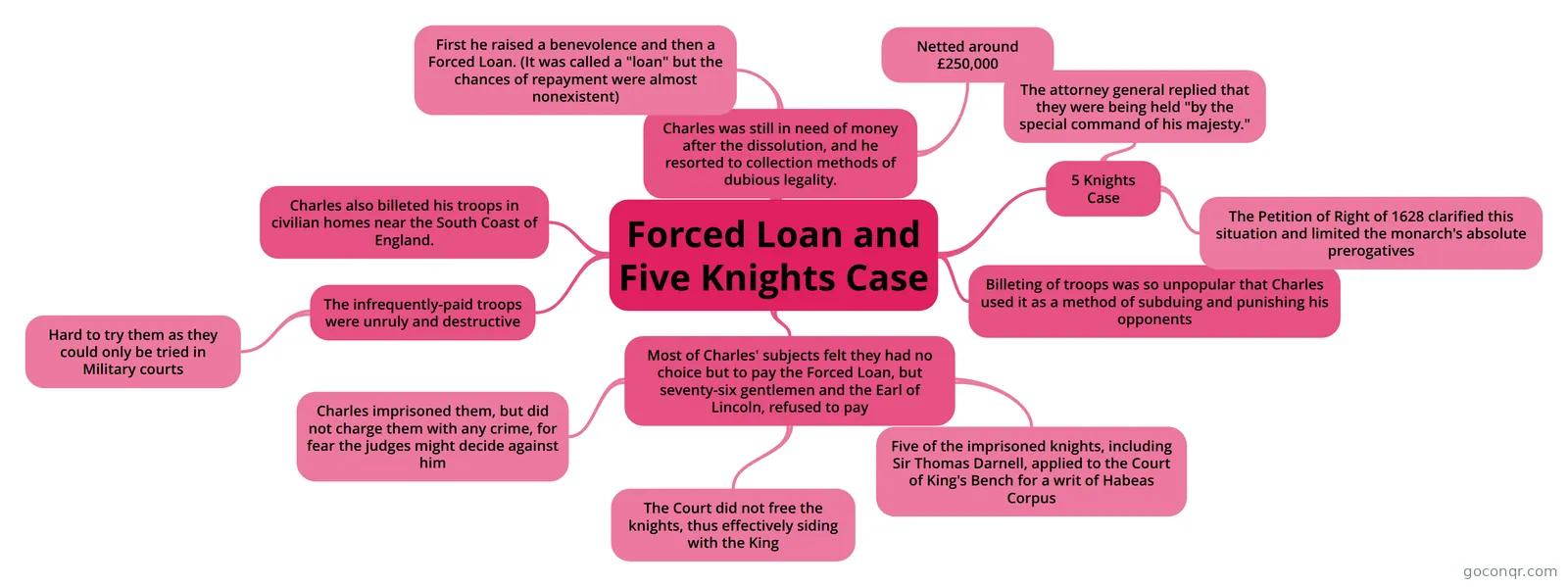
Mind map: Forced Loan and Five Knights Case
Map content
Forced Loan and Five Knights Case
Charles was still in need of money after the dissolution, and he resorted to collection methods of dubious legality.
- First he raised a benevolence and then a Forced Loan. (It was called a "loan" but the chances of repayment were almost nonexistent)
- Netted around £250,000
Charles also billeted his troops in civilian homes near the South Coast of England.
The infrequently-paid troops were unruly and destructive
- Hard to try them as they could only be tried in Military courts
Billeting of troops was so unpopular that Charles used it as a method of subduing and punishing his opponents
Most of Charles' subjects felt they had no choice but to pay the Forced Loan, but seventy-six gentlemen and the Earl of Lincoln, refused to pay
- Charles imprisoned them, but did not charge them with any crime, for fear the judges might decide against him
- Five of the imprisoned knights, including Sir Thomas Darnell, applied to the Court of King's Bench for a writ of Habeas Corpus
- The Court did not free the knights, thus effectively siding with the King
5 Knights Case
- The attorney general replied that they were being held "by the special command of his majesty."
- The Petition of Right of 1628 clarified this situation and limited the monarch's absolute prerogatives
Information
- Description
- History AS (Crown, Parliament and Authority) (Charles I) Mind Map on Forced Loan and Five Knights Case, created by Katie Difford on 12/04/2013.
- Created by
- Katie Difford
- Views
- 189
- Tags
- Rating