
Mind map
Structures and Properties of Matter
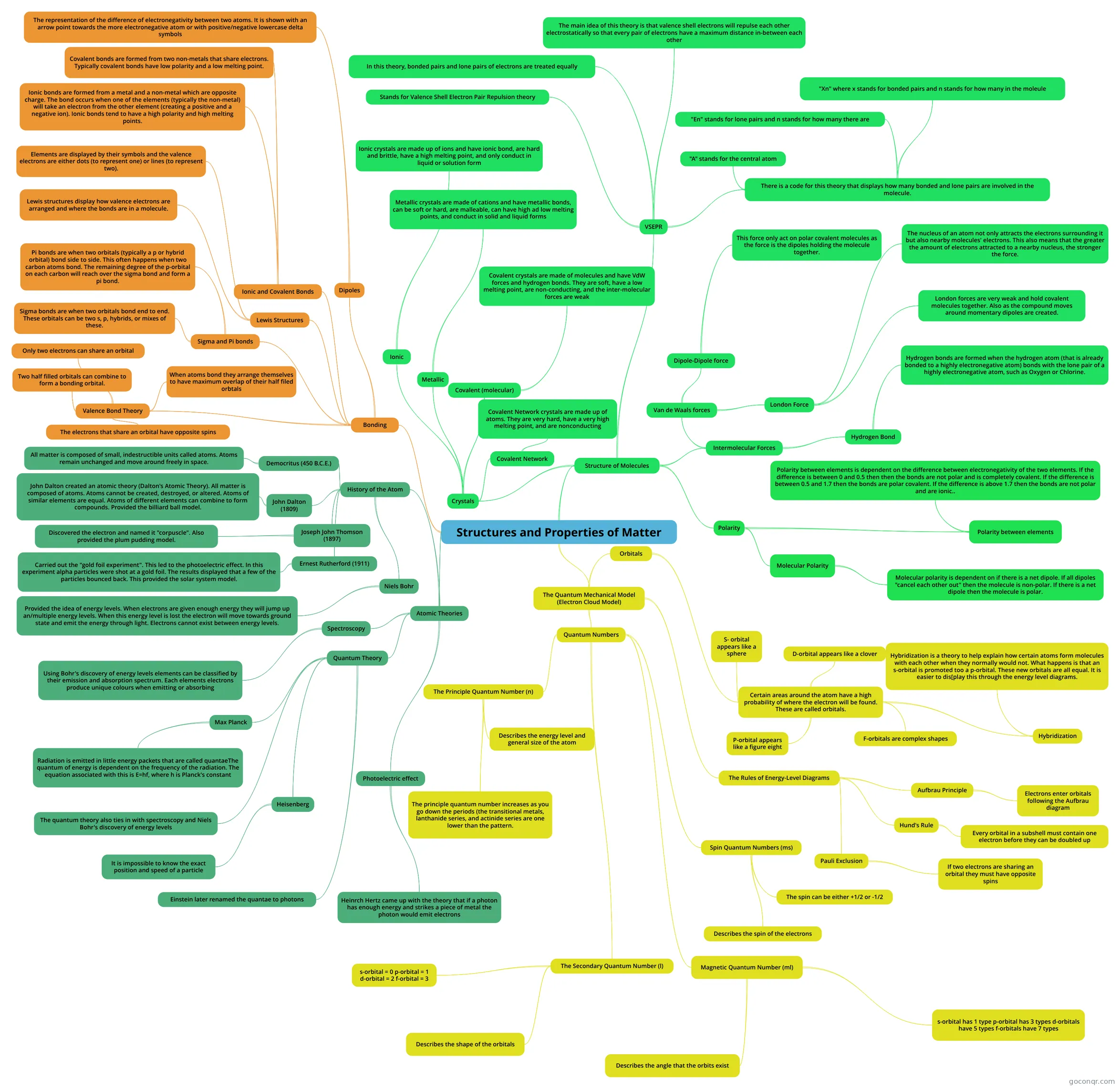
Mind map: Structures and properties of matter
Map content
Structures and Properties of Matter
Bonding
- Valence Bond Theory
- Two half filled orbitals can combine to form a bonding orbital.
- The electrons that share an orbital have opposite spins
- Only two electrons can share an orbital
- When atoms bond they arrange themselves to have maximum overlap of their half filed orbtals
- Sigma and Pi bonds
- Sigma bonds are when two orbitals bond end to end. These orbitals can be two s, p, hybrids, or mixes of these.
- Pi bonds are when two orbitals (typically a p or hybrid orbital) bond side to side. This often happens when two carbon atoms bond. The remaining degree of the p-orbital on each carbon will reach over the sigma bond and form a pi bond.
- Lewis Structures
- Lewis structures display how valence electrons are arranged and where the bonds are in a molecule.
- Elements are displayed by their symbols and the valence electrons are either dots (to represent one) or lines (to represent two).
- Ionic and Covalent Bonds
- Ionic bonds are formed from a metal and a non-metal which are opposite charge. The bond occurs when one of the elements (typically the non-metal) will take an electron from the other element (creating a positive and a negative ion). Ionic bonds tend to have a high polarity and high melting points.
- Covalent bonds are formed from two non-metals that share electrons. Typically covalent bonds have low polarity and a low melting point.
- Dipoles
- The representation of the difference of electronegativity between two atoms. It is shown with an arrow point towards the more electronegative atom or with positive/negative lowercase delta symbols
- Valence Bond Theory
Structure of Molecules
- Polarity
- Polarity between elements
- Polarity between elements is dependent on the difference between electronegativity of the two elements. If the difference is between 0 and 0.5 then then the bonds are not polar and is completely covalent. If the difference is between 0.5 and 1.7 then the bonds are polar covalent. If the difference is above 1.7 then the bonds are not polar and are ionic..
- Molecular Polarity
- Molecular polarity is dependent on if there is a net dipole. If all dipoles "cancel each other out" then the molecule is non-polar. If there is a net dipole then the molecule is polar.
- Polarity between elements
- Intermolecular Forces
- Van de Waals forces
- Dipole-Dipole force
- This force only act on polar covalent molecules as the force is the dipoles holding the molecule together.
- London Force
- The nucleus of an atom not only attracts the electrons surrounding it but also nearby molecules' electrons. This also means that the greater the amount of electrons attracted to a nearby nucleus, the stronger the force.
- London forces are very weak and hold covalent molecules together. Also as the compound moves around momentary dipoles are created.
- Dipole-Dipole force
- Hydrogen Bond
- Hydrogen bonds are formed when the hydrogen atom (that is already bonded to a highly electronegative atom) bonds with the lone pair of a highly electronegative atom, such as Oxygen or Chlorine.
- Van de Waals forces
- Crystals
- Ionic
- Ionic crystals are made up of ions and have ionic bond, are hard and brittle, have a high melting point, and only conduct in liquid or solution form
- Metallic
- Metallic crystals are made of cations and have metallic bonds, can be soft or hard, are malleable, can have high ad low melting points, and conduct in solid and liquid forms
- Covalent (molecular)
- Covalent crystals are made of molecules and have VdW forces and hydrogen bonds. They are soft, have a low melting point, are non-conducting, and the inter-molecular forces are weak
- Covalent Network
- Covalent Network crystals are made up of atoms. They are very hard, have a very high melting point, and are nonconducting
- Ionic
- VSEPR
- Stands for Valence Shell Electron Pair Repulsion theory
- In this theory, bonded pairs and lone pairs of electrons are treated equally
- The main idea of this theory is that valence shell electrons will repulse each other electrostatically so that every pair of electrons have a maximum distance in-between each other
- There is a code for this theory that displays how many bonded and lone pairs are involved in the molecule.
- "A" stands for the central atom
- "Xn" where x stands for bonded pairs and n stands for how many in the moleule
- "En" stands for lone pairs and n stands for how many there are
- Polarity
Atomic Theories
- History of the Atom
- Democritus (450 B.C.E.)
- All matter is composed of small, indestructible units called atoms. Atoms remain unchanged and move around freely in space.
- John Dalton (1809)
- John Dalton created an atomic theory (Dalton's Atomic Theory). All matter is composed of atoms. Atoms cannot be created, destroyed, or altered. Atoms of similar elements are equal. Atoms of different elements can combine to form compounds. Provided the billiard ball model.
- Joseph John Thomson (1897)
- Discovered the electron and named it "corpuscle". Also provided the plum pudding model.
- Ernest Rutherford (1911)
- Carried out the "gold foil experiment". This led to the photoelectric effect. In this experiment alpha particles were shot at a gold foil. The results displayed that a few of the particles bounced back. This provided the solar system model.
- Niels Bohr
- Provided the idea of energy levels. When electrons are given enough energy they will jump up an/multiple energy levels. When this energy level is lost the electron will move towards ground state and emit the energy through light. Electrons cannot exist between energy levels.
- Democritus (450 B.C.E.)
- Spectroscopy
- Using Bohr's discovery of energy levels elements can be classified by their emission and absorption spectrum. Each elements electrons produce unique colours when emitting or absorbing
- Quantum Theory
- The quantum theory also ties in with spectroscopy and Niels Bohr's discovery of energy levels
- Max Planck
- Radiation is emitted in little energy packets that are called quantaeThe quantum of energy is dependent on the frequency of the radiation. The equation associated with this is E=hf, where h is Planck's constant
- Einstein later renamed the quantae to photons
- Heisenberg
- It is impossible to know the exact position and speed of a particle
- Photoelectric effect
- Heinrch Hertz came up with the theory that if a photon has enough energy and strikes a piece of metal the photon would emit electrons
- History of the Atom
The Quantum Mechanical Model (Electron Cloud Model)
- Quantum Numbers
- The Principle Quantum Number (n)
- Describes the energy level and general size of the atom
- The principle quantum number increases as you go down the periods (the transitional metals, lanthanide series, and actinide series are one lower than the pattern.
- The Secondary Quantum Number (l)
- Describes the shape of the orbitals
- s-orbital = 0 p-orbital = 1 d-orbital = 2 f-orbital = 3
- Magnetic Quantum Number (ml)
- Describes the angle that the orbits exist
- s-orbital has 1 type p-orbital has 3 types d-orbitals have 5 types f-orbitals have 7 types
- Spin Quantum Numbers (ms)
- Describes the spin of the electrons
- The spin can be either +1/2 or -1/2
- The Principle Quantum Number (n)
- The Rules of Energy-Level Diagrams
- Pauli Exclusion
- If two electrons are sharing an orbital they must have opposite spins
- Hund's Rule
- Every orbital in a subshell must contain one electron before they can be doubled up
- Aufbrau Principle
- Electrons enter orbitals following the Aufbrau diagram
- Pauli Exclusion
- Orbitals
- Certain areas around the atom have a high probability of where the electron will be found. These are called orbitals.
- S- orbital appears like a sphere
- P-orbital appears like a figure eight
- D-orbital appears like a clover
- F-orbitals are complex shapes
- Hybridization
- Hybridization is a theory to help explain how certain atoms form molecules with each other when they normally would not. What happens is that an s-orbital is promoted too a p-orbital. These new orbitals are all equal. It is easier to dis[play this through the energy level diagrams.
- Certain areas around the atom have a high probability of where the electron will be found. These are called orbitals.
- Quantum Numbers
Information
- Description
- grade 12 Chemistry Mind Map on Structures and Properties of Matter, created by Ethan Philion on 07/03/2016.
- Created by
- Ethan Philion
- Views
- 0
- Rating