
Mind map
The Mass Media and Audiences
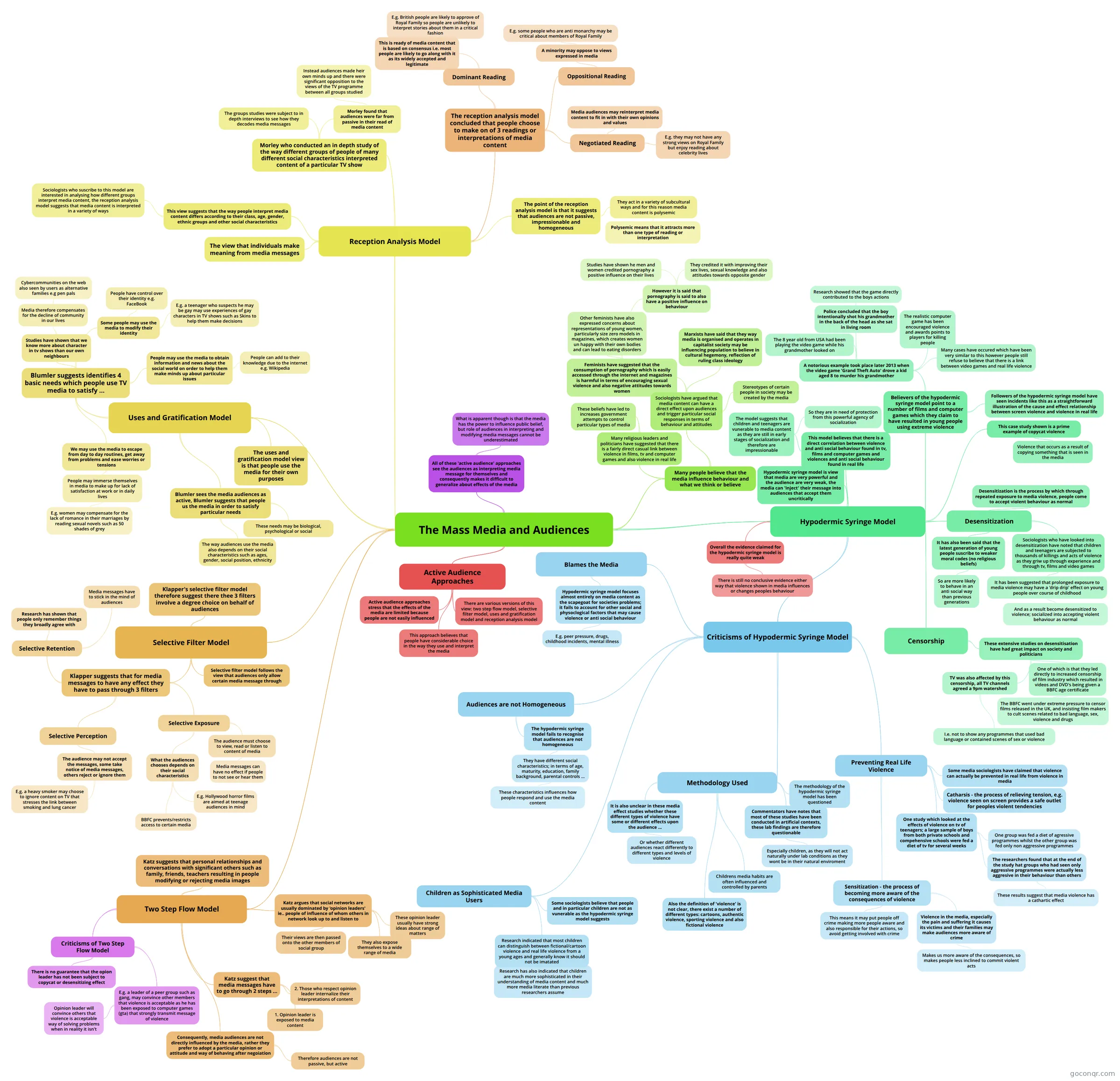
Mind map: The mass media and audiences
Map content
The Mass Media and Audiences
Many people believe that the media influence behaviour and what we think or believe
- Many religious leaders and politicians have suggested that there is a fairly direct casual link between violence in films, tv and computer games and also violence in real life
- These beliefs have led to increases government attempts to control particular types of media
- Sociologists have argued that media content can have a direct effect upon audiences and trigger particular social responses in terms of behaviour and attitudes
- Feminists have suggested that the consumption of pornography which is easily accessed through the internet and magazines is harmful in terms of encouraging sexual violence and also negative attitudes towards women
- Other feminists have also expressed concerns about representations of young women, particularly size zero models in magazines, which creates women un happy with their own bodies and can lead to eating disorders
- However it is said that pornography is said to also have a positive influence on behaviour
- Studies have shown he men and women credited pornography a positive influence on their lives
- They credited it with improving their sex lives, sexual knowledge and also attitudes towards opposite gender
- Marxists have said that they way media is organised and operates in capitalist society may be influencing population to believe in cultural hegemony, reflection of ruling class ideology
- Stereotypes of certain people in society may be created by the media
- Feminists have suggested that the consumption of pornography which is easily accessed through the internet and magazines is harmful in terms of encouraging sexual violence and also negative attitudes towards women
- Many religious leaders and politicians have suggested that there is a fairly direct casual link between violence in films, tv and computer games and also violence in real life
Hypodermic Syringe Model
- Hypodermic syringe model is view that media are very powerful and the audience are very weak, the media can 'inject' their message into audiences that accept them uncritically
- This model believes that there is a direct correlation between violence and anti social behaviour found in tv, films and computer games and violences and anti social behaviour found in real life
- The model suggests that children and teenagers are vunerable to media content as they are still in early stages of socialization and therefore are impressionable
- So they are in need of protection from this powerful agency of socialization
- The model suggests that children and teenagers are vunerable to media content as they are still in early stages of socialization and therefore are impressionable
- Believers of the hypodermic syringe model point to a number of films and computer games which they claim to have resulted in young people using extreme violence
- A notorious example took place later 2013 when the video game 'Grand Theft Auto' drove a kid aged 8 to murder his grandmother
- The 8 year old from USA had been playing the video game while his grandmother looked on
- Police concluded that the boy intentionally shot his grandmother in the back of the head as she sat in living room
- Research showed that the game directly contributed to the boys actions
- The realistic computer game has been encouraged violence and awards points to players for killing people
- Many cases have occured which have been very similar to this however people still refuse to believe that there is a link between video games and real life violence
- Followers of the hypodermic syringe model have seen incidents like this as a straightforward illustration of the cause and effect relationship between screen violence and violence in real life
- A notorious example took place later 2013 when the video game 'Grand Theft Auto' drove a kid aged 8 to murder his grandmother
- This case study shown is a prime example of copycat violence
- Violence that occurs as a result of copying something that is seen in the media
- Desensitization
- Desensitization is the process by which through repeated exposure to media violence, people come to accept violent behaviour as normal
- Sociologists who have looked into desensitization have noted that children and teenagers are subjected to thousands of killings and acts of violence as they griw up through experience and through tv, films and video games
- It has been suggested that prolonged exposure to media violence may have a 'drip drip' effect on young people over course of childhood
- And as a result become desensitized to violence; socialized into accepting violent behaviour as normal
- It has been suggested that prolonged exposure to media violence may have a 'drip drip' effect on young people over course of childhood
- It has also been said that the latest generation of young people suscribe to weaker moral codes (no religious beliefs)
- So are more likely to behave in an anti social way than previous generations
- Censorship
- These extensive studies on desensitisation have had great impact on society and politicians
- One of which is that they led directly to increased censorship of film industry which resulted in videos and DVD's being given a BBFC age certificate
- The BBFC went under extreme pressure to censor films released in the UK, and insisting film makers to cult scenes related to bad language, sex, violence and drugs
- TV was also affected by this censorship, all TV channels agreed a 9pm watershed
- I.e. not to show any programmes that used bad language or contained scenes of sex or violence
- One of which is that they led directly to increased censorship of film industry which resulted in videos and DVD's being given a BBFC age certificate
- These extensive studies on desensitisation have had great impact on society and politicians
- Criticisms of Hypodermic Syringe Model
- Preventing Real Life Violence
- Some media sociologists have claimed that violence can actually be prevented in real life from violence in media
- Catharsis - the process of relieving tension, e.g. violence seen on screen provides a safe outlet for peoples violent tendencies
- One study which looked at the effects of violence on tv of teenagers; a large sample of boys from both private schools and compehensive schools were fed a diet of tv for several weeks
- One group was fed a diet of agressive programmes whilst the other group was fed only non aggressive programmes
- The researchers found that at the end of the study hat groups who had seen only aggressive programmes were actually less aggresive in their behaviour than others
- These results suggest that media violence has a cathartic effect
- Sensitization - the process of becoming more aware of the consequences of violence
- Violence in the media, especially the pain and suffering it causes its victims and their families may make audiences more aware of crime
- Makes us more aware of the consequences, so makes people less inclined to commit violent acts
- This means it may put people off crime making more people aware and also responsible for their actions, so avoid getting involved with crime
- Violence in the media, especially the pain and suffering it causes its victims and their families may make audiences more aware of crime
- Methodology Used
- The methodology of the hypodermic syringe model has been questioned
- Commentators have notes that most of these studies have been conducted in artificial contexts, these lab findings are therefore questionable
- Especially children, as they will not act naturally under lab conditions as they wont be in their natural enviroment
- Childrens media habits are often influenced and controlled by parents
- Also the definition of 'violence' is not clear, there exist a number of different types: cartoons, authentic violence, sporting violence and also fictional violence
- It is also unclear in these media effect studies whether these different types of violence have some or different effects upon the audience ...
- Or whether different audiences react differently to different types and levels of violence
- Children as Sophisticated Media Users
- Some sociologists believe that people and in particular children are not as vunerable as the hypodermic syringe model suggests
- Research indicated that most children can distinguish between fictional/cartoon violence and real life violence from a young ages and generally know it should not be imatated
- Research has also indicated that children are much more sophisticated in their understanding of media content and much more media literate than previous researchers assume
- Audiences are not Homogeneous
- The hypodermic syringe model fails to recognise that audiences are not homogeneous
- They have different social characteristics; in terms of age, maturity, education, family background, parental controls ...
- These characteristics influences how people respond and use the media content
- They have different social characteristics; in terms of age, maturity, education, family background, parental controls ...
- The hypodermic syringe model fails to recognise that audiences are not homogeneous
- Blames the Media
- Hypodermic syringe model focuses almost entirely on media content as the scapegoat for societies problems; it fails to account for other social and physoclogical factors that may cause violence or anti social behaviour
- E.g. peer pressure, drugs, childhood incidents, mental illness
- Hypodermic syringe model focuses almost entirely on media content as the scapegoat for societies problems; it fails to account for other social and physoclogical factors that may cause violence or anti social behaviour
- Preventing Real Life Violence
- Overall the evidence claimed for the hypodermic syringe model is really quite weak
- There is still no conclusive evidence either way that violence shown in media influences or changes peoples behaviour
Two Step Flow Model
- Katz suggests that personal relationships and conversations with significant others such as family, friends, teachers resulting in people modifying or rejecting media images
- Katz argues that social networks are usually dominated by 'opinion leaders' ie.. people of influence of whom others in network look up to and listen to
- These opinion leader usually have strong ideas about range of matters
- They also expose themselves to a wide range of media
- Their views are then passed onto the other members of social group
- Katz suggest that media messages have to go through 2 steps ...
- 1. Opinion leader is exposed to media content
- 2. Those who respect opinion leader internalize their interpretations of content
- Consequently, media audiences are not directly influenced by the media, rather they prefer to adopt a particular opinion or attitude and way of behaving after negoiation
- Therefore audiences are not passive, but active
- Criticisms of Two Step Flow Model
- There is no guarantee that the opion leader has not been subject to copycat or desensitizing effect
- E.g. a leader of a peer group such as gang, may convince other members that violence is acceptable as he has been exposed to computer games (gta) that strongly transmit message of violence
- Opinion leader will convince others that violence is acceptable way of solving problems when in reality it isn't
Active Audience Approaches
- Active audience approaches stress that the effects of the media are limited because people are not easily influenced
- This approach believes that people have considerable choice in the way they use and interpret the media
- There are various versions of this view: two step flow model, selective filter model, uses and gratification model and reception analysis model
Selective Filter Model
- Selective filter model follows the view that audiences only allow certain media message through
- Klapper suggests that for media messages to have any effect they have to pass through 3 filters
- Selective Exposure
- The audience must choose to view, read or listen to content of media
- Media messages can have no effect if people to not see or hear them
- What the audiences chooses depends on their social characteristics
- E.g. Hollywood horror films are aimed at teenage audiences in mind
- BBFC prevents/restricts access to certain media
- The audience must choose to view, read or listen to content of media
- Selective Perception
- The audience may not accept the messages, some take notice of media messages, others reject or ignore them
- E.g. a heavy smoker may choose to ignore content on TV that stresses the link between smoking and lung cancer
- The audience may not accept the messages, some take notice of media messages, others reject or ignore them
- Selective Retention
- Research has shown that people only remember things they broadly agree with
- Media messages have to stick in the mind of audiences
- Selective Exposure
- Klapper's selective filter model therefore suggest there thee 3 filters involve a degree choice on behalf of audiences
Uses and Gratification Model
- The uses and gratification model view is that people use the media for their own purposes
- Blumler sees the media audiences as active, Blumler suggests that people us the media in order to satisfy particular needs
- These needs may be biological, psychological or social
- The way audiences use the media also depends on their social characteristics such as ages, gender, social position, ethnicity
- Blumler suggests identifies 4 basic needs which people use TV media to satisfy ...
- We may use the media to escape from day to day routines, get away from problems and ease worries or tensions
- People may immerse themselves in media to make up for lack of satisfaction at work or in daily lives
- E.g. women may compensate for the lack of romance in their marriages by reading sexual novels such as 50 shades of grey
- People may immerse themselves in media to make up for lack of satisfaction at work or in daily lives
- Studies have shown that we know more about character in tv shows than our own neighbours
- Media therefore compensates for the decline of community in our lives
- Cybercommunities on the web also seen by users as alternative families e.g pen pals
- Media therefore compensates for the decline of community in our lives
- Some people may use the media to modify their identity
- E.g. a teenager who suspects he may be gay may use experiences of gay characters in TV shows such as Skins to help them make decisions
- People have control over their identity e.g. FaceBook
- People may use the media to obtain information and news about the social world on order to help them make minds up about particular issues
- People can add to their knowledge due to the internet e.g. Wikipedia
- We may use the media to escape from day to day routines, get away from problems and ease worries or tensions
Reception Analysis Model
- The view that individuals make meaning from media messages
- This view suggests that the way people interpret media content differs according to their class, age, gender, ethnic groups and other social characteristics
- Sociologists who suscribe to this model are interested in analysing how different groups interpret media content, the reception analysis model suggests that media content is interpreted in a variety of ways
- Morley who conducted an in depth study of the way different groups of people of many different social characteristics interpreted content of a particular TV show
- The groups studies were subject to in depth interviews to see how they decodes media messages
- Morley found that audiences were far from passive in their read of media content
- Instead audiences made heir own minds up and there were significant opposition to the views of the TV programme between all groups studied
- The reception analysis model concluded that people choose to make on of 3 readings or interpretations of media content
- Dominant Reading
- This is ready of media content that is based on consensus i.e. most people are likely to go along with it as its widely accepted and legitimate
- E.g. British people are likely to approve of Royal Family so people are unlikely to interpret stories about them in a critical fashion
- This is ready of media content that is based on consensus i.e. most people are likely to go along with it as its widely accepted and legitimate
- Oppositional Reading
- A minority may oppose to views expressed in media
- E.g. some people who are anti monarchy may be critical about members of Royal Family
- A minority may oppose to views expressed in media
- Negotiated Reading
- Media audiences may reinterpret media content to fit in with their own opinions and values
- E.g. they may not have any strong views on Royal Family but enjoy reading about celebrity lives
- Dominant Reading
- The point of the reception analysis model is that it suggests that audiences are not passive, impressionable and homogeneous
- They act in a variety of subcultural ways and for this reason media content is polysemic
- Polysemic means that it attracts more than one type of reading or interpretation
- They act in a variety of subcultural ways and for this reason media content is polysemic
All of these 'active audience' approaches see the audiences as interpreting media message for themselves and consequently makes it difficult to generalize about effects of the media
- What is apparent though is that the media has the power to influence public belief, but role of audiences in interpreting and modifying media messages cannot be underestimated
Information
- Description
- A-Level Sociology Mind Map on The Mass Media and Audiences, created by Hannah Campbell on 16/03/2016.
- Created by
- Hannah Campbell
- Views
- 4
- History
-
- Created by Victor Mendon · Mar 16, 2016
- Copied by Hannah Campbell · Mar 16, 2016
- Rating
More on Media Audiences and Effects