
Mind map
Oligopoly (incomplete)
Map content
Oligopoly (incomplete)
Where there are a few large firms that have the majority of the market share.
- Measured using a concentration ratio which measure how much of the market share the large firms acquire because there are going to be some small firms in the industry that do not have much market share but it is not only the few large firms in the industry.
- For example, if there was a supermarket industry with five large firms that had 95% of the market share, you would say the concentration ratio is 5:95
- Measured using a concentration ratio which measure how much of the market share the large firms acquire because there are going to be some small firms in the industry that do not have much market share but it is not only the few large firms in the industry.
The barriers to entry could be the advertising costs; the brand loyalty; non-price competition; predatory pricing.
- Non-price competition is used instead of price competition because that leads to price wars and it doesn't achieve anything apart from lower revenue for the goods.
- Non-price competition could be deals such as BOGOF, loyalty cards, branding etc.
- Brand loyalty leads to inelastic demand for the good because regardless of the price, because the individual likes the brand so much, they will pay high prices for it.
- Predatory pricing is when a firm has exploited economies of scale and this leads to them being able to offer cheap prices that other firms cannot compete with and this leads to the other firms exiting the industry.
- When a large firm advertises, it's fine because they can spread their fixed costs out over large volume of output and it will not cost them a lot. However, when a small firm attempts to, they will not be able to do as large scale advertising as it costs too much.
- Non-price competition is used instead of price competition because that leads to price wars and it doesn't achieve anything apart from lower revenue for the goods.
Firms are INTERDEPENDENT meaning that any action taken by one firm has effect on other firms so the react causing more reactions.
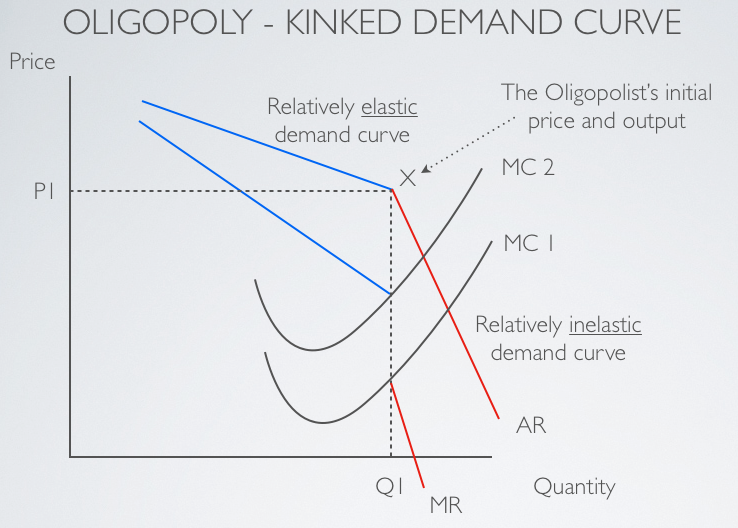
- This interdependence leads to firms being careful with their actions and firms' prices are usually quite rigid due to if they increase their prices, there will be elastic demand because the other firms will not increase their prices and this will lead to the firm that increased prices just losing consumers. Firms do not reduce price because the other firms will follow suit and demand becomes inelastic because all the prices from all the firms are cheaper. This leads to firms remaining at one price.
- Additionally, due to the discontinuous marginal cost curve, it shows that firms do not have to change their prices because even with lower/costs (remaining in the discontinuity) the quantity demanded will be the same
- As seen in the in the diagram below, you can see that an increase in the marginal costs from MC1 to MC2 but the quantity remains the same and so is the price and so there is no need for the price to change.
- Additionally, due to the discontinuous marginal cost curve, it shows that firms do not have to change their prices because even with lower/costs (remaining in the discontinuity) the quantity demanded will be the same
- This interdependence leads to firms being careful with their actions and firms' prices are usually quite rigid due to if they increase their prices, there will be elastic demand because the other firms will not increase their prices and this will lead to the firm that increased prices just losing consumers. Firms do not reduce price because the other firms will follow suit and demand becomes inelastic because all the prices from all the firms are cheaper. This leads to firms remaining at one price.
Images and files in the map
Information
- Description
- A-Level Economics Mind Map on Oligopoly (incomplete), created by veronicaamin on 21/04/2016.
- Created by
- veronicaamin
- Views
- 0
- Rating