
Mind map
Attempt
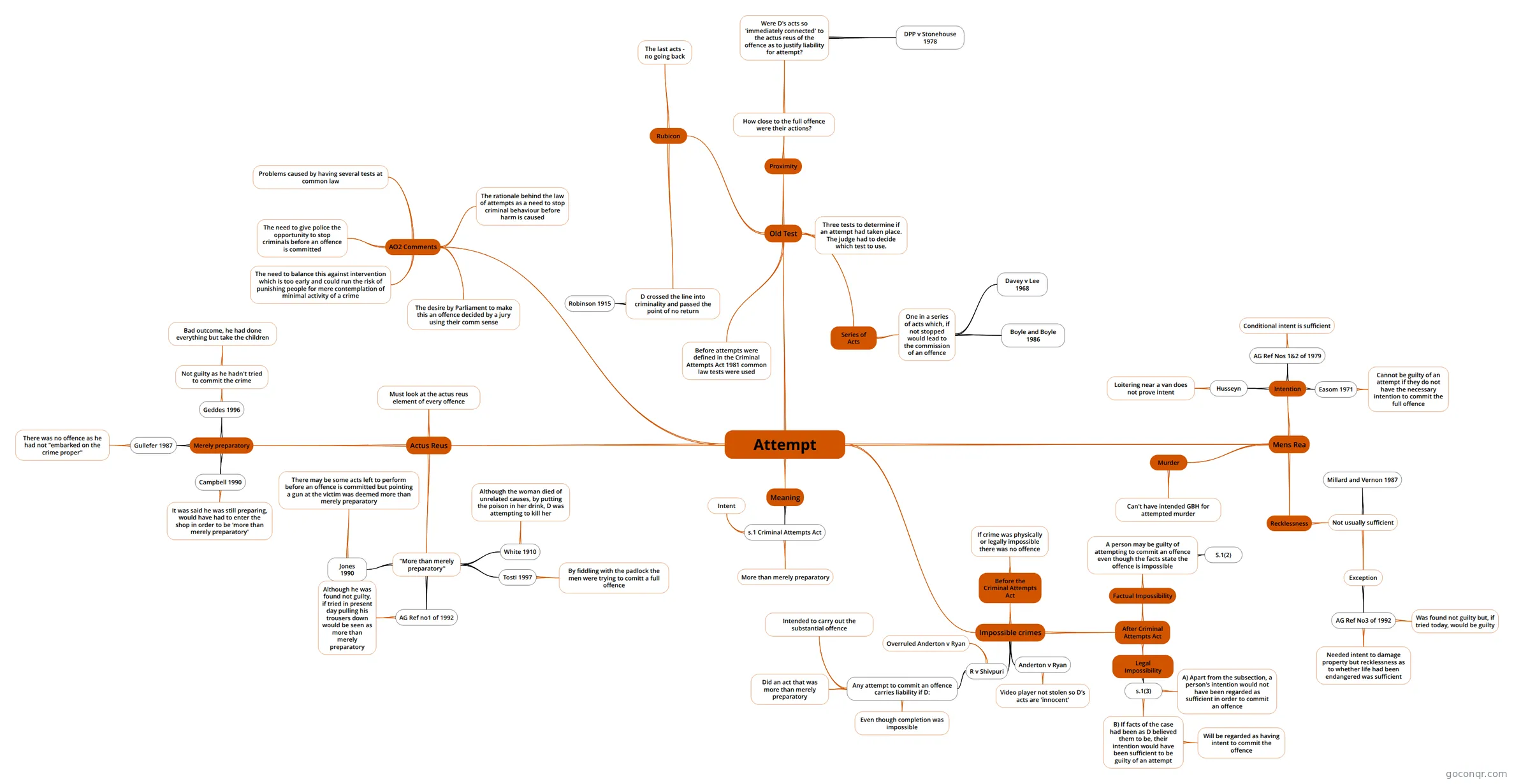
Mind map: Criminal attempts law
Map content
Attempt
Actus Reus
- Must look at the actus reus element of every offence
- "More than merely preparatory"
- Jones 1990
- There may be some acts left to perform before an offence is committed but pointing a gun at the victim was deemed more than merely preparatory
- Tosti 1997
- By fiddling with the padlock the men were trying to comitt a full offence
- White 1910
- Although the woman died of unrelated causes, by putting the poison in her drink, D was attempting to kill her
- AG Ref no1 of 1992
- Although he was found not guilty, if tried in present day pulling his trousers down would be seen as more than merely preparatory
- Jones 1990
- Merely preparatory
- Campbell 1990
- It was said he was still preparing, would have had to enter the shop in order to be 'more than merely preparatory'
- Gullefer 1987
- There was no offence as he had not "embarked on the crime proper"
- Geddes 1996
- Not guilty as he hadn't tried to commit the crime
- Bad outcome, he had done everything but take the children
- Not guilty as he hadn't tried to commit the crime
- Campbell 1990
Meaning
- s.1 Criminal Attempts Act
- Intent
- More than merely preparatory
- s.1 Criminal Attempts Act
Old Test
- Three tests to determine if an attempt had taken place. The judge had to decide which test to use.
- Series of Acts
- One in a series of acts which, if not stopped would lead to the commission of an offence
- Davey v Lee 1968
- Boyle and Boyle 1986
- One in a series of acts which, if not stopped would lead to the commission of an offence
- Before attempts were defined in the Criminal Attempts Act 1981 common law tests were used
- Proximity
- How close to the full offence were their actions?
- Were D's acts so 'immediately connected' to the actus reus of the offence as to justify liability for attempt?
- DPP v Stonehouse 1978
- Were D's acts so 'immediately connected' to the actus reus of the offence as to justify liability for attempt?
- How close to the full offence were their actions?
- Rubicon
- The last acts - no going back
- D crossed the line into criminality and passed the point of no return
- Robinson 1915
Mens Rea
- Intention
- Easom 1971
- Cannot be guilty of an attempt if they do not have the necessary intention to commit the full offence
- Husseyn
- Loitering near a van does not prove intent
- AG Ref Nos 1&2 of 1979
- Conditional intent is sufficient
- Easom 1971
- Recklessness
- Not usually sufficient
- Exception
- AG Ref No3 of 1992
- Needed intent to damage property but recklessness as to whether life had been endangered was sufficient
- Was found not guilty but, if tried today, would be guilty
- AG Ref No3 of 1992
- Millard and Vernon 1987
- Exception
- Not usually sufficient
- Murder
- Can't have intended GBH for attempted murder
- Intention
Impossible crimes
- Before the Criminal Attempts Act
- If crime was physically or legally impossible there was no offence
- After Criminal Attempts Act
- Factual Impossibility
- A person may be guilty of attempting to commit an offence even though the facts state the offence is impossible
- S.1(2)
- A person may be guilty of attempting to commit an offence even though the facts state the offence is impossible
- Legal Impossibility
- s.1(3)
- A) Apart from the subsection, a person's intention would not have been regarded as sufficient in order to commit an offence
- B) If facts of the case had been as D believed them to be, their intention would have been sufficient to be guilty of an attempt
- Will be regarded as having intent to commit the offence
- s.1(3)
- Factual Impossibility
- Anderton v Ryan
- Video player not stolen so D's acts are 'innocent'
- R v Shivpuri
- Overruled Anderton v Ryan
- Any attempt to commit an offence carries liability if D:
- Intended to carry out the substantial offence
- Did an act that was more than merely preparatory
- Even though completion was impossible
- Before the Criminal Attempts Act
AO2 Comments
- Problems caused by having several tests at common law
- The rationale behind the law of attempts as a need to stop criminal behaviour before harm is caused
- The desire by Parliament to make this an offence decided by a jury using their comm sense
- The need to balance this against intervention which is too early and could run the risk of punishing people for mere contemplation of minimal activity of a crime
- The need to give police the opportunity to stop criminals before an offence is committed
Information
- Description
- A2 level Law (Attempts) Mind Map on Attempt, created by ellenclare on 02/06/2016.
- Created by
- ellenclare
- Views
- 4
- Tags
- Rating