
Mind map
Unit 1: Insurance Fundamentals
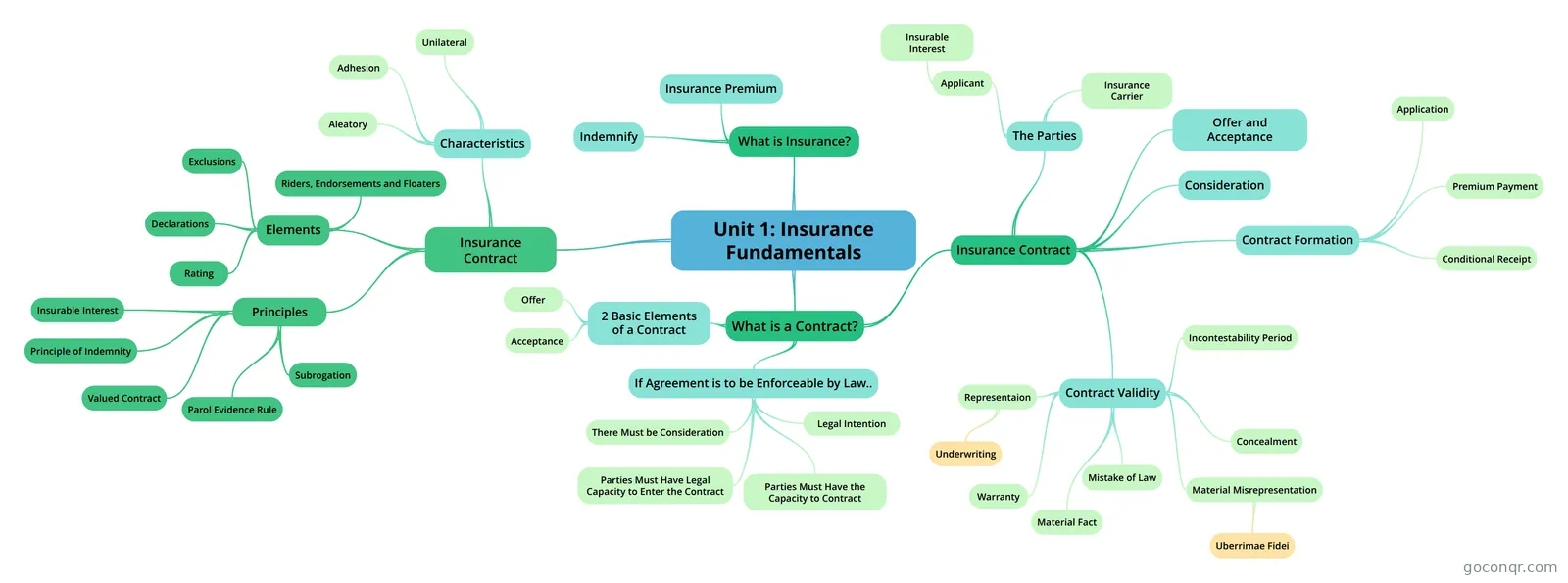
Mind map: Insurance fundamentals
Map content
Unit 1: Insurance Fundamentals
What is Insurance?
- - A protective measure - A contract binds 1 party to indemnify another party - In the event that a specified loss should occur - In return, the covered party pays the insurer an insurance premium
- Indemnify
- To compensate someone for harm or loss
- Insurance Premium
- A sum of money that the insured pays to the insurer in exchange for insurance coverage.
What is a Contract?
- A legally enforceable agreement between two or more parties.
- 2 Basic Elements of a Contract
- Offer
- Acceptance
- If Agreement is to be Enforceable by Law..
- There Must be Consideration
- An exchange of values.
- Parties Must Have Legal Capacity to Enter the Contract
- Legal Intention
- By both parties to enter into a contract.
- Parties Must Have the Capacity to Contract
- There Must be Consideration
- Insurance Contract
- - Similar to a regular contract - Insurance carriers promise to pay is made in return for premium payment by policy holder.
- Offer and Acceptance
- Offer: The completion of the insurance application by an individual. Acceptance: When the insurance carrier issues the contract and it is delivered to the applicant.
- Consideration
- - The payment of insurance premiums by policy owner is consideration from one party. - The contract itself becomes the consideration put forth by the insurance carrier.
- The Parties
- Applicant
- The individual who wishes to be the owner of the insurance contract. - Does not have to be the "Life Insured"
- Insurable Interest
- At the time the policy becomes effective, the policy owner must have an insurable interest. If not, the the contract is void. - If there is no insurable interest, the individual who's life is being insured can give written consent for the insurance to be placed on their life.
- Insurance Carrier
- The party who accepts the applicants offer - By agreeing to issue the contract or; - By making a counter offer that modifies terms
- Applicant
- Contract Validity
- A number of factors may be found to affect the validity of an insurance contract.
- Representaion
- Applicant provides statements that are true to the best of their knowledge. Ex: An approximation of the age at which the life insured had measles (30 years ago when he was a child)
- Underwriting
- The process an insurance carrier goes through to assess the risk associated with an applicant for insurance.
- Warranty
- A guarantee. -Involves a presentation of facts that are material to underwriting of the contract. -Critical to the acceptance of risk
- Material Fact
- A fact that has a definite influence on the decision of the parties. - A mistake could be serious enough to affect the validity of the contract
- Material Misrepresentation
- Both parties in an insurance contract are obliged to disclose all pertinent information.
- Uberrimae Fidei
- An insurance contracts is considered to be one of the "utmost good faith."
- Mistake of Law
- The parties to a contract are mistaken with regard to the legal effect of some facts with reference to which the contract is made. - If there has been no error in connection with the facts, a mistake of law will not affect the validity of a contract.
- Concealment
- When an applicant for insurance consciously choses not to disclose know facts to the insurance carrier. - May also skew the facts to achieve a particular slant.
- Incontestability Period
- A two year limitation on the insurance carrier's ability to void the contract. - Within the first two years that the contract is in force (during the lifetime of the life insured) - If there is a non-disclosure or misrepresentation
- Contract Formation
- Application
- 1. Completed by the policy owner (& life insured if life insurance) - Often with assistance of agent of insurer - Signiture is witnessed2. Submitted to insurance carrier3. Applicant has a duty to read the completed application before signing it & is responsible for the info that it contains
- Premium Payment
- A policy can only come into effect by delivery of the policy to the policy owner, along with the first premium payment.
- Conditional Receipt
- If the applicant has met conditions, there are situations where a carrier will provide interim insurance, accepting the risk.
- Application
Insurance Contract
- Characteristics
- Aleatory
- One party to the contract offers a conditional promise should a specific event occur, in exchange for the other party offering something of value. - The insurance carrier provides the promise of benefits should an event occur ( death, injury, damage) in exchange for premiums from policy owner.
- Adhesion
- Prepared by one party and requires the other party to accept or reject all of the conditions within the contract as a whole. - No opportunity to negotiate contract
- Unilateral
- One party agrees to fulfill the conditions of the contract, and can be held accountable for the fulfillment of the contract. -Carrier must fulfill contract if something happens - Owner must pay premiums in order for contract to remain viable
- Aleatory
- Elements
- Declarations
- A statement of fact by the policy owner that ties to the risk exposure that is to be insured. - Forms basis for decisions of acceptability of the risk being underwritten by carrier
- Rating
- A term used in the insurance industry to identify the level of risk relative to a base-line risk. A rated policy is one where the risk is classified as greater than average. -The ratings on a policy will affect the premium or cost of insurance.
- Exclusions
- A loss for which the insurance carrier does not provide any coverage. - Common to exclude losses that would imperil solvency of the insurer, non accidental losses, inevitable losses, or those covered by another insurance contract.
- Riders, Endorsements and Floaters
- Rider: An amendment or addition to a contract that forms part of the contract by extending coverage. (Standardized additions so it still follows adhesion) - Often referred to as Endorsements Floaters: Are riders attached to property and fire insurance policies to extend coverage
- Declarations
- Principles
- Insurable Interest
- To discourage financial gain through speculation, the law requires that an individual has a insurable interest before a contract can be issued and valid. - For a life insurance contract, insurable interest must only be present at issuing of contract. (Normally ownership may be transferred at will & without need for insurable interest)
- Principle of Indemnity
- An individual is compensated for a specific loss, with no possibility of profiting from that loss
- Valued Contract
- The amount of benefit payable under the contract is established in advance of any loss. - Life insurance is valued contract because the max amount of benefit is pre established prior to the claim. - Useful for property insurance by predetermining value of item and then insuring for that amount.
- Parol Evidence Rule
- Specifically applies to the written contract that has evolved from a discussion b/w two parties, & effects the addition of excluded contract items. - prevents a party to a written contract from presenting exterior evidence that discloses a doubt and clarifies it or adds to the written terms of the contract that appears to be whole.
- Subrogation
- Involves the transfer of rights and entitlements from one person to another. - Does not apply to life insurance - Applies to property and disability insurance
- Insurable Interest
- Characteristics
Information
- Description
- SEC III Business Studies Mind Map on Unit 1: Insurance Fundamentals, created by Cianna Goldade on 27/01/2017.
- Created by
- Cianna Goldade
- Views
- 0
- Rating
More on Insurance Contracts and Policy Provisions