
Mind map
Miss Laetitia Prism
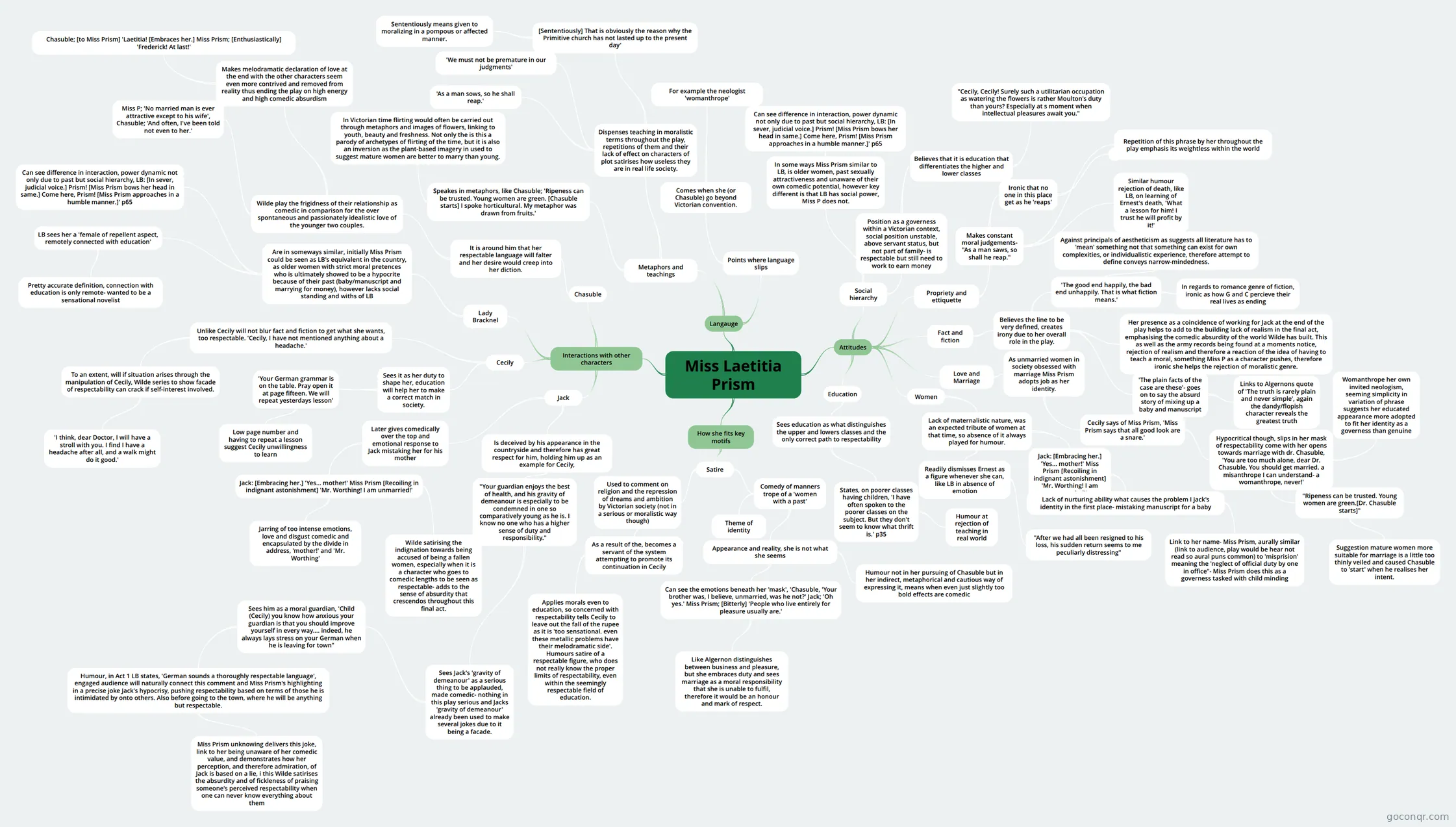
Mind map: Miss Laetitia Prism
Map content
Miss Laetitia Prism
Attitudes
- Social hierarchy
- Position as a governess within a Victorian context, social position unstable, above servant status, but not part of family- is respectable but still need to work to earn money
- Believes that it is education that differentiates the higher and lower classes
- "Cecily, Cecily! Surely such a utilitarian occupation as watering the flowers is rather Moulton's duty than yours? Especially at s moment when intellectual pleasures await you."
- Believes that it is education that differentiates the higher and lower classes
- In some ways Miss Prism similar to LB, is older women, past sexually attractiveness and unaware of their own comedic potential, however key different is that LB has social power, Miss P does not.
- Can see difference in interaction, power dynamic not only due to past but social hierarchy, LB: [In sever, judicial voice.] Prism! [Miss Prism bows her head in same.] Come here, Prism! [Miss Prism approaches in a humble manner.]' p65
- Position as a governess within a Victorian context, social position unstable, above servant status, but not part of family- is respectable but still need to work to earn money
- Propriety and ettiquette
- Makes constant moral judgements- "As a man saws, so shall he reap."
- Ironic that no one in this place get as he 'reaps'
- Similar humour rejection of death, like LB, on learning of Ernest's death, 'What a lesson for him! I trust he will profit by it!'
- Repetition of this phrase by her throughout the play emphasis its weightless within the world
- Ironic that no one in this place get as he 'reaps'
- Makes constant moral judgements- "As a man saws, so shall he reap."
- Fact and fiction
- Believes the line to be very defined, creates irony due to her overall role in the play.
- 'The good end happily, the bad end unhappily. That is what fiction means.'
- Against principals of aestheticism as suggests all literature has to 'mean' something not that something can exist for own complexities, or individualistic experience, therefore attempt to define conveys narrow-mindedness.
- In regards to romance genre of fiction, ironic as how G and C percieve their real lives as ending
- Her presence as a coincidence of working for Jack at the end of the play helps to add to the building lack of realism in the final act, emphasising the comedic absurdity of the world Wilde has built. This as well as the army records being found at a moments notice, rejection of realism and therefore a reaction of the idea of having to teach a moral, something Miss P as a character pushes, therefore ironic she helps the rejection of moralistic genre.
- 'The plain facts of the case are these'- goes on to say the absurd story of mixing up a baby and manuscript
- Links to Algernons quote of 'The truth is rarely plain and never simple', again the dandy/flopish character reveals the greatest truth
- 'The good end happily, the bad end unhappily. That is what fiction means.'
- Believes the line to be very defined, creates irony due to her overall role in the play.
- Women
- Lack of maternalistic nature, was an expected tribute of women at that time, so absence of it always played for humour.
- Jack: [Embracing her.] 'Yes... mother!' Miss Prism [Recoiling in indignant astonishment] 'Mr. Worthing! I am unmarried!'
- Lack of nurturing ability what causes the problem I jack's identity in the first place- mistaking manuscript for a baby
- Link to her name- Miss Prism, aurally similar (link to audience, play would be hear not read so aural puns common) to 'misprision' meaning the 'neglect of official duty by one in office"- Miss Prism does this as a governess tasked with child minding
- Lack of nurturing ability what causes the problem I jack's identity in the first place- mistaking manuscript for a baby
- Readily dismisses Ernest as a figure whenever she can, like LB in absence of emotion
- "After we had all been resigned to his loss, his sudden return seems to me peculiarly distressing"
- Jack: [Embracing her.] 'Yes... mother!' Miss Prism [Recoiling in indignant astonishment] 'Mr. Worthing! I am unmarried!'
- Lack of maternalistic nature, was an expected tribute of women at that time, so absence of it always played for humour.
- Education
- Sees education as what distinguishes the upper and lowers classes and the only correct path to respectability
- States, on poorer classes having children, 'I have often spoken to the poorer classes on the subject. But they don't seem to know what thrift is.' p35
- Humour at rejection of teaching in real world
- States, on poorer classes having children, 'I have often spoken to the poorer classes on the subject. But they don't seem to know what thrift is.' p35
- Sees education as what distinguishes the upper and lowers classes and the only correct path to respectability
- Love and Marriage
- As unmarried women in society obsessed with marriage Miss Prism adopts job as her identity.
- Cecily says of Miss Prism, 'Miss Prism says that all good look are a snare.'
- Hypocritical though, slips in her mask of respectability come with her opens towards marriage with dr. Chasuble, 'You are too much alone, dear Dr. Chasuble. You should get married. a misanthrope I can understand- a womanthrope, never!'
- Womanthrope her own invited neologism, seeming simplicity in variation of phrase suggests her educated appearance more adopted to fit her identity as a governess than genuine
- "Ripeness can be trusted. Young women are green.[Dr. Chasuble starts]"
- Suggestion mature women more suitable for marriage is a little too thinly veiled and caused Chasuble to 'start' when he realises her intent.
- Hypocritical though, slips in her mask of respectability come with her opens towards marriage with dr. Chasuble, 'You are too much alone, dear Dr. Chasuble. You should get married. a misanthrope I can understand- a womanthrope, never!'
- Cecily says of Miss Prism, 'Miss Prism says that all good look are a snare.'
- As unmarried women in society obsessed with marriage Miss Prism adopts job as her identity.
- Social hierarchy
How she fits key motifs
- Satire
- Comedy of manners trope of a 'women with a past'
- Appearance and reality, she is not what she seems
- Can see the emotions beneath her 'mask', 'Chasuble, 'Your brother was, I believe, unmarried, was he not?' Jack; 'Oh yes.' Miss Prism; [Bitterly] 'People who live entirely for pleasure usually are.'
- Like Algernon distinguishes between business and pleasure, but she embraces duty and sees marriage as a moral responsibility that she is unable to fulfil, therefore it would be an honour and mark of respect.
- Humour not in her pursuing of Chasuble but in her indirect, metaphorical and cautious way of expressing it, means when even just slightly too bold effects are comedic
- Can see the emotions beneath her 'mask', 'Chasuble, 'Your brother was, I believe, unmarried, was he not?' Jack; 'Oh yes.' Miss Prism; [Bitterly] 'People who live entirely for pleasure usually are.'
- Theme of identity
- Appearance and reality, she is not what she seems
- Used to comment on religion and the repression of dreams and ambition by Victorian society (not in a serious or moralistic way though)
- As a result of the, becomes a servant of the system attempting to promote its continuation in Cecily
- Applies morals even to education, so concerned with respectability tells Cecily to leave out the fall of the rupee as it is 'too sensational. even these metallic problems have their melodramatic side'. Humours satire of a respectable figure, who does not really know the proper limits of respectability, even within the seemingly respectable field of education.
- As a result of the, becomes a servant of the system attempting to promote its continuation in Cecily
- Comedy of manners trope of a 'women with a past'
- Satire
Interactions with other characters
- Jack
- Is deceived by his appearance in the countryside and therefore has great respect for him, holding him up as an example for Cecily,
- "Your guardian enjoys the best of health, and his gravity of demeanour is especially to be condemned in one so comparatively young as he is. I know no one who has a higher sense of duty and responsibility."
- Sees Jack's 'gravity of demeanour' as a serious thing to be applauded, made comedic- nothing in this play serious and Jacks 'gravity of demeanour' already been used to make several jokes due to it being a facade.
- Sees him as a moral guardian, 'Child (Cecily) you know how anxious your guardian is that you should improve yourself in every way.... indeed, he always lays stress on your German when he is leaving for town"
- Humour, in Act 1 LB states, 'German sounds a thoroughly respectable language', engaged audience will naturally connect this comment and Miss Prism's highlighting in a precise joke Jack's hypocrisy, pushing respectability based on terms of those he is intimidated by onto others. Also before going to the town, where he will be anything but respectable.
- Miss Prism unknowing delivers this joke, link to her being unaware of her comedic value, and demonstrates how her perception, and therefore admiration, of Jack is based on a lie, i this Wilde satirises the absurdity and of fickleness of praising someone's perceived respectability when one can never know everything about them
- Humour, in Act 1 LB states, 'German sounds a thoroughly respectable language', engaged audience will naturally connect this comment and Miss Prism's highlighting in a precise joke Jack's hypocrisy, pushing respectability based on terms of those he is intimidated by onto others. Also before going to the town, where he will be anything but respectable.
- Sees him as a moral guardian, 'Child (Cecily) you know how anxious your guardian is that you should improve yourself in every way.... indeed, he always lays stress on your German when he is leaving for town"
- Sees Jack's 'gravity of demeanour' as a serious thing to be applauded, made comedic- nothing in this play serious and Jacks 'gravity of demeanour' already been used to make several jokes due to it being a facade.
- "Your guardian enjoys the best of health, and his gravity of demeanour is especially to be condemned in one so comparatively young as he is. I know no one who has a higher sense of duty and responsibility."
- Later gives comedically over the top and emotional response to Jack mistaking her for his mother
- Jack: [Embracing her.] 'Yes... mother!' Miss Prism [Recoiling in indignant astonishment] 'Mr. Worthing! I am unmarried!'
- Jarring of too intense emotions, love and disgust comedic and encapsulated by the divide in address, 'mother!' and 'Mr. Worthing'
- Wilde satirising the indignation towards being accused of being a fallen women, especially when it is a character who goes to comedic lengths to be seen as respectable- adds to the sense of absurdity that crescendos throughout this final act.
- Jack: [Embracing her.] 'Yes... mother!' Miss Prism [Recoiling in indignant astonishment] 'Mr. Worthing! I am unmarried!'
- Is deceived by his appearance in the countryside and therefore has great respect for him, holding him up as an example for Cecily,
- Cecily
- Sees it as her duty to shape her, education will help her to make a correct match in society.
- 'Your German grammar is on the table. Pray open it at page fifteen. We will repeat yesterdays lesson'
- Low page number and having to repeat a lesson suggest Cecily unwillingness to learn
- 'Your German grammar is on the table. Pray open it at page fifteen. We will repeat yesterdays lesson'
- Unlike Cecily will not blur fact and fiction to get what she wants, too respectable. 'Cecily, I have not mentioned anything about a headache.'
- To an extent, will if situation arises through the manipulation of Cecily, Wilde series to show facade of respectability can crack if self-interest involved.
- 'I think, dear Doctor, I will have a stroll with you. I find I have a headache after all, and a walk might do it good.'
- To an extent, will if situation arises through the manipulation of Cecily, Wilde series to show facade of respectability can crack if self-interest involved.
- Sees it as her duty to shape her, education will help her to make a correct match in society.
- Lady Bracknel
- Are in someways similar, initially Miss Prism could be seen as LB's equivalent in the country, as older women with strict moral pretences who is ultimately showed to be a hypocrite because of their past (baby/manuscript and marrying for money), however lacks social standing and withs of LB
- Can see difference in interaction, power dynamic not only due to past but social hierarchy, LB: [In sever, judicial voice.] Prism! [Miss Prism bows her head in same.] Come here, Prism! [Miss Prism approaches in a humble manner.]' p65
- LB sees her a 'female of repellent aspect, remotely connected with education'
- Pretty accurate definition, connection with education is only remote- wanted to be a sensational novelist
- Are in someways similar, initially Miss Prism could be seen as LB's equivalent in the country, as older women with strict moral pretences who is ultimately showed to be a hypocrite because of their past (baby/manuscript and marrying for money), however lacks social standing and withs of LB
- Chasuble
- It is around him that her respectable language will falter and her desire would creep into her diction.
- Wilde play the frigidness of their relationship as comedic in comparison for the over spontaneous and passionately idealistic love of the younger two couples.
- Miss P; 'No married man is ever attractive except to his wife', Chasuble; 'And often, I've been told not even to her.'
- Makes melodramatic declaration of love at the end with the other characters seem even more contrived and removed from reality thus ending the play on high energy and high comedic absurdism
- Chasuble; [to Miss Prism] 'Laetitia! [Embraces her.] Miss Prism; [Enthusiastically] 'Frederick! At last!'
- Wilde play the frigidness of their relationship as comedic in comparison for the over spontaneous and passionately idealistic love of the younger two couples.
- It is around him that her respectable language will falter and her desire would creep into her diction.
- Jack
Langauge
- Metaphors and teachings
- Speakes in metaphors, like Chasuble; 'Ripeness can be trusted. Young women are green. [Chasuble starts] I spoke horticultural. My metaphor was drawn from fruits.'
- In Victorian time flirting would often be carried out through metaphors and images of flowers, linking to youth, beauty and freshness. Not only the is this a parody of archetypes of flirting of the time, but it is also an inversion as the plant-based imagery in used to suggest mature women are better to marry than young.
- Dispenses teaching in moralistic terms throughout the play, repetitions of them and their lack of effect on characters of plot satirises how useless they are in real life society.
- 'As a man sows, so he shall reap.'
- 'We must not be premature in our judgments'
- [Sententiously] That is obviously the reason why the Primitive church has not lasted up to the present day'
- Sententiously means given to moralizing in a pompous or affected manner.
- Speakes in metaphors, like Chasuble; 'Ripeness can be trusted. Young women are green. [Chasuble starts] I spoke horticultural. My metaphor was drawn from fruits.'
- Points where language slips
- Comes when she (or Chasuble) go beyond Victorian convention.
- For example the neologist 'womanthrope'
- Comes when she (or Chasuble) go beyond Victorian convention.
- Metaphors and teachings
Information
- Description
- A2 English Mind Map on Miss Laetitia Prism, created by Molly Thatcher on 15/04/2017.
- Created by
- Molly Thatcher
- Views
- 0
- Rating