
Mind map
GCSE C4 - Chemical Patterns
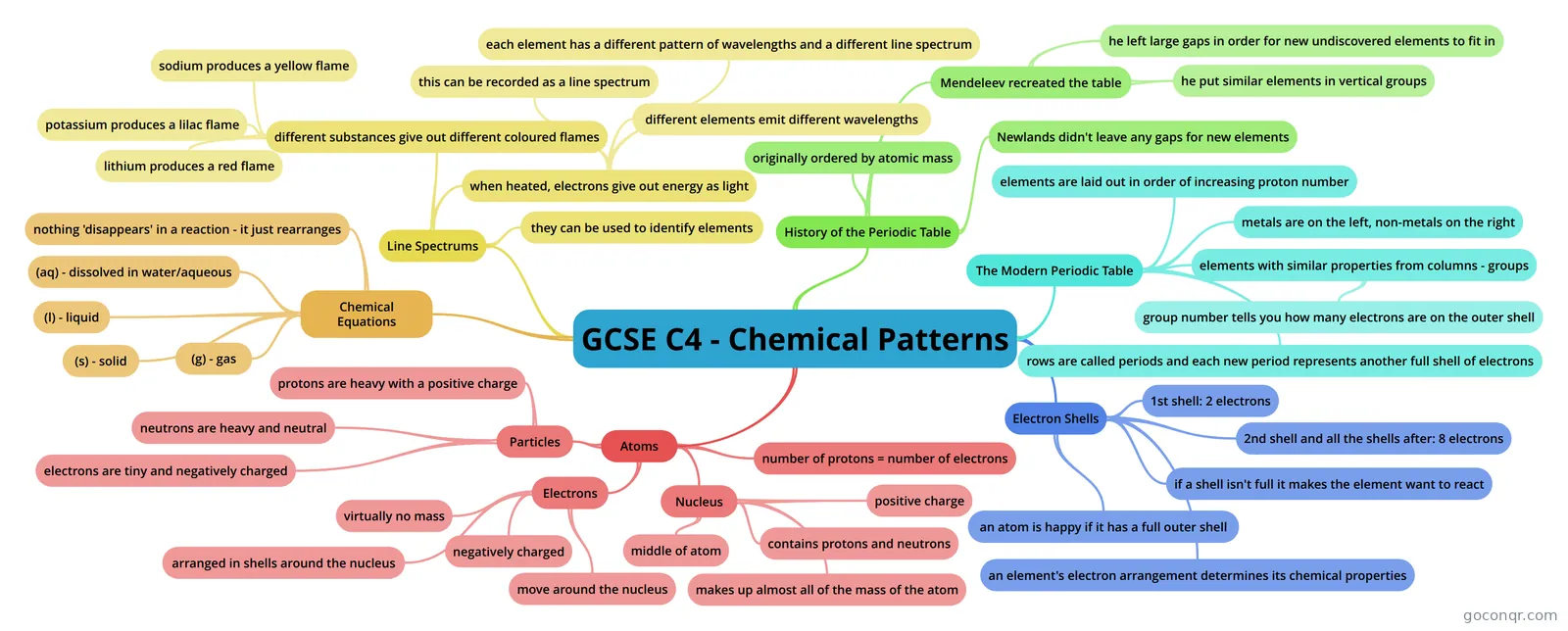
Mind map: GCSE C4 chemical patterns
Map content
GCSE C4 - Chemical Patterns
Atoms
- Nucleus
- middle of atom
- contains protons and neutrons
- makes up almost all of the mass of the atom
- positive charge
- Electrons
- move around the nucleus
- negatively charged
- virtually no mass
- arranged in shells around the nucleus
- Particles
- protons are heavy with a positive charge
- neutrons are heavy and neutral
- electrons are tiny and negatively charged
- number of protons = number of electrons
- Nucleus
Chemical Equations
- (s) - solid
- (l) - liquid
- (g) - gas
- (aq) - dissolved in water/aqueous
- nothing 'disappears' in a reaction - it just rearranges
Line Spectrums
- different substances give out different coloured flames
- lithium produces a red flame
- sodium produces a yellow flame
- potassium produces a lilac flame
- when heated, electrons give out energy as light
- this can be recorded as a line spectrum
- different elements emit different wavelengths
- each element has a different pattern of wavelengths and a different line spectrum
- they can be used to identify elements
- different substances give out different coloured flames
History of the Periodic Table
- originally ordered by atomic mass
- Newlands didn't leave any gaps for new elements
- Mendeleev recreated the table
- he put similar elements in vertical groups
- he left large gaps in order for new undiscovered elements to fit in
The Modern Periodic Table
- elements are laid out in order of increasing proton number
- metals are on the left, non-metals on the right
- elements with similar properties from columns - groups
- group number tells you how many electrons are on the outer shell
- rows are called periods and each new period represents another full shell of electrons
Electron Shells
- 1st shell: 2 electrons
- 2nd shell and all the shells after: 8 electrons
- an atom is happy if it has a full outer shell
- an element's electron arrangement determines its chemical properties
- if a shell isn't full it makes the element want to react