
Mind map
Climate Change
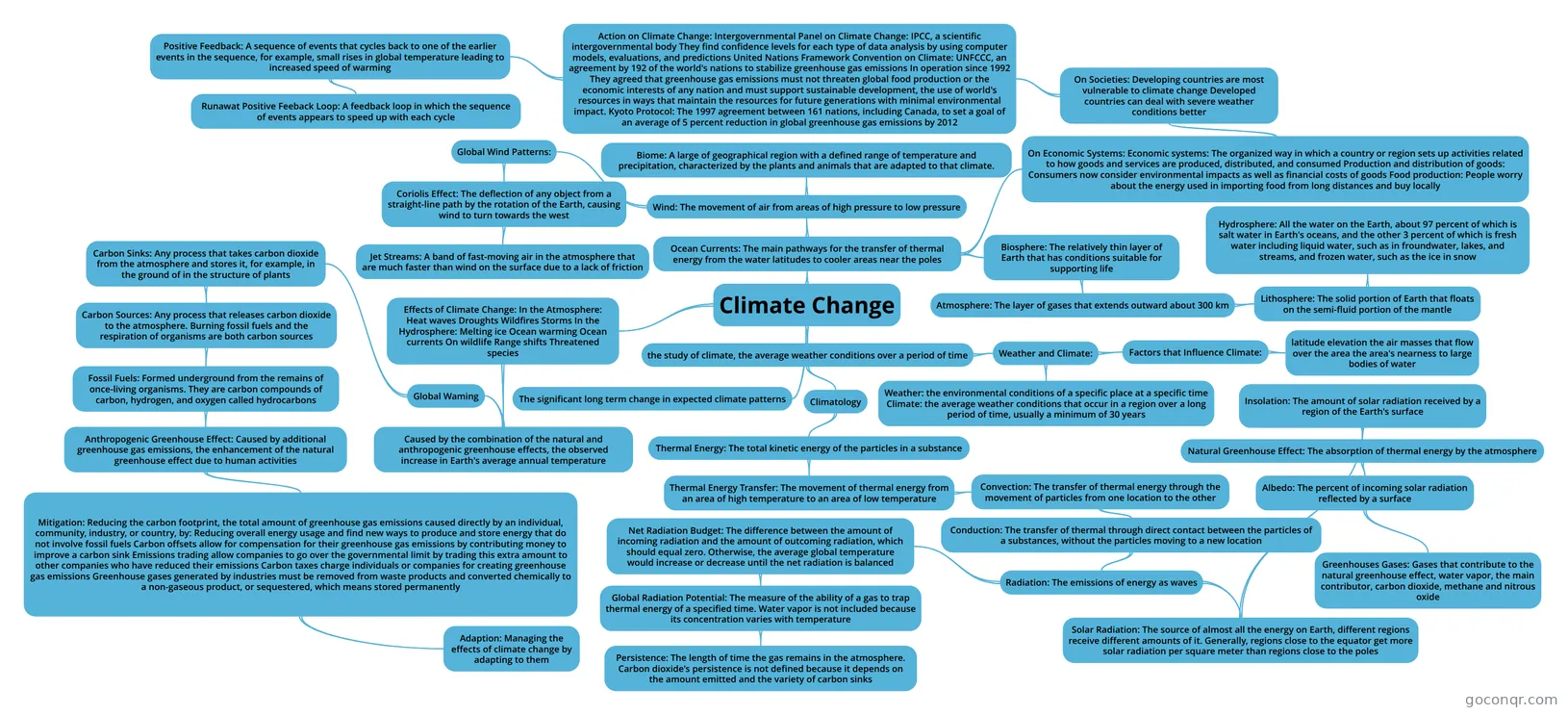
Mind map: Climate Change
Map content
Climate Change
the study of climate, the average weather conditions over a period of time
- Weather and Climate:
- Weather: the environmental conditions of a specific place at a specific time Climate: the average weather conditions that occur in a region over a long period of time, usually a minimum of 30 years
- Factors that Influence Climate:
- latitude elevation the air masses that flow over the area the area's nearness to large bodies of water
- Climatology
- Thermal Energy: The total kinetic energy of the particles in a substance
- Thermal Energy Transfer: The movement of thermal energy from an area of high temperature to an area of low temperature
- Convection: The transfer of thermal energy through the movement of particles from one location to the other
- Conduction: The transfer of thermal through direct contact between the particles of a substances, without the particles moving to a new location
- Radiation: The emissions of energy as waves
- Solar Radiation: The source of almost all the energy on Earth, different regions receive different amounts of it. Generally, regions close to the equator get more solar radiation per square meter than regions close to the poles
- Insolation: The amount of solar radiation received by a region of the Earth's surface
- Natural Greenhouse Effect: The absorption of thermal energy by the atmosphere
- Albedo: The percent of incoming solar radiation reflected by a surface
- Greenhouses Gases: Gases that contribute to the natural greenhouse effect, water vapor, the main contributor, carbon dioxide, methane and nitrous oxide
- Albedo: The percent of incoming solar radiation reflected by a surface
- Natural Greenhouse Effect: The absorption of thermal energy by the atmosphere
- Insolation: The amount of solar radiation received by a region of the Earth's surface
- Net Radiation Budget: The difference between the amount of incoming radiation and the amount of outcoming radiation, which should equal zero. Otherwise, the average global temperature would increase or decrease until the net radiation is balanced
- Global Radiation Potential: The measure of the ability of a gas to trap thermal energy of a specified time. Water vapor is not included because its concentration varies with temperature
- Persistence: The length of time the gas remains in the atmosphere. Carbon dioxide's persistence is not defined because it depends on the amount emitted and the variety of carbon sinks
- Global Radiation Potential: The measure of the ability of a gas to trap thermal energy of a specified time. Water vapor is not included because its concentration varies with temperature
- Solar Radiation: The source of almost all the energy on Earth, different regions receive different amounts of it. Generally, regions close to the equator get more solar radiation per square meter than regions close to the poles
- Radiation: The emissions of energy as waves
- Conduction: The transfer of thermal through direct contact between the particles of a substances, without the particles moving to a new location
- Convection: The transfer of thermal energy through the movement of particles from one location to the other
- Thermal Energy Transfer: The movement of thermal energy from an area of high temperature to an area of low temperature
- Thermal Energy: The total kinetic energy of the particles in a substance
- Weather and Climate:
Ocean Currents: The main pathways for the transfer of thermal energy from the water latitudes to cooler areas near the poles
- Biosphere: The relatively thin layer of Earth that has conditions suitable for supporting life
- Atmosphere: The layer of gases that extends outward about 300 km
- Lithosphere: The solid portion of Earth that floats on the semi-fluid portion of the mantle
- Hydrosphere: All the water on the Earth, about 97 percent of which is salt water in Earth's oceans, and the other 3 percent of which is fresh water including liquid water, such as in froundwater, lakes, and streams, and frozen water, such as the ice in snow
- Lithosphere: The solid portion of Earth that floats on the semi-fluid portion of the mantle
- Atmosphere: The layer of gases that extends outward about 300 km
- Wind: The movement of air from areas of high pressure to low pressure
- Biome: A large of geographical region with a defined range of temperature and precipitation, characterized by the plants and animals that are adapted to that climate.
- Global Wind Patterns:
- Coriolis Effect: The deflection of any object from a straight-line path by the rotation of the Earth, causing wind to turn towards the west
- Jet Streams: A band of fast-moving air in the atmosphere that are much faster than wind on the surface due to a lack of friction
- Coriolis Effect: The deflection of any object from a straight-line path by the rotation of the Earth, causing wind to turn towards the west
- On Economic Systems: Economic systems: The organized way in which a country or region sets up activities related to how goods and services are produced, distributed, and consumed Production and distribution of goods: Consumers now consider environmental impacts as well as financial costs of goods Food production: People worry about the energy used in importing food from long distances and buy locally
- On Societies: Developing countries are most vulnerable to climate change Developed countries can deal with severe weather conditions better
- Action on Climate Change: Intergovernmental Panel on Climate Change: IPCC, a scientific intergovernmental body They find confidence levels for each type of data analysis by using computer models, evaluations, and predictions United Nations Framework Convention on Climate: UNFCCC, an agreement by 192 of the world's nations to stabilize greenhouse gas emissions In operation since 1992 They agreed that greenhouse gas emissions must not threaten global food production or the economic interests of any nation and must support sustainable development, the use of world's resources in ways that maintain the resources for future generations with minimal environmental impact. Kyoto Protocol: The 1997 agreement between 161 nations, including Canada, to set a goal of an average of 5 percent reduction in global greenhouse gas emissions by 2012
- Positive Feedback: A sequence of events that cycles back to one of the earlier events in the sequence, for example, small rises in global temperature leading to increased speed of warming
- Runawat Positive Feeback Loop: A feedback loop in which the sequence of events appears to speed up with each cycle
- Positive Feedback: A sequence of events that cycles back to one of the earlier events in the sequence, for example, small rises in global temperature leading to increased speed of warming
- Action on Climate Change: Intergovernmental Panel on Climate Change: IPCC, a scientific intergovernmental body They find confidence levels for each type of data analysis by using computer models, evaluations, and predictions United Nations Framework Convention on Climate: UNFCCC, an agreement by 192 of the world's nations to stabilize greenhouse gas emissions In operation since 1992 They agreed that greenhouse gas emissions must not threaten global food production or the economic interests of any nation and must support sustainable development, the use of world's resources in ways that maintain the resources for future generations with minimal environmental impact. Kyoto Protocol: The 1997 agreement between 161 nations, including Canada, to set a goal of an average of 5 percent reduction in global greenhouse gas emissions by 2012
- On Societies: Developing countries are most vulnerable to climate change Developed countries can deal with severe weather conditions better
- Biosphere: The relatively thin layer of Earth that has conditions suitable for supporting life
Effects of Climate Change: In the Atmosphere: Heat waves Droughts Wildfires Storms In the Hydrosphere: Melting ice Ocean warming Ocean currents On wildlife Range shifts Threatened species
- Caused by the combination of the natural and anthropogenic greenhouse effects, the observed increase in Earth's average annual temperature
- Global Waming
- Carbon Sinks: Any process that takes carbon dioxide from the atmosphere and stores it, for example, in the ground of in the structure of plants
- Carbon Sources: Any process that releases carbon dioxide to the atmosphere. Burning fossil fuels and the respiration of organisms are both carbon sources
- Fossil Fuels: Formed underground from the remains of once-living organisms. They are carbon compounds of carbon, hydrogen, and oxygen called hydrocarbons
- Anthropogenic Greenhouse Effect: Caused by additional greenhouse gas emissions, the enhancement of the natural greenhouse effect due to human activities
- Mitigation: Reducing the carbon footprint, the total amount of greenhouse gas emissions caused directly by an individual, community, industry, or country, by: Reducing overall energy usage and find new ways to produce and store energy that do not involve fossil fuels Carbon offsets allow for compensation for their greenhouse gas emissions by contributing money to improve a carbon sink Emissions trading allow companies to go over the governmental limit by trading this extra amount to other companies who have reduced their emissions Carbon taxes charge individuals or companies for creating greenhouse gas emissions Greenhouse gases generated by industries must be removed from waste products and converted chemically to a non-gaseous product, or sequestered, which means stored permanently
- Adaption: Managing the effects of climate change by adapting to them
- Mitigation: Reducing the carbon footprint, the total amount of greenhouse gas emissions caused directly by an individual, community, industry, or country, by: Reducing overall energy usage and find new ways to produce and store energy that do not involve fossil fuels Carbon offsets allow for compensation for their greenhouse gas emissions by contributing money to improve a carbon sink Emissions trading allow companies to go over the governmental limit by trading this extra amount to other companies who have reduced their emissions Carbon taxes charge individuals or companies for creating greenhouse gas emissions Greenhouse gases generated by industries must be removed from waste products and converted chemically to a non-gaseous product, or sequestered, which means stored permanently
- Anthropogenic Greenhouse Effect: Caused by additional greenhouse gas emissions, the enhancement of the natural greenhouse effect due to human activities
- Fossil Fuels: Formed underground from the remains of once-living organisms. They are carbon compounds of carbon, hydrogen, and oxygen called hydrocarbons
- Carbon Sources: Any process that releases carbon dioxide to the atmosphere. Burning fossil fuels and the respiration of organisms are both carbon sources
- Carbon Sinks: Any process that takes carbon dioxide from the atmosphere and stores it, for example, in the ground of in the structure of plants
- Global Waming
- Caused by the combination of the natural and anthropogenic greenhouse effects, the observed increase in Earth's average annual temperature
The significant long term change in expected climate patterns
Information
- Description
- Grade 10 Environmental Science Mind Map on Climate Change, created by Leah Mascarenhas on 11/06/2017.
- Created by
- Leah Mascarenhas
- Views
- 0
- Rating
More on Climate change and global warming