
Notes
"All About Authentic Assessment" - created from Mind Map
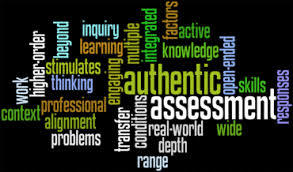
Content of the notes (1)
Page 1
What is Authentic Assessment???
Why use Authentic Assessment??
How to create a Authentic Assessment??
Difference Between Traditional Assessment vs. Authentic Assessment
Assessments
Informal Assessment
Includes a task for students to perform and a rubric, which will be used to evaluate the students's performance on the ask..
Drives the Curriculum
More student structured rather than teacher structured
Teachers will first determine the tasks that students will perform to demonstrate their mastery.
"Planning Backwards"
We do not want the students to "know" the content but be able to "use" the knowledge gained.
Assessments need to tell us if the students can apply what they have learned.
(Indirect Evidence) On test of knowledge might infer that the student could also apply knowledge
Research on learning state that we cannot simply be fed knowledge. We need to construct our own meaning of the world around us.
A more direct way would be by asking the student to apply their knowledge in some meaningful way.
#1. Ask Questions: "What do we want the students to know and be able to do?"
#2. Standards: What indicates students have met these standards? To determine this you will....
#3. Create Authentic Tasks: What does good performance on the task look like? To determine if the students have performed well on the task you need to identify and look for characteristics of good performance called...
:#4. Criteria: How well did the students perform?
#5. Rubric: Evaluate students performance
How well should most students perform?
What do students need to improve on?
Cut Scores or Benchmarks
ADJUST INSTRUCTION
TA: Testing to the test!
TA: forced-choice measures of multiple-choice tests, fill-in-the-blanks, true-false, matching and the like that have been and remain so common in education
Because a test usually assesses a sample of students' knowledge and understanding and assumes that students' performance on the sample is representative of their knowledge of all the relevant material
AA: Teachers are only encouraged to teach the test!
TA: 1. A school's mission is to develop productive citizens. 2. To be a productive citizen an individual must possess a certain body of knowledge and skills. 3. Therefore, schools must teach this body of knowledge and skills. 4. To determine if it is successful, the school must then test students to see if they acquired the knowledge and skills.
AA: 1. A school's mission is to develop productive citizens. 2. To be a productive citizen, an individual must be capable of performing meaningful tasks in the real world. 3. Therefore, schools must help students become proficient at performing the tasks they will encounter when they graduate. 4. To determine if it is successful, the school must then ask students to perform meaningful tasks that replicate real world challenges to see if students are capable of doing so.
Initial Asessment
Ongoing Assessment
High-Stakes Testing
According to federal statutes, school districts are legally obligated to identify students who are ELLs so that appropriate educational decisions can be made and appropriate services provided
How are ELLs identified and assessed throughout the United States?
As part of the school enrollment process for a new student, the school provides the parent/guardian with a home language survey in the parent/guardian's primary language
Ongoing assessment of student learning provides continuous feedback on the effectiveness of instruction and indicates areas where a change in instructional strategy may be advised
High-stakes tests are tests used to make important decisions about students. These include whether students should be promoted, allowed to graduate, or admitted to programs
High-stakes assessments are considered a natural outcome of the standards movement in the U.S
Allows teachers to track the ongoing progress of their students regularly and often
Standardized tests measure students at a particular point in the year, ongoing assessments provide continual snapshots of where students are throughout the school year
Standardized tests in English do not usually reflect ELLs' true content knowledge or abilities
Two commonly used informal methods: performance-based assessment and portfolio assessment
These methods utilize typical classroom activities to measure progress toward curricular goals and objectives
Information
- Description
- english language learners Note on "All About Authentic Assessment" - created from Mind Map, created by Ashlyn Gray on 08/09/2017.
- Created by
- Ashlyn Gray
- Views
- 0
- History
-
- Created by Ashlyn Gray · Sep 8, 2017
- Copied to Note by Ashlyn Gray · Sep 8, 2017
- Rating