
Notes
U4 Chemistry
Content of the notes (3)
Page 1
Particle theory
Key words
Distillation:
Impure solvent - what is put in at the beginning of distillation
Leibig condenser - condenser in distillation
Filtration
Residue - substance left in filter paper
Filtrate - substance which goes through funnel
Chromatography
Differential - Showing a difference, distinctive
Stationary Phase - Part of apparatus, doesn't move with sample
Affinity - Natural attraction or force between things
Mobile Phase - Liquid or gas that carries component
Other
Solute - Solid chemical - is dissolved
Solvent - Chemical liquid - dissolves another chemical
Solution - Mixture of solute and solvent
Distillation
2 types of distillation
Simple distillation - Separates 1 liquid
Fractional distillation - Separates a mixture of liquids
Method
Heat solution in flash, it evaporates, steam rises to condenser, salt is left behind.
Condenser is cold (water jacket), steam condenses
Water drips into beaker - distilled water
http://www.docbrown.info/page12/gifs/distill.gif
Crystallisation
Soluble liquids can be separated
Method
Solution is heated - get rid of some solvent
As solvent evaporates, solution more concentrated
Solution can be checked to see if ready - place drop of solution on microscopic slide
Solution is left to cool and crystallise
Crystals are filtered, rinsed and dried
Filtration
Separates insoluble solids from liquid
Residue gets left in paper, filtrate goes through paper
http://www.micromountain.com/sci_diagrams/sci_app/sci_app_assets/filter_lab_eng.jpg
Chromatography
Used to identify, analyse, purify and/or quantify a mixture of components
Some particles travel further than others -different solubility / attractions
RF ( retention factor )
Used to compare components of various samples
Distance from past line to the spot ÷ distance from the base line to the solvent front
Always less than 1
States of matter
solid -----> liquid = melting
liquid -----> gas = evaporation
gas -----> liquid = condensation
liquid -----> solid = freezing
solid -----> gas = sublimation
Page 2
Atomic structure
3 particles in an atom:
protons
neutrons
electrons
| Atomic particle | Relative mass | Relative charge |
| Protons | 1 | +1 |
| Electrons | 1 | -1 |
| Neutrons | 1/2000 (0.0005) | 0 |
Structure of an atom
Protons and neutrons are in the nucleus
Electrons are in the shells around nucleus
Number of electrons and protons are the same (unless bonded)
Mass number - total number of protons and neutrons (mass of atom)
Atomic number (number below element symbol) - number of protons in an atoms nucleus
Relative mass (number above element symbol) - ✩✩ FIND ANSWER
Number of neutrons = mass number - atomic number
Isotopes - atoms containing same number of protons, different number of neutrons
Group number - number of outer shell electrons
Period number - number of electric shells
RAM (relative atomic mass) = (mass number of atom 1 x percentage of atom 1) +
(mass number of atom 2 x % of atom 2) + etc
(÷) divided by --------------------------------------------------------------------------
100
(will get given %)
Page 3
Periodic Table
Balancing Equations
Write correct formula of each substance
Balance number of atoms (of each element) by putting a BIG NUMBER IN FRONT of formula
Check both sides of equation to see if there are same number of atoms each element on both sides of equation
NEVER CHANGE SMALL NUMBER WHEN TRYING TO BANCE AN EQUATION
Number of atoms must be same on both sides
Subscript (small) number only multiplies thing it's attached to
Big
((s2) = small 2)
Eg
Sodium + Chlorine > Sodium chlorid
2Na + Cl(s2) > 2NaCl
Potassium + Oxygen > Potassium oxide
4K + O(s2) > 2K(s2)O
Vertical columns - groups
Horizontal columns - periods
Group number - number of outer shell electrons
Period number - number of electron shells
Diatomic Elements - Elements which come in pairs (small 2 at bottom)
H2
N2
O2
F2
Cl2
Br2
I2
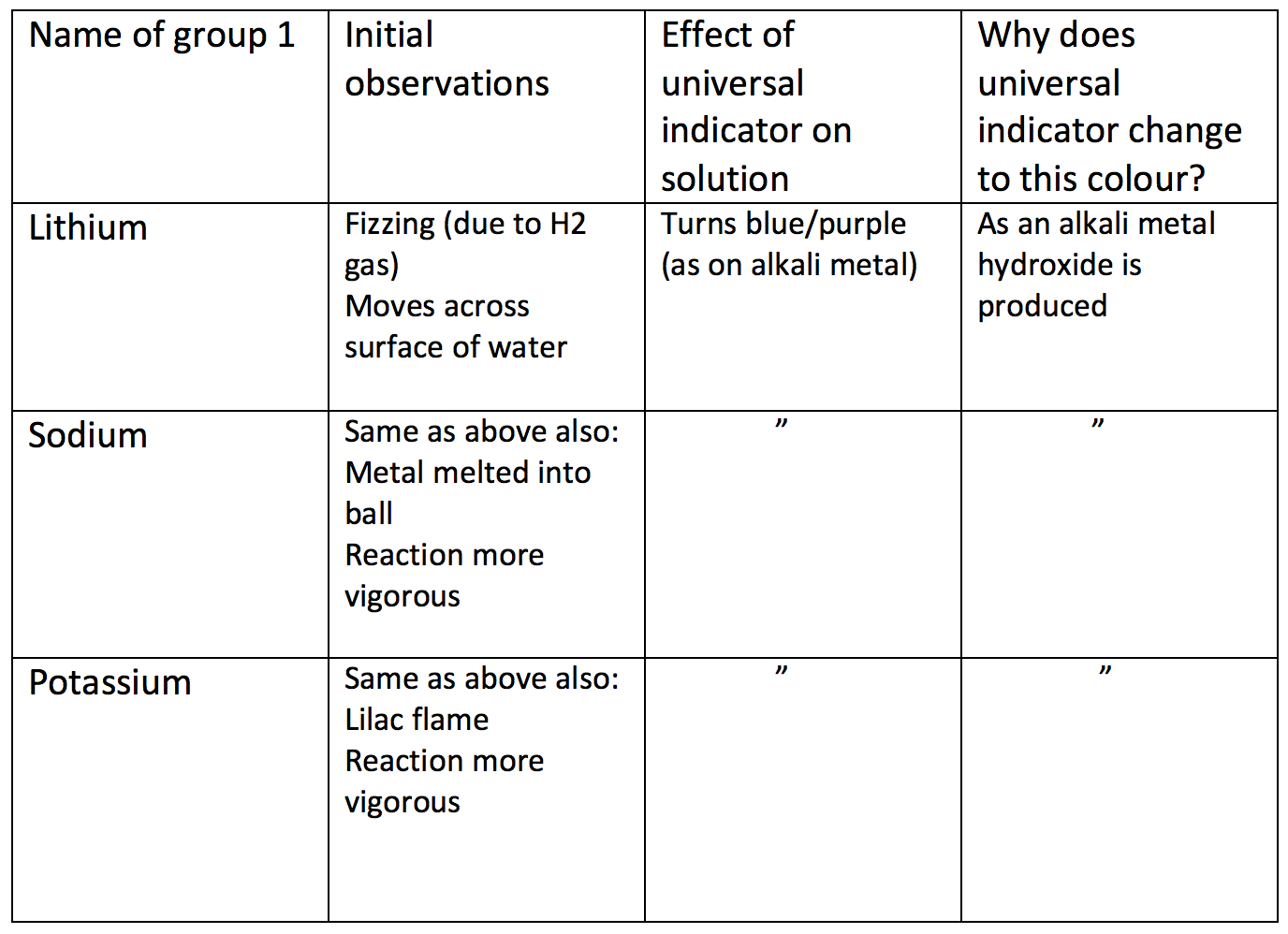
Group 1 (Alkali metals)
Soft metals (get softer as you go down)
Dull grey colours (oxidisation)
When heated in air, group 1 metals react with oxygen - forms metal oxide
Eg
Word equation : Sodium + Oxygen → Sodium Oxide
Chemical equation : 4Na + O2 → 2Na2O
Density of water - 1g/cmº2
General word equation:
GROUP 1 METAL + WATER → METAL HYDROXIDE + HYDROGEN GAS
Eg
Lithium + water → Lithium hydroxide + hydrogen
2Li + 2H2O → 2LiOH + H2
Group 7 (Halogens)
Less reactive going down group
Group 7 elements are referred to as DIATOMIC non-metals
Diatomic molecule - molecule consisting of 2 atoms chemically combined
Information
- Description
- Year 9 Chemistry Note on U4 Chemistry, created by Honor Neville on 05/01/2018.
- Created by
- Honor Neville
- Views
- 1
- Rating