
Notes
Chem1510 Notes-Fall2020
Content of the notes (8)
Page 1
Chemistry-chapter 2
Ammonium-common polyatomic cation
Hydroxide, acetate, chlorate, perchlorate, nitrate, carbonate-Common polyatomic anions
Polyatomic Ions
When a group of atoms gain/lose electrons
Ionic Compounds
Ionic compounds are formed by nonmeteals and metals
Electrons transferred from the metal to the nonmetal. The oppositely charged ions attract eachother(only empirical formulas)
Writing Formulas
Compounds electrically neutral
Charge on cation becomes subscript on the anion, vice versa.
Simplify the subscripts
Chemical Nomenclature
The system of naming coumpounds is called chemical nomenclature
Inorganic Nomenclature
Write name of cation, if it can have more than 1 possible charge, write charge as a roman numeral in parentheses. If polyatomic cation, it will end in -ium.
If the anion is an element, change ending to -ide, if the anion is polyatomic, simply write its name.
Patterns in Oxyanion Nomenclature
When there are two oxyanions involving the same element
The one with fewer oxygens ends with -ite
prefix hypo- (Hypochlorite) one less oxygen
The one with more oxygens ends in -ate
Prefix per- (Perchlorate) one more oxygen
Central atoms on the 2nd row have a bond to at most 3 oxygens, those on 3rd row take up to 4.
Nomenclature of Binary Molecular Compounds
The element farther left in the pt or lower in the same group is usually written first
A prefix is used to denote the # of atoms of each element in the compound (mono- is not used on the 1st element listed)
Nomenclature of Organic Compounds
Organic Chemistry is the study of carbon.
Has it's own nomenclature
Simplest hydrocarbons (compounds containing only carbon and hydrogen) are alkanes
1st part of the names listed correspond to the # of carbons (meth-=1, eth-=2, prop-=3, etc)
followed by -ane
Nomenclature of Organic Compounds-alcohols
When a hydrogen in an alkane is replaced with something else (a functional group, like -OH), the name is derived from the name of the alkane.
Ending denotes the type of compound (an alcohol ends in -ol)
When 2 or more molecules have the same chemical formula, but different structures, they are called isomers.
1-Propanol and 2-propanol have the oxygen atom connected to different atoms, but both have the formula C_3H_8O
Page 2
Chemistry Chapter 3
Stoichiometry
Area of study that examines the quantities of substances consumed and produced in chemical reactions
Based on the Law of Conservation of Mass
Chemical Equations
Chemical equations are how chemists represent chemical reactions on paper.
Arrows seperate starting materials(left), reactants, from ending materials (right, products.
Coefficients are used to balance the equation, so that it obeys the law of mass conservation.
Balancing equations
Start with an element that is only in one reactant and product
Balance by changing coefficients, Not subscripts.
Changing subscripts to balance
Hydrogen and oxygen can make water OR hydrogen peroxide
Other symbols in chemical equations
The states of matter for the reactants and products are ofter written in parentheses to the right of each formula or symbol (g), (s), (l).
Other symbols used to represnt conditions during a reaction. (triangle) over reaction arrow, which means heat is needed for a reaction.
Simple Patterns of Chemical Reactivity
Combination reactions
Decomposition rections
Combustion reaction
Combination Reactions
In a CR, 2 or more substances react to form one product.
CR Predictions: Metal and Nonmetal
Product of the combination reaction between a metal/nonmetal predictable
Decomposition Reactions
In a DR, 1 substance breaks down into 2 pr more substances.
Metal carbonates decompose when heated to give off carbon dioxide and a metal dioxide.
Balancing these equations is based on the charge of the metal.
Combustion Reactions
CRs are rapid reactions that produce a flame.
When burning compounds with C and H in them, the products are CO_2 and H_2O
Formula Weight
A FW is the sum of the atomic weights for the atoms in a chemical formula.
This is the quantitative significance of a formula.
For atoms like Na, the FW is the atomic weight (23.0 amu)
For an ionic compound, use the empirical formula.
Molecualr Weight (MW)
If the substance is a molecule, the formula weight is also called it's MW
A MW is the sum of the atomic weights of the atoms in a molecule.
Avogrado's Number
1 mole is 6.02x10^23 atoms or molecules.
A quantity of particles.
Molar Mass
A MM is the mass of 1 mol of a substance
It is the atomic weight for the element from the P table. If diatomic, it is twice that weight.
Mole Relationships
1 mole of atoms, ions, or molecules contains Avogrados number of those particles.
# of atoms of an element in a mole is the subscript in a formula (# of atoms of element in formula) times Avogadros #.
Converting Amounts
Moles provide a bridge from the molecular scale to the real-world scale.
Using equalities, we can convert from mass to atoms or from atoms to mass.
Determining Empirical Formulas
3 steps:
assume 100g sample and find the mass in grams of each element
Use molar masses to determine the # of moles of each element
Calculate the mole ratio
Determining a Molecular Formula
Combustion Analysis
Compounds containing C, H, and O are routinely analyzed through combustion in a chamber.
Mass of C is determined from mass of CO_2
Mass of H is determined from the mass of H_2O
Mass of O is determined by the difference of the mass of the compound used and the total mass of C and H
The mass of O in the compound can NOT be determined from CO_2 and H_2O because O is added during combustion
Heat and Stoichiometry
Heat does NOT appear in a balanced equation
(Chp 5)
Limiting Reactants
The LR is the reactant present in the smallest stoichiometric amount.
It is the reactant you will run out of first
The LR is used in all stoichiometry calcs to determine amounts of products that are produced and amounts of any other reactants that are used in a reaction.
Theoretical Yield
The theoretical yield is the maximum amount of product that can be made.
-(the amount of product possible as calculated through the stoichiometry problem.)
Different than actual yield, which is the amount one actually produces and measures.
Page 3
Chemistry Chapter 4
Solutions
Solutions are homogeneous mixtures of two or more pure substances.
The solvent is present in greatest abundance.
All other substances are solutes.
When water is the solvent, the solution is called an aqeous solution.
Aqeous Solutions
Substances can dissolve in water by different ways:
-Ionic compounds dissolve by dissociation, where water surrounds the seperated ions.
-Molecular compounds interact with water, but most do not dissociate
Some molecular substances react with water when they dissolve
-All substances dissolve by solvation, surrounding of the solute by solvent.
Electrolytes and Nonelectrolytes
An electrolyte is a substance that dissociates into ions when dissolved in water.
A nonelectrolyte maydissolve in water, but it oes not dissociate into ions when it does so.
A strong electrolyte dissociates completely when dissolved in water.
A weak electrolyte only dissociates pertially when dissolved in water.
A nonelectrolyte does NOT dissociate in water.
Strong vs. Weak electrolytes
A strong electrolyte dissociates completely when dissolved in water.
A weak electrolyte only dissociates partially when dissolved in water. It's equations indicate a chemical equilibrium, where a reaction goes both forward and backward.
Solubility of Ionic Compounds
Not all ionic compounds dissolve in water.
A list of solubility rules is used to decide what combination of ions will dissolve.
All nitrates and acetates are soluble!
NH+_4 is always soluble
Group 1 metals: Always soluble
Metathesis (Exchange) Reactions
Metathesis comes from a greek word that means "to transpose"
It appears as though the ions in the reactant compounds exchange, or transpose, ions
Molecular Equation
The ME lists the reactants and products without indicating the ionic nature of the compounds. The only indication of the overall reaction is the states of matter given.
Complete ionic Equation
In the CIE all electrolytes (strong acids, bases, and soluble ionic salts) are dissociated into their ions.
More accuratley reflects the species that are found in the reaction mixture.
Net Ionic Equations
To form the NIE, cross out anythings that does not change from left to right on the equation
Ions crossed out are called spectator ions.
The remaining ions are the reactants that form the product, an insoluble salt in a precipitation reaction, as in this example.
How to write NIE
Write a balanced equation for the reaction
Rewrite the equation to show the ions that form in solution when each soluble strong electrolyte dissociates into its ions.
Only strong electrolytes dissolved in aq solutions are written in ionic form.
Acids
Arrhenius definition: Acids are substances that increase the concentration of H+ when dissolved in water.(They ionize to form H+ in aq solution)
Bronsted-Lowry definition: Acids are substances that act as proton donors (H+ is just a proton)
Bronsted Lowry acids are more broadly defined, as they are not restricted to aq solutions.
Bases
Arrhenius definition: Bases are substances that increase the concentration of OH- when dissolved in water (They ionize to form OH- in aq solution)
Bronsted lowry definition: Bases are substances that act as proton acceptors
Strong or weak
Strong acids completely dissociate in water, weak acids only partially dissociate.
Strong bases dissociate to metal cations and hydroxide anions in water, weak bases only partially react to produce hydroxide anions.
Strong or Weak electrolyte
Is the substance ionic or molecular? If it is ionic, itis a strong electrolyte. (as long as its soluble)
Molecular: is it an acid or a base? If not, it is a nonelectrolyte.
If it starts with H or ends in COOH, it is an acid. If it is NOT on the list of strong acids, it is a weak acid. (stron acid=strong elec.;weak acid=weak elc.)
Strong bases are strong electrollytes;NH3 is a weak base(weak elec.)
Neutralization Reaction
Reactions between an acid and a base are called neutralization reactions.
When the base is a metal hydroxide, water and a salt (an ionic compound) are produced.
These equation can be written as molecular, complete ionic, or net ionic equations.
NR with gas formation
Some metethesis reactions do NOT give the product expected
When a carbonate or bicarbonate reacts with an acid, the products are a salt, carbion dioxide, and water.
Application of Neutralization Reactions: Antacids
Oxidation-Reduction Reactions
Loss of electrons os oxidation
Gain of electrons is reduction
One cannot occur without the other
Called redox reactions
Oxidation Numbers
To determine if an ox-red reaction has occured, we assign an ox # to each element
Rules to assign ox numbers
Atoms in their standard elemental form have an oxidation number of 0
The ox number of a monatomic ion is the same as it's charge
Nonmetals usually have - ox #s, although they can sometimes be +
Oxygen-usually -2, except in the peroxide ion, where it is -1.
Hydrogen- usually +1 when bonded to a nonmetal and -1 when bonded to a metal.
Flourine- -1, other halogens- usually -1 unless combined with oxygen(oxyanions), where they will be +.
The sum of the ox # in a neutral compound is 0. The sum of the ox # in a polyatomic ion is the charge on the ion. (count every atom!)
Displacement Reaction
In DR, ions oxidize an element.(H oxidizes Mg)
The ion is displaced in solution (Mg replaces H)
Titration
A titration is an alalytical technique in which one can calculate the concentration of a solute in a solution.
A solution of known concentration, called a standard solution, is used to determine the unknown
Page 4
Chemistry 5
Energy
From chp 1, energy is the ability to do work or transfer heat.
Thermodynamics is the study of energy and its transformations.
Specifically. thermochem is the study of chemical reactions and the energy changes that involve heat.
Chem Energy is mainly Potential Energy
The most important form of potential energy in molecules is electrostatic potential energy.
Electrrostatic attraction is seen between oppositely charged ions.
Attraction Between Ions
Energy is released when chemical bonds are formed; energy is consumed when chemical bonds are broken.
Units of Energy
The unit pf energy commonly used is the Joule
An older, non-SI unit that is still in widespread use is the calorie
This is not the same as a food Calorie(note the capital C) which is actually equal to 1 kilocalorie.
First Law of Thermodynamics
Energy can be converted from 1 form to another, but it is neither created nor destroyed.
To heat your home, chem energy needs to be converted to heat.
Sunlight is converted to chemical energy in green plants.
There are many more examples of conversion of energy.
Definition: System and Surroundings
The portion of the universe that we single out to study is called the system
The surroundings are everything else
Types of systems
Open System: a region of the universe being studied that can exchange heat and mass with its surroundings.
Closed system: a region of the iniverse being studied that can only exchange heat with its surroundings (not mass)
Isolated system: a region of the universe that can not exchange heat or mass with its surroundings
Internal Energy
The internal energy of a system is the sum of all kinetic and potential energies of all components of the system; we use E to represent it.
We generally don't know E, only how it changes.
Internal Energy
By definition, the change in internal energy is the final energy of the system minus the initial energy of the system.
Thermodynamic Quantites Have 3 Parts
number
unit
sign
A +E results when the system gains energy from the surroundings
A -E results when the system loses energy to the surroundings
Changes in Internal Energy
When energy is exchanged between the system and the surroundings, it is exchanged as either heat (q) or work (w)
change in E=q+w
Exchange of Heat Between System and Surroundings
When heat is absorbed by the system from the surroundings, the process is endothermic
When heat is released by the system into the surroundings, the process is exothermic
Usually we have no way of knowing the initial energy of a system; finding that value is simply too complex a problem
However, we do know that the internal energy of a system is independant of the path by which the system achieved a given state.
State Functions
Therefor, internal energy is a state function.
It depends only on the state of the system, not
State function
q and w are not state functions. They depend on the taken path.
Work
Usually the only work done by chemical or physical change is the mechanical work associated with a change in volume of gas.
W=-(P x change inV)
We can measure the work done by the gas if the reaction is done in a vessel that has been fitted with a piston
The work is - because it is work done by the system
Hess's Law
Change in H is well known for many reactions, and it is inconvenient to measure C.in.H for every reaction we are interested in.
Intead we can get C.in.H using published C.in.H values and the properties of enthalpy.
The Bohr Model
Electrons in the lowest energy state are in the ground state
The Wave Nature of Matter
Louis de Broglie theorized that if light can have material properties, matter should exhibit wave properties.
He demonstrated that the relationship between mass and wavelength was:
lamda=h/mv
The Uncertaity Principle
Heisenberg showed that the more precisely the momentum of a particle is known, the less precisely it's position is known.
(ch.X)(ch. mv)>h/4pie
Quantum Mechanics
Erwin schrodinger developed a methematical treatment into which both the wave and particle nature of matter could be incorporated
known as quantum mechanics
The solution of schrodinges wave equation for hydrogen yields wave functions for the electon
The square of the wave function gives the electron density, or the probability of where an electron is likely to be at any given time.
Quantum Numbers
Solving the wave equation gives a set of wave functions, or orbitals, and their correspomding energies
Each orbital describes a spatial distribution of electron density
An orbital is described by a set of three quantum numbers
Principal Quantum Number (n)
The principal quantum number, n, describes the energy level on which the orbital resides
The values of n are integers > 1
These correspond to the values in the Bohr model.
Angular Momentum Quantum Number
This quantum number defines the shape of the orbital
Allowed values of l are integers ranging from 0 to n-1
Letter designates the different values of l. This defines the shape of the orbitals.
Magnetic Quantum Number(m_l)
The magnetic quantum number describes the 3 dimensional orientation of the orbital
Allowed values of m_l are integers ranging from -l to l including 0:
-l < m_l < l
Therefore, on any given energy level, there can be up to 1 s orbital, 3 p orbitals, 5 d orbitals, and so forth.
Orbitals with the same value of n form an electron shell
Different orbital types within a shell are subshells (l)
s orbitals
The value of I for s orbitals is 0
They are spherical in shape
The radius of the sphere increases with the value of n
A radial probability function shows the probability of finding the electron as a function of distance from the nucleus.
For an ns orbital, the number of peaks is n.
For an ns orbital, the number of nodes (where there is 0 probability of finding the electron) is n-1
As n increases, the elctron density is more spread out and there is a greater probability of finding an electron further from the nucleus.
p Orbitals
The value of l or p orbital is 1
They have 2 lobes with a node between them
d Orbitals
The value of l for a d orbital is 2
4 of 5 d orbitals have four lobes, the other resembls a p orbital witha doughnut around the center.
f Orbitals
Very complicated shapes
7 equivelent orbitals ina sublevel
l=3
Energies of Orbitals- Hyrdrogen
For a 1-electron hyrdrgen atom, orbtials on the same level have the same energy
Chemeists call them degenerate orbitals
Energies of orbitals-Many electron Atoms
As the # of electrons increases, the repulsion increases beteween them
In atoms with more than 1 electron, not all orbitals on the same energy level are degenerate
Orbitals sets in the same sublevel are still degenerate
Energy levels start to overlap in energy (4s is lower in energy than 3d)
Spin Quantum Number, ms
In the 1920s, it was discovered that 2 electrons in the same orbital do not have exactly the same energy
The spin of an electron describes its magnetic field, which affects its energy
This led to the spin quantum #, ms
The spin quantum number has only 2 allowed values, +1/2 and -1/2
Pauli Exclusion Principle
No 2 electrons in the same atom can have the same set of 4 quantum numbers!
This means that every electron in an atom must differ by at least one of the four quantum number values: n, l, ml, ms.
For a given orbital, the values of n, l, ml, are fixed. Therfore, each orbital can only hold two electrons with opposing spins
Electron Configuration
The way electrons are distribited in an atom is called its electron configuration
The most stable organization is the lowest possible energy, called the ground state.
Each component consists of:
-A # denoting the enrgy level
-A letter denoting the type of orbital
-The superscript denoting the # of electrons in those orbitals
Orbital Diagrams
Each box in the diagram represents one orbital
Half-arrows represent the electrons
The direction of the arrow represents the relative spin of the electron.
Hunds Rule
When filling degenerate orbitals the lowest energy is attained when the number of electrons having the same spin is maximized.
This means that for the set of oritals in the same sublevel, there must be one elctron in each orbital before pairing and the electrons have the same spin, as much as possible.
Condensed Electron Configurations
Elements in the same group of the periodic table ahev the same number of elctrons n the outer most shell. These are the valence electrons.
The filled inner shell electrons are called core electrons. These include completely filled d or f sublevels
We write a shortened version of an electron cinfig using brackets around the noble gas symbol and listing only valence electrons.
Transition Metals
Argon(18) ends period 3. Its electron configuration is 1s2 2s2 2p6 3s2 3p6.
Potassium(19) might be expected to have electrons in 3d, but 4s fills next.
Transition metels follow the filling of 4s by filling 3d in the 4th period
Lanthanides and Actinides
The elements which fill the f orbitals have a special names as a portion of a period, not as a group.
The lanthanide elements have electrons enterig the 4f sublevel
The actinide elements have electrons entering the 5f sublevel.
Periodic Table
We fill orbitals in increasing order of energy
Different blocks on the periodic table correspond to different types of orbitals: s=bl
Page 5
Chapter 7 -Periodic Properties of the Elements
Development of the Periodic Table
Dmitri Mendeleev and Lothar Meyer independently came to the same conclusion about how elements should be grouped.
Mendeleev and the PT
Chemists mostly credit mendeleev because he also used chem properties to organize the table and predicted some missing elements and their expected properties (germanium)
Atomic Number
Mendeleevs table was based on atomic masses, as it was the fundamental property of elements known at the time.
35 years later, the nuclear atom was discovered by Rutherord
Periodicity
Periodicity is the repetitive pattern of a property for elements based on aomic number.
Effective nuclear charge
many properties depend on attractions between valence electrons and the nucleus.
Electrons are both attracted to the nucleus and repelled by other electrons.
The forces an electron experiences depend on both factors
The enc, Zeff, is found this way
enc is a periodic property: increases across a period, increases slightly down a group
What is the size of an atom?
The nonbonding atomic radius, or van der waals radius, is half of the shortest distance seperating two nuclei during a collision of atoms.
The bonding atomic radius, or covalent radius, is half the distance between nuclei ina bond.
Size of Atoms
This figure shows the trend in bonding atomic radius.
The bonding atomic radius tends to
-decrease from left to right across the period
-increase from top to bottom of a group
Sizes of ions
Determined by interatomic distances in ionic compounds
Ionic size depends on
-The nuclear charge
-The # of electrons
-The orbitals in which electrons reside
Periodic Trends in 1st Ionization Energy
I1 generally increases across a period
I1 generally decreases down a group
The s and p block elements show a larger range of values for I1. (d block increases slowly across a period, f block elements show only small variations)
Factors of IE
Smaller atoms have higher I values
I values depend on effective nuclear charge and average distance of the electron from the nucleus.
Irregularities in the gen trend
The trend is not followed when the added valence electron in the next element.
eners a new sublevel (higher e sublevel)
nitrogen and oxygen for ex.
Electron Affinity
EA is the energy change accompanying the addition of an electron to a gaseous atom:
Cl+e-=Cl-
Gen Trend in EA
Not much change in a group
Across a period, it generally increases. 3 notable exceptions include the following
Group 2A: s sublevel is full
Group 5A: p sublevel is half full
Group 8A: p sublevel is half full
ea for many of these elements is positive
Page 6
CHP 8 Basic concepts of chemical bonding
Chemical bonds
3 basic types of bonds
ionic-Electrostatic attraction between ions
Covalent-Sharing of electrons
Metallic-Free elctrons hold metal atoms together
Lewis Symbols
developed a method to denote potential bonding electrons by using one dot fo every valence electron around the element symbol.
When forming compounds, atoms gain, lose, or share electrons until they are surrounded by 8 valenec electrons (the octete rule)
Ionic bonding
Metals and nonmetals (except 8A)
Electron transfer
Very exothermic process
1 element readily gives up an electron (has a LOW ionization energy)
Another element readily gains an electron (has a HIGH electron affinity)
Arrows indicate the transfer of electrons
Properties of ionic substances
Evidence of well defined 3-D structures:
-Brittle
-high melting points
-crystalline
-leaves along smoooth lines
Energies of ionic bonding-Born-Haber cycle
Many factors affect the energy of ionic bonding.
Start with the metal and nonmetal elements: Na(s) and Cl2(g)
Make gaseous atoms: Na(g) and Cl(g)
Make ions: Na+(g) and Cl-(g)
Combine the ions: NaCl(s)
Energies of Ionic Bonding
It takes energy to convert elements to individual gaseous atoms (endothermic)
Lattice Energy
Energy required to completely separate one mole of a solid ionic compound into its gaseous ions
That amount of energy is released to make the ionic
Lattice energy increases with: increasing charge on the ions
Electron Config of Ions
Main group metals lose elctrons, resulting in the elc. config. of the previous noble gas.
Nonmetals gain electrons, resulting in the elctron config. of the nearest noble gas.
Nonmetals gain elecs, resulting in the elc config of the nearest noble gas
Trans metals DO NOT follow the octet rule
Transition metals lose the valence electrons first, tthen lose the d-electrons necessary for the given ion charge.
Covalent Bonding
In covalent bonds, atoms share electrons.
Several electrostatic interactions:
-Attractions between electrons and nuclei
-Repulsions between electrons
-Repulsions between nuclei
For a bond to form, the attractions must be greater than the repulsions.
Lewis Structures
Sharing elecs to make covalent bonds can be demonstrated using lewis structures
Give each atom the same # of elecs as the nearest noble gas by sharing elecs
The simplest examps are for H, H2, and Cl, Cl2.
Number of Bonds for nonmetals
The group number is the number of valence electrons.
To get an octet, like the nearest noble gas, in the simplest covalent molecules for nonmetals, the number of bonds neede will be the same as the electrons needed to complete the octet.
Electrons on Lewis Structures
Lone pairs: electrons located on only one atom in a lewis structure.
Bonding pairs: shared electrons in a lewis structure; they can be represented by two dots or one line, but NOT both together
Multiple Bonds
Some atoms share only 1 pair of electrons. These bonds are called single bonds.
2 pairs shared=double bonds
3 bonds=triple bonds
Polarity of Bonds
The elcs in a covalent bond are not always shared equally.
Bond polarity: a measure of how equally or unequally the electrons in a covalent bond are shared.
In a nonpolar covalent bond
Electronegativity
Electronegativety is the ability of an atom in a molecule to attract electrons to itself.
E gen increases as you go:
left to right
bottom to top
Electronegativety and Polar covalent bonds
When two atoms share electrons unequally, a polar covalent bond results
Elecs tend to spend more time around more elcn atoms. The result is a partial negative charge (not a complete transfer of charge). symbol -
The other atom is "more positive", or symbol+.
Polar cov. bonds
The greater the diff in elecn, the more polar the bond.
Dipoles
When 2 equal. but opposite, charges are separated by a distance, a dipole forms
A dipole moment, mew, produced by 2 equal but opposite charges separated by a distance, r, is calculated.
Measured in debyes (D)
mew=Qr
Is a compound ionic or covalent
Metal+nonmetal=ionic
nonmetal+nonmetal=covalent
Exceptions= oxidation # of certain metals (higher ox # = covalent bonding)
Electronegativety difference can be used
Properties of compounds are best, lower melting points = covalent
Writing Lewis Structures
Sum the valence electrons from all atoms, taking into account overall charge.
If an anion, add 1 elec for each neg charge
If a cation, subtract 1 elec for each pos charge.
Resonance
1 lewis structure cannot accurately depict a molecule like ozone
We use multiple structures, resonance structures, to describe the molecule.
Resonance structures commonly depeicted as a hexagon with a circle inside to signify the delocalized elctrons in the ring.
Exceptions to the octet rule
There are 3 types of ions or molecules that do not follow the octet rule:
-Ions/mols with an odd # of elecs
-Ions/mols with less than an octet (2nd period before carbon able to make stable compounds with -8 elecs)(B,Be)
-Ions/mols with more than 8 valence elecs (an expanded octet) (periods 3-6, can use d orbitals to make +4 bonds and be hypervalent)
Page 7
Ch 9
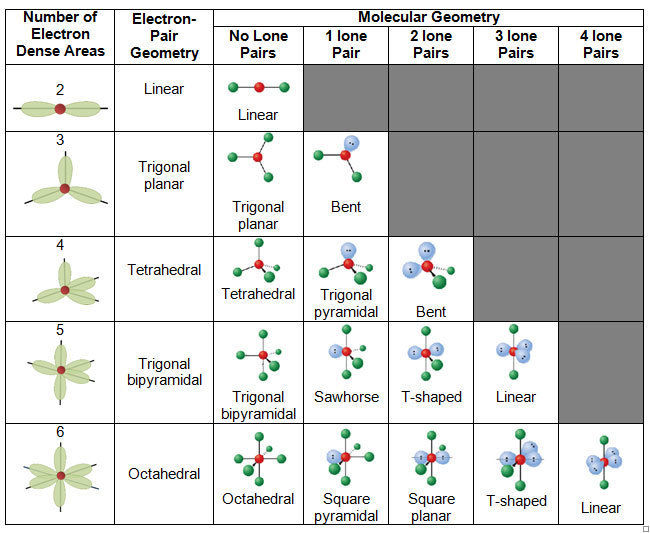
Molecular shapes
Lewis structures show bonding and lone pairs but do not denote shape
However, we can use lewis structures to help us determine shapes.
What detremines the shape of a molecule
The bond angles and bond lengths determine the shape and size of molecules
Electron pairs repel each other
Electron pairs are as far apart as possible; this allows us to predict the shape of the molecule
This is known as the valence shell electron pair repulsion (VSEPR) model
Electron Domain
We can refer to the directions to which electrons point as electron domains. This is true whether there is one or more electron pairs pointing in that direction. It is also true if it is a lone pair or a bond.
Valence shell elec pair repulsion model
The best arrangement of a given number of elctron domains is the one that minimizes the repulsions among them.
Molecular geometries
Draw the best lewis structure
Determine the lectron domain geometry
Use the arrangement of the bonded atoms to determine the molec geometry
Linear Electron domain
In the linear domain, there is only 1 molecular geometry: linear
If 2 atom in molecule, the molecule will be linear no matter what the elec domain is
Trigonal planar elec domains
There are 2 molec geometries
Trigonal planar, if all electron domains are bonding elecs
Bent, if one of the domains is a lone pair
4 elec domains
-Tetrahedral, if all bonding pairs
Page 8
Information
- Description
- AP Chemistry Note on Chem1510 Notes-Fall2020, created by Jade Siegrist on 13/10/2020.
- Created by
- Jade Siegrist
- Views
- 3
- Rating