
Notes
Ch 8 Inheritance U2AOS1
Content of the notes (5)
Page 1
8A - The Nature of Genes
Gene: a sequence of DNA that codes the production of a polypeptide
Allele: an alternative form of a gene
Genome: the complete set of genetic material in an organism/cell at a given time
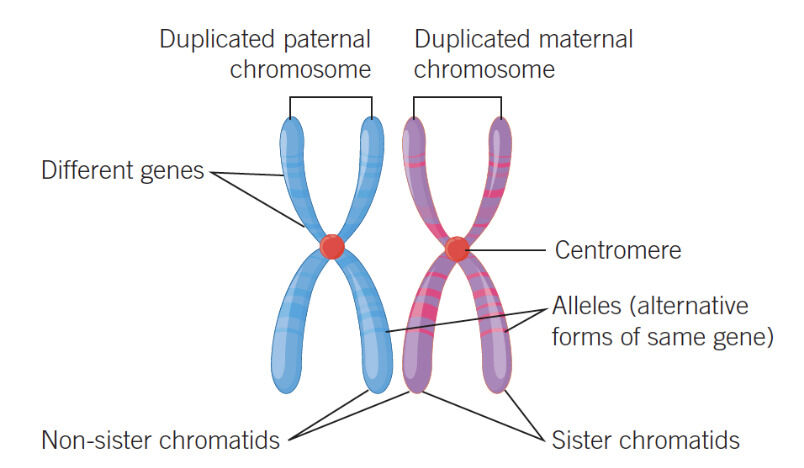
Homologous Chromosomes: chromosomes that have matching structural features (size, banding pattern, centromere location) and gene loci, one from each parent. Image pictured below ↓
Gene Locus: the position of a gene on a chromosome; plural: gene loci
Homologus Chromosomes ↓↓
Nature of Chromosomes
Chromosomes are made up of segments of DNA which are called genes. These genes code for many different proteins. Within a species, homologous chromosomes contain the same sequence of genes at the same gene loci. The alleles for these genes aren't necessarily the same for each chromosome in the pair, however, the two sister chromatids on a double chromosome both have the same gene sequence.
Page 2
8B - Introduction to Genetics
Genotype: the combination of alleles that an organism has for a gene
Phenotype: a physical characteristic in an organism determined by the genotype and/or the environment
Complete Dominance: when the allele for the dominant trait completely hides the allele for the recessive trait
Dominant: trait expressed in a heterozygous individual
Recessive: the trait not expressed in a heterozygous individual
Heterozygous: having two different alleles for a gene
Homozygous: having two copies of the same allele for a gene
Epigenetics: mechanisms that regulate gene expression, causing changes to the phenotype (epi = above, genetics = relating to genes)
Basic Allele Notation
For traits determined by a single gene with only two alleles (complete dominance), instead of writing out the whole DNA sequence geneticists use letters to represent it. Usually, an uppercase or lowercase letter is used to represent the two alleles.
E.g: for the gene that codes for earlobes to be attached or unattached, the letters 'E - Dominant' (Unattached) and 'e - recessive' (attached) can be used to represent the two alleles
The uppercase letter usually represents dominant trait, and the lowercase the recessive trait. The dominant trait is the trait that is seen hen an individual has two different alleles for a gene.
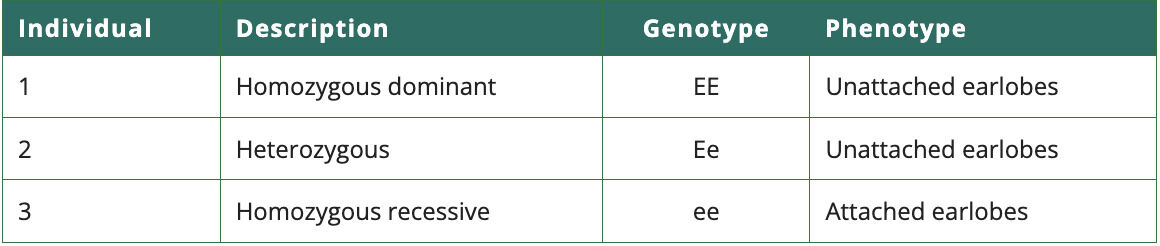
Genotypes and Phenotypes: Pictured below ↓↓
The phenotype is the observable characteristic or trait that is seen in the individual. An organism's phenotype is determined by the genotype. An organism's phenotype can be affected by the environment e.g. melanin - when you are exposed to more sunlight, the pigment in your skin causes you to appear more tanned.
Epigenetics
We know that the genotype and environmental factors determine an individual's phenotype. Along with this, epigenetics can also influence the phenotype. Epigenetic factors affect how genes are 'read' by cells and these changes influence the production of proteins, by regulating whether the genes are 'turned on' or 'turned off' in the cells. This ensures that particular proteins are not produced in cells that don't require them. Epigenetics is also important in helping to determine the specialisation of a cell from its stem cell or as an embryo develops into a foetus and then into a baby.
In epigenetics, many things can cause chemical modifications that turn genes on or off, including:
- The food you eat - Where you live and who you interact with
- Sleep - Exercise - Ageing
Page 3
8C Monohybrid Crosses
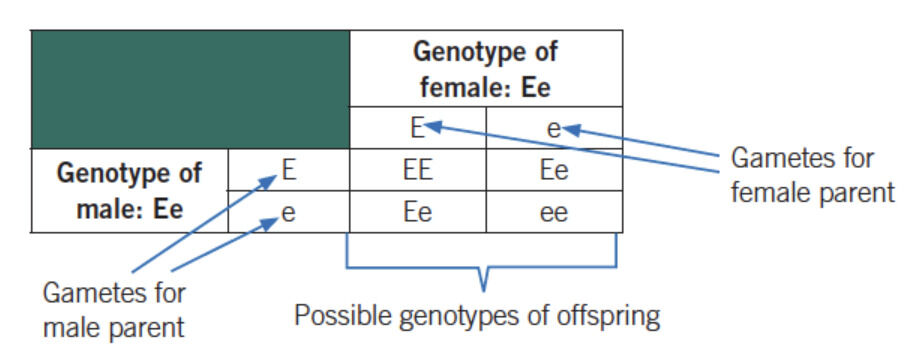
Punnett Square: a diagram used to determine the expected genotypes and phenotypes offspring from the genotypes of both parents. Shown below↓
Monohybrid Cross: a genetic cross carried out to determine the possible genotypes and phenotypes of offspring inheriting one gene only (mono = one, hybrid = the combining of two different elements)
Pure breeding: refers to an individual being homozygous
Multiple alleles: when there are three or more alleles for a gene
Codominant: when both alleles are expressed in the phenotype of an organism
Incomplete Dominance: when the allele for the dominant phenotype does not completely mask the presence of the allele for the recessive phenotype, and a blend of both alleles occurs.
Sex-linked Genes: a gene located on a sex chromosome (X or Y in humans)
X-linked: refers to a gene that is located on the X chromosome (in humans)
Polygenic Trait: a trait that is controlled by more than one gene (poly = many, genic = gene)
Continuous Variation: when a trait does not have distinct phenotypes but instead shows a series of phenotypes on a continuum
Discontinuous Variation: when a trait has only a few phenotypes or discrete categories

Test Crosses
In order to determine an individual's genotype, a test cross is carried out. A test cross involves crossing the dominant parent (with an unknown genotype) with a homozygous recessive parent. The phenotype of the offspring produced can then be used to determine the genotype the genotype of the unknown parent - this is why it's called a 'test cross'.
Codominance and multiple alleles
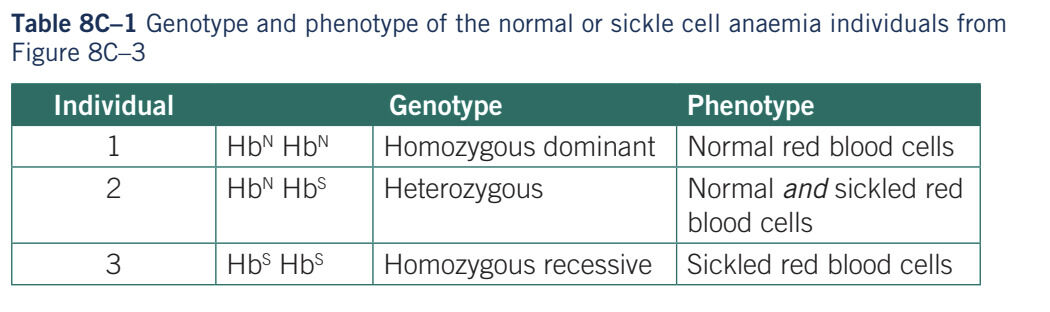
Many characteristics are coded for by more than two alleles (multiple alleles). Even though there are more than two alternative forms of the gene, only two can be present in a single organism and determine their genotype. Rather than using a single letter, geneticists sometimes use a letter or a combination of letters (to represent he name of the gene or its location) with a superscipt letter (to represent the allele). Shown below↓↓
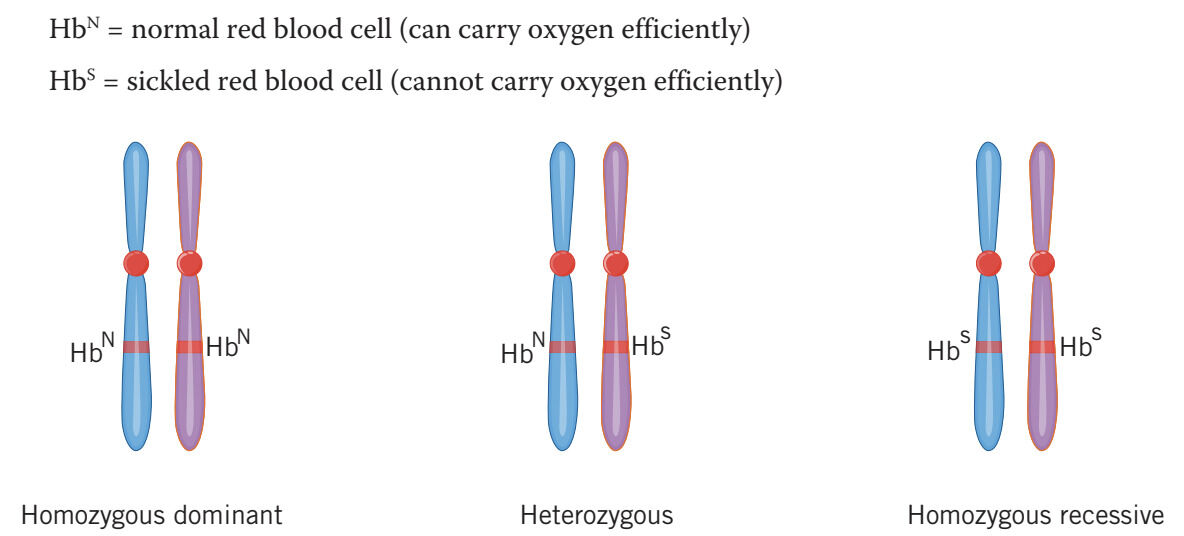
From the 3 individuals shown in the image above, we can combine the two alleles to form their genotype. The phenotype determined by this genotype is shown in the image below ↓↓
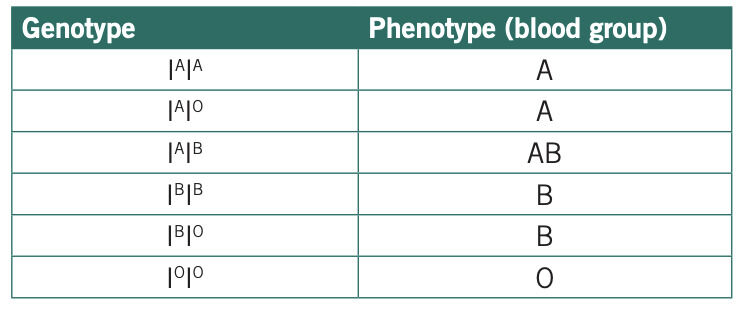
Blood groups are another example of codominance. There are 4 blood groups: A, B, AB, and O. The possible genotypes and phenotypes are shown below ↓↓. This table shows that alleles I^A and I^B are codominant (when both are present, the individual has an AB blood type). Both I^A and I^B are dominant over IO (in other words, IO is masked by the presence of either I^A or I^B).
Incomplete Dominance
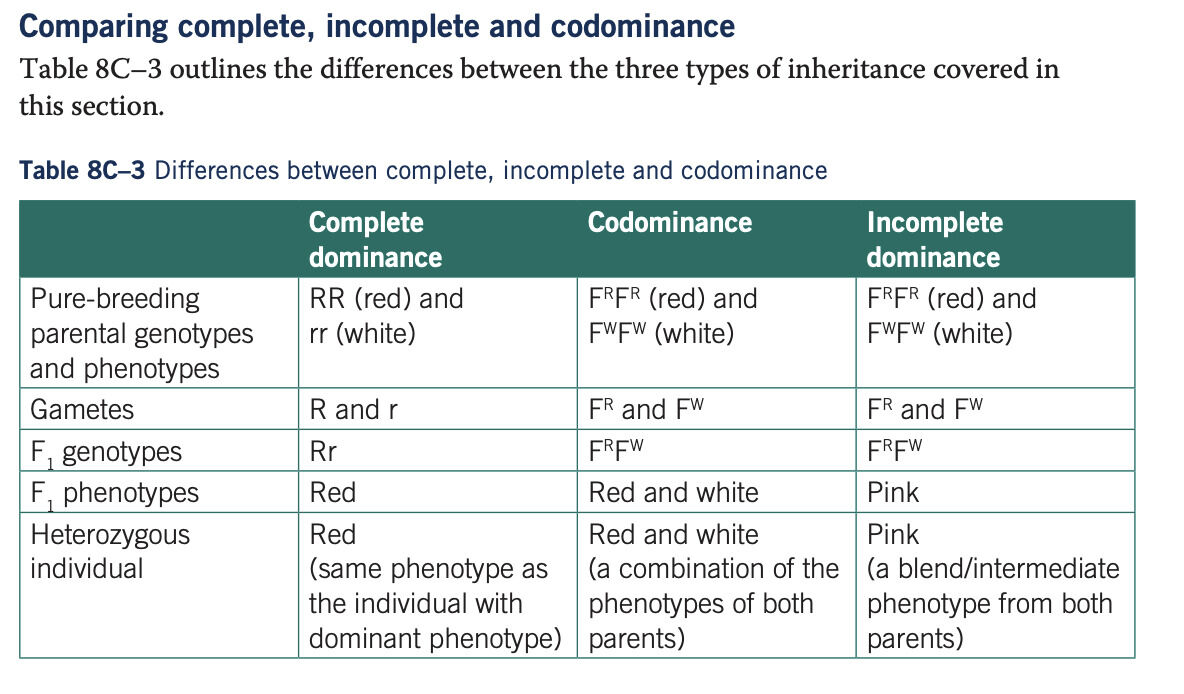
Variations in phenotypes can result when a combination of both parental phenotypes for a given trait is observed in the offspring. This is referred to as codominance. There are also scenarios where one phenotype is not dominant or codominant with the other phenotype. Instead, a kind of intermediate phenotype is observed in offspring, due to a blending of alleles. This is called incomplete dominance.
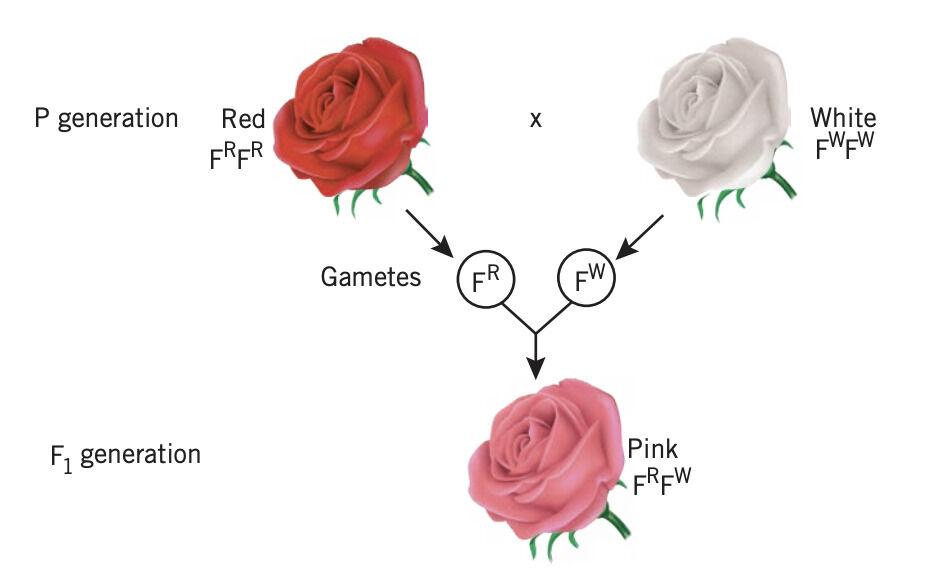
e.g. Incomplete dominance can be shown in roses. When a pure-breeding red rose, with allele F^R, is crossed with a pure-breeding white rose, with allele F^W, the offspring will all be heterozygous. However, rather than showing a red, white, or red and white phenotype, a pink rose is produced (blend of both parents). Shown below ↓↓
Sex-linked genes
The previously discussed genes have been autosomes. Sex chromosomes also contain many genes. A common sex-linked gene located on the X chromosome is one that produces a pigment in the cones of the retina. In some individuals, deficiencies or complete absence of these cones can result in colour blindness. The most common is red-green colour blindness which is caused by an X-linked (located on the x chromosome) recessive gene.
A female has two X chromosomes, and a male has a single X and a single Y chromosome. This means that, for a female to be affected, she must inherit two alleles for the red-green colourblind gene. If she only inherits one copy of the allele, then she is referred to as a carrier. Compared to a male who only needs to inherit one colour blind allele, which must come from the mother as the father passes on the Y chromosome to their sons. Males can never be carriers for a sex linked gene. This is due to other genes having two alleles present in the individual, but males only have one allele.
There are also Y-linked genes. These genes occupy the gene locus on the Y chromosome an therefore in humans, are only present in males. With any Y-linked gene, if the father has the trait, then all his sons l also inherit the trait as he passes the Y chromosome to them. No daughters will show the trait, as they inherit the X chromosome from their father.
Inheritance of Characteristic determined by multiple genes
A monohybrid cross involves a single gene, and is the type of cross discussed so far. Polygenic traits are due to the action of many genes. Some examples of characteristics that are determined by multiple genes are skin colour, eye colour, and height. If height was controlled by a single gene where the allele for one phenotype was completely dominant to the other, there would be short people and tall people, with nothing in between. Polygenic traits show continuous variation, whereas traits determined by a single gene (monogenic) show discontinous variation.
Page 4
8D Dihybrid Crosses
Independent assortment: the random arrangement of pairs of homologous chromosomes during meiosis, resulting in the random combination of alleles into gametes, thereby increasing variation
Unlinked genes: genes that are located on different chromosomes or very far apart on the same chromosome
Dihybrid cross: the study of inheritance for phenotypes of two different genes through the mating of organisms over generations
Linked Genes: two genes that are located on the same chromosome
Independent assortment (unlinked genes)
When an allele for one gene gets sorted into a gamete, it has no influence on the alleles of another gene. In other words, because the two genes under investigation are on different chromosomes, the inheritance of one chromosome from the homologous pair has no effect on the inheritance of a chromosome from the other pair. Therefore, each of the alleles from a given gene has an equal chance of combining with each of the alleles from another gene. These genes are said to be unlinked genes and we know this process as independent assortment.
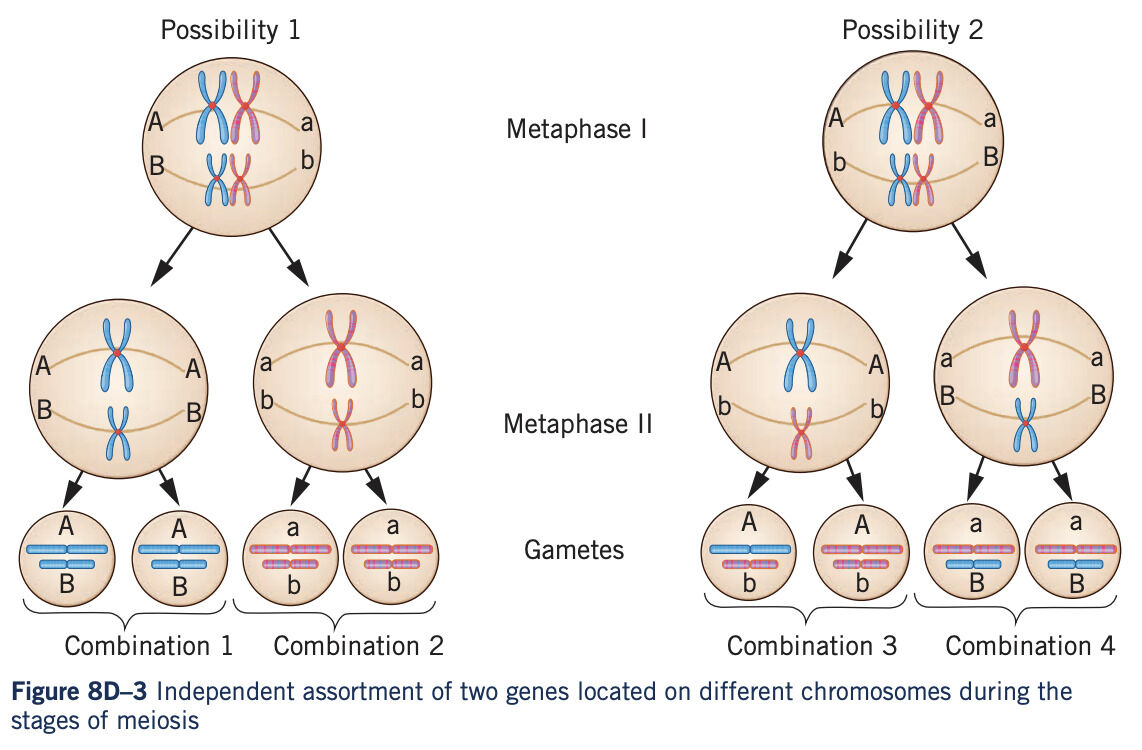
Independent assortment takes place in metaphase I of meiosis, when homologous chromosomes align at the equator of the call. In metaphase I (shown below↓↓), the two genes for seed shape and colour are heterozygous (Aa and Bb). Notice that there are two possible orientations for the two homologous pairs of chromosomes.
Remember that, for each gene, a gamete contains only one allele. When considering two genes, the same rules apply for each gene. Therefore, we would expect four types of gametes to be produced, in roughly an equal number: A B, a b, A b, and a B. These are the four combinations shown below.
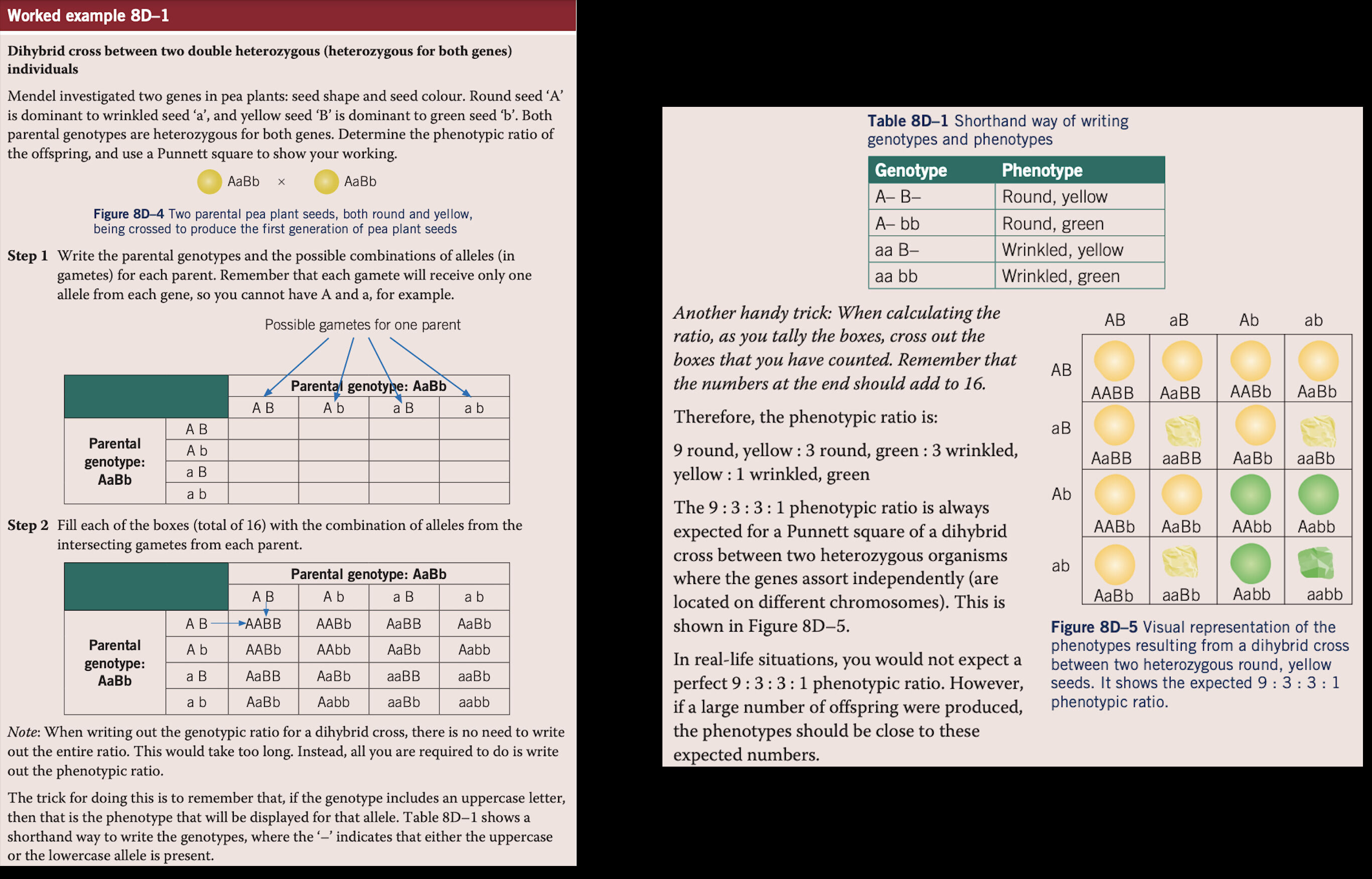
The study of the inheritance of two genes using a Punnett square is called a Dihybrid cross. With a dihybrid cross, because there are more possible combinations in the gametes (four instead of two), the Punnett square will have 16 boxes, rather than four. Shown Below ↓↓
Dihybrid test crosses
A test cross includes one organism that is homozygous for the recessive trait(s) (in dihybrid test crosses, a double homozygous recessive). This organism is crossed with another organism that shows the dominant phenotype(s). The purpose of a test cross is to identify the genotype of the organism with the dominant phenotype(s) as homozygous or heterozygous. And, more importantly in dihybrid crosses, it is also to determine whether the two genes under investigation are linked or unlinked (assorting independently).
Page 5
8E Pedigrees
Pedigree Chart: a chart used to trace the inheritance of a phenotype over generations
Parental generation (P): the first set of parents in a cross/pedigree
first filial generation (F1): offspring resulting from the parental cross/generation
Pedigree numbering rules
In questions, you will often also see the first generation (I) referred to as 'P'. This 'P' stands for parental generation. Their children can then also be referred to as 'F1', meaning first filial generation. These are the offspring from that parental cross/mating. Following on from this, the next generation, or second filial generation, is known as 'F2'.
Analysing Pedigrees
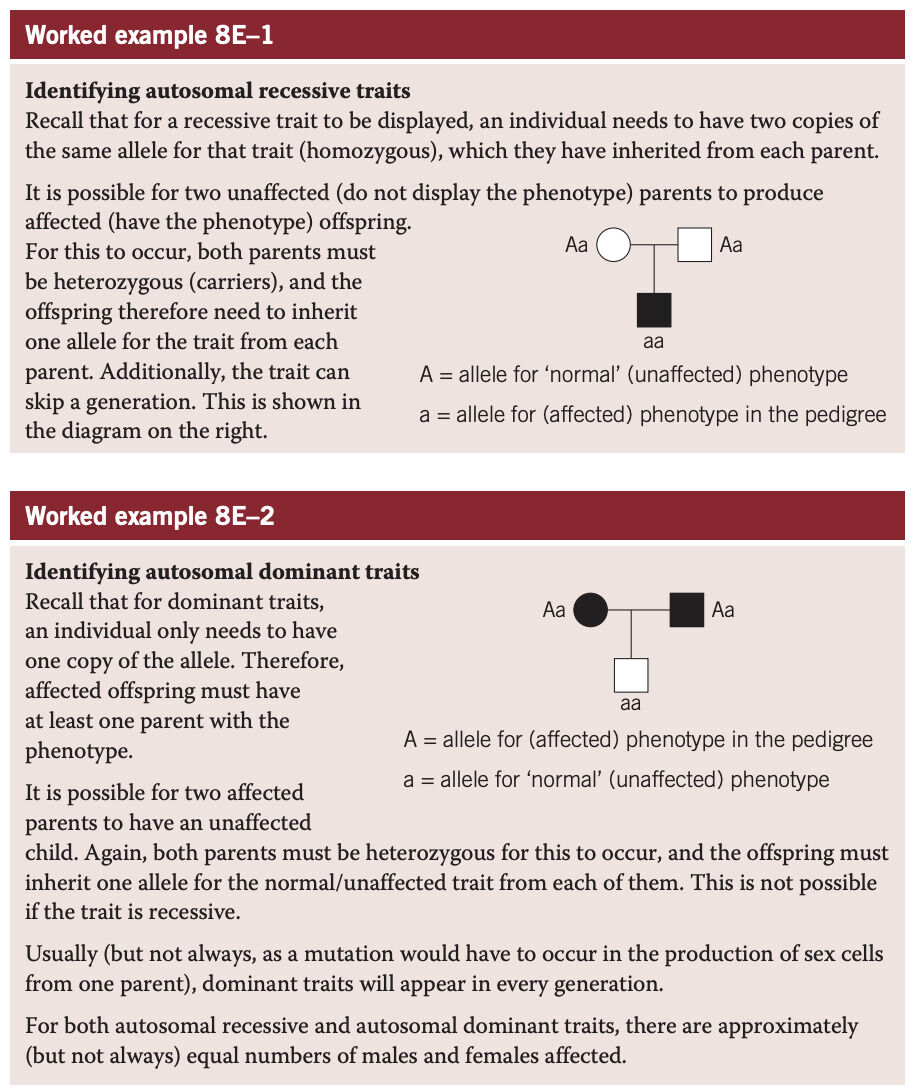
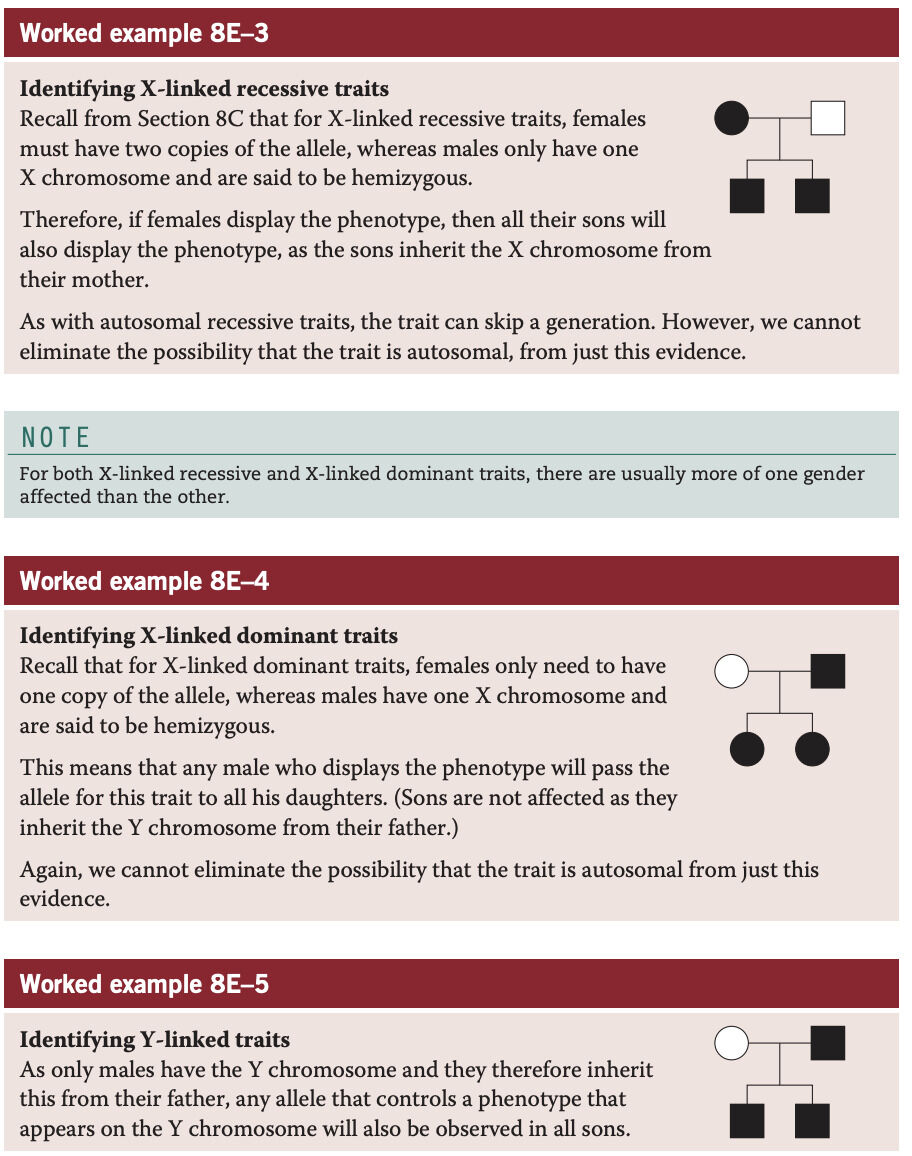
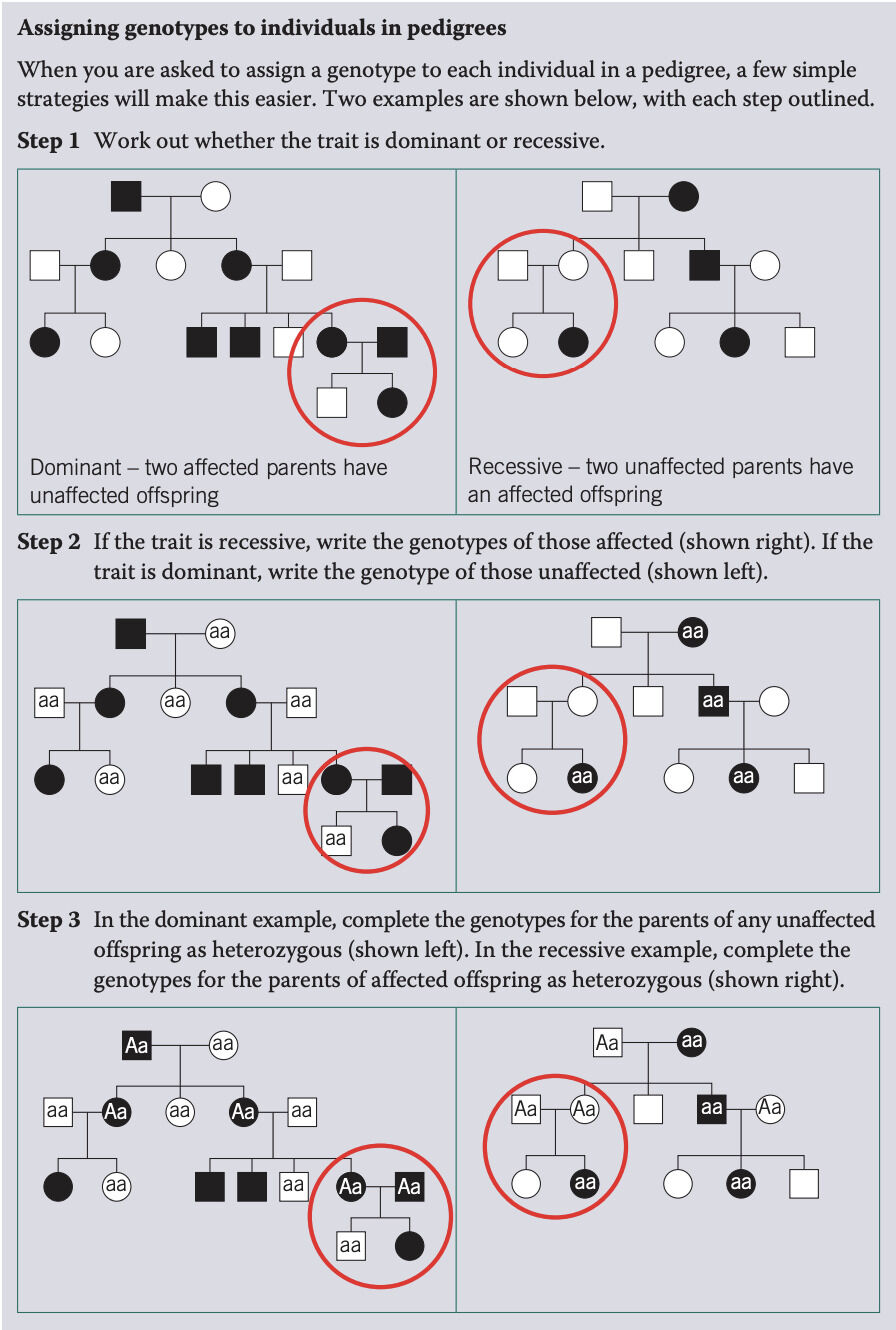
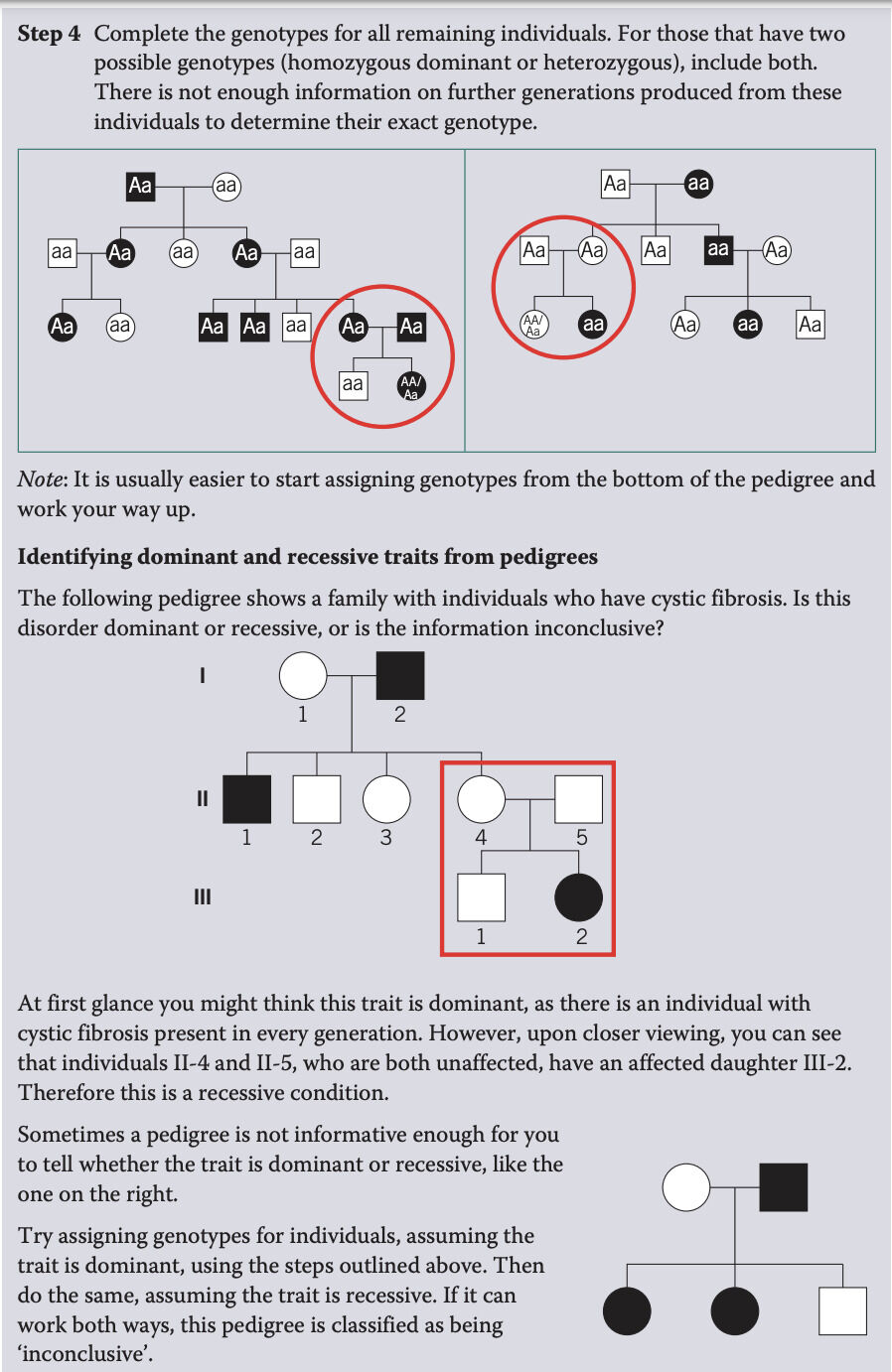
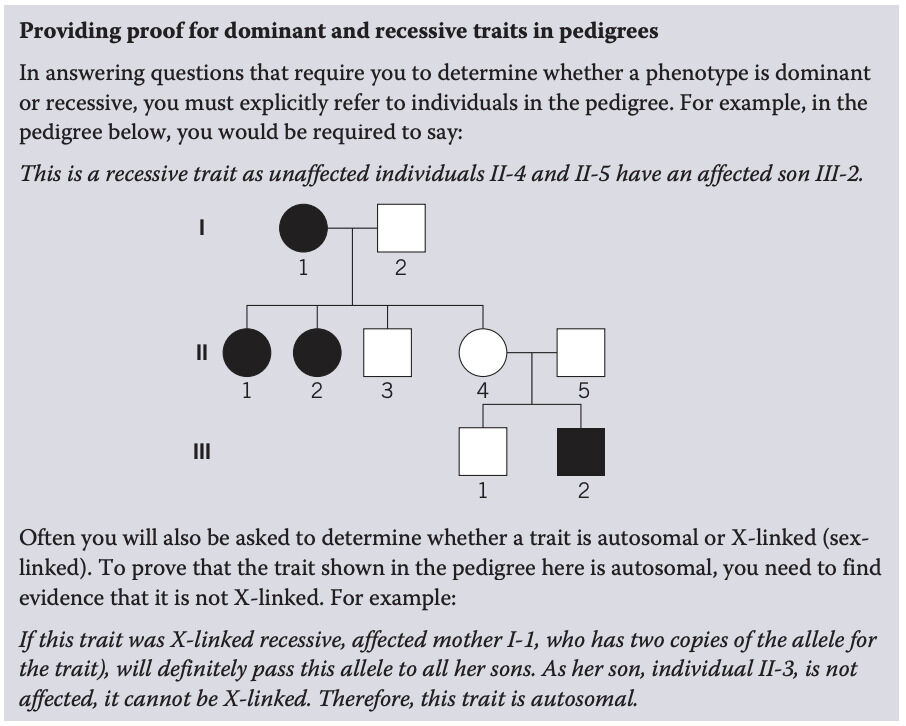
Genetic disorders arise from mutations and these disorders may be dominant or recessive. Their gene locus may be on an autosome or a sex chromosome. The alleles for these phenotypes are passed on to offspring from the parents. The advantage of observing individuals in the pedigree is that you can determine whether a disorder (or any trait) is dominant or recessive and also predict the transmission from parents to offspring. In order to do this, you will need to use knowledge of genotypes and phenotypes, dominant and recessive, homozygous and heterozygous, and Punnett squares. Some traits and their patterns to watch are described Below↓↓.
Information
- Description
- Year 11 Biology Note on Ch 8 Inheritance U2AOS1, created by Bec F on 13/10/2023.
- Created by
- Bec F
- Views
- 3
- Rating