
Notas
Lipids and triglycerides
Conteúdo das notas (1)
Página 1
Lipids.
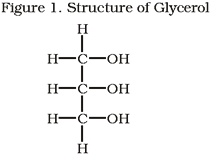
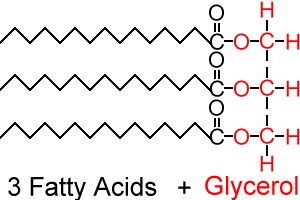
Lipids are fats made up of molecules of glycerol and fatty acids
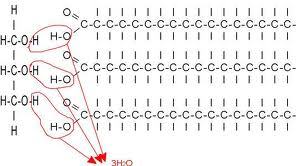
These join together in a condensation reaction, creating a ester bond.
=
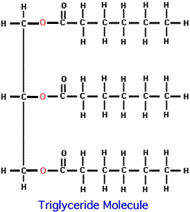
When 3 fatty acids are bonded to the glycerol molecule this makes a Triglyceride.
Fats are solid at room temperature
Oils are liquid at room temperature
Lipids are insoluble in water
Testing for lipids.
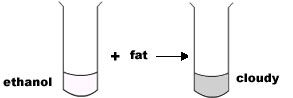
The test for lipids is known as the ethanol emulsion test.
Grind up sample in a pestle and mortar
Add ethanol to create a solution and extract lipids.
Filter with paper and a funnel into a test tube
Add water to test tube
Cloudy white emulsion will form if lipids are present
Triglycerides
Triglycerides are the most common lipids in nature.
Triglycerides are formed when a glyceride molecule undergoes a condensation reaction with 3 fatty acids, in which water is also produced.
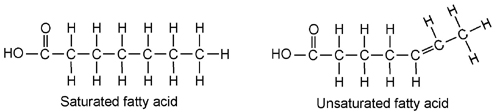
There are two types of fatty acids, unsaturated and saturated. Unsaturated contains and least one double bond where as saturated contains all single bonds.
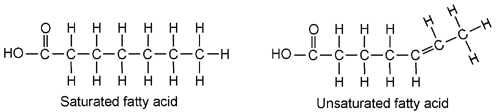
Solid at room temperature due to closely packed parallel structure of fatty acids chains
Liquid at room temperature due to kinks in the structure so particles are more spaced out.
Triglycerides are stored in tissue called adipose tissue.
Triglyceride functions include:
insulation
protection of organs
help give organs bouyancy
Introduction to lipids
Testing for lipids
Triglycerides
Informações
- Descrição
- Introduction to lipids, how to test for them and triglycerides.
- Criado por
- HeatherTxo
- Visualizações
- 310
- Avaliação