
Flashcards
OCB02-1018- Dental Pulp/Dentine Complex
Flashcards do conjunto (32)
- 1Why is the dentine pulp complex called this?Odontoblast processes extend at least 1/3 into dentine tubules from pulp
- 2What are the functions of dental pulp? (4)1. Formation of dentine
2. Eruption of tooth/root formation
3. Dentine repair
4. Defence against infection - 3What is dentine?The hard connective tissue that forms the bulk and form of tooth
- 4What forms dentine?Odontoblast cells in dental papilla
- 5What is the function of dentine?Determines shape of crown+number/size of roots
- 6Rank the following in order of hardness from hardest to softest: 1. Enamel 2. Dentine 3. Bone/cementumEnamel>Dentine>Bone/cementum
- 7What is the composition of dentine?70% inorganic hydroxyapatite
20% organic (type 1 collagen+glycoproteins, proteoglycans, phosphoproteins)
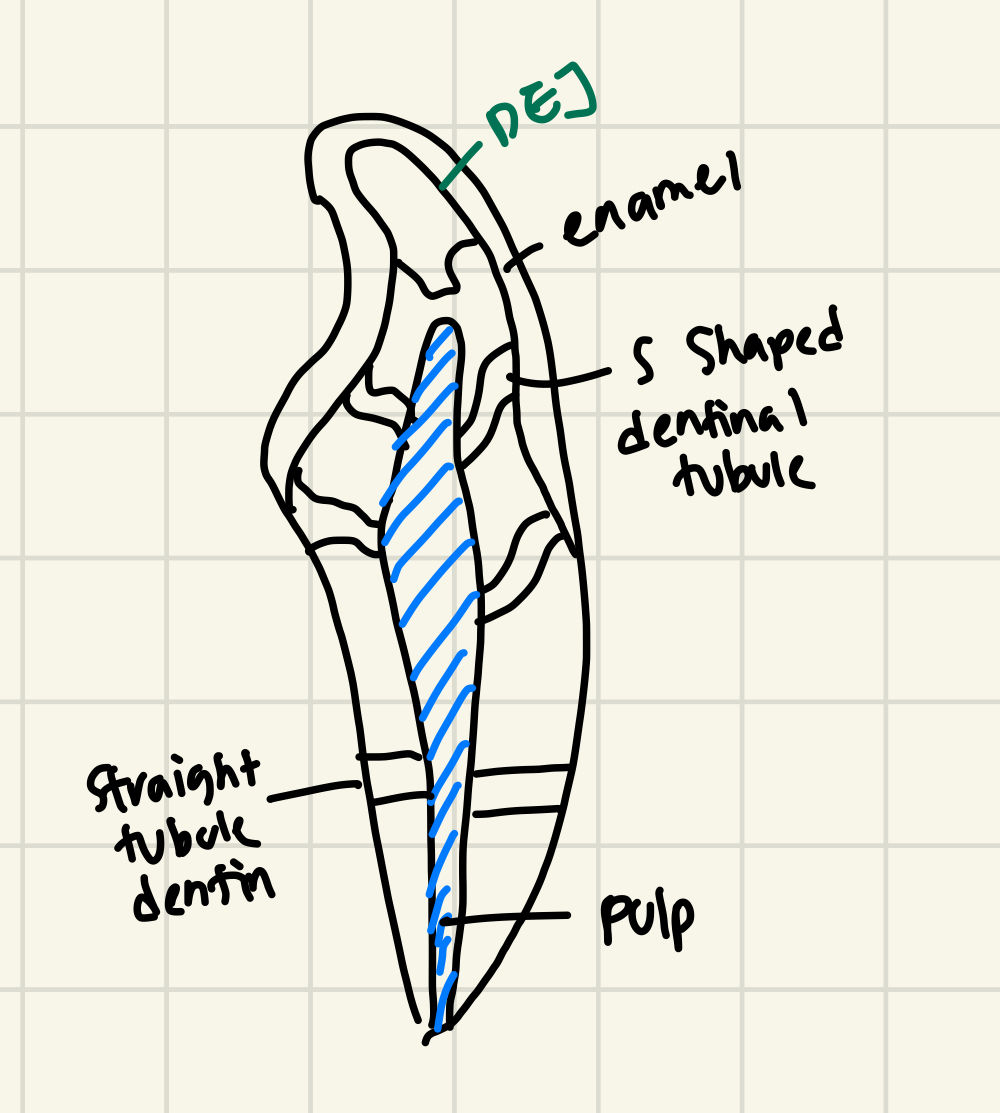
10% H20 - 8What do the tubules in dentin come from? Where do they go?Come from Dental Enamel Junction, goes to pulp
- 9What are the two types of primary curvature tubules? Where are they located?Straight and S shaped
Straight are in the radicular region (more)
S shaped are in the coronal region (less) - 10Canaliculi are... and are oriented in what way against the tubules?lateral branches throughout dentin at 90 degree to tubule
- 11Enamel spindles areTubules extending PAST EDJ into enamel
- 12What is the function of peritubular/intratubular dentin? How does its composition differ from intertubular dentin?Forms walls of all tubules but the ones near pulp
15% more mineralised (inter is 50% organic)
Forms around same time as intertubular though - 13Which type of dentin is formed first?Intertubular dentin
- 14What does dental pulp contain (5)? What cells are present in the pulp (5)?Contains cells, fibres, ground substance, blood vessels, nerves
Cells are odontoblasts, stem cells/mesenchyme cells, fibroblasts, Schwann cells, defence cells - 15What fibers are in the pulp?Type 1 collagen and type 3 collagen
- 16What nerves are present in the pulp?Sensory nerves
Sympathetic nerves - 17What is pulpitis, and which factors can cause it (6)?The inflammation of the pulp
Caries, cracks, fractures, cavity preparation, dental materials, exposure of dentine - 18What is the mechanism of pulpitis?1. Inflammation of the pulp increases blood pressure
2. Vasodilation of arterioles in the pulp increase blood flow (causes redness)
3. Increased venous BP, lymph flow, osmotic pressure
4. Acute inflammation - 19What are the 5 indicators of inflammation?1. Rubor (redness)
2. Tumour (swelling)
3. Calor (increased temp)
4. Dolor (pain)
5. Loss of function - 20How do thermal tests test for pulpitis?A lack of response/lingering pain indicates damaged nerves
- 21How does an electric pulp tester test for pulpitis?Response to EPT indicates viable nerve fibres
- 22How does vital pulp therapy work?A pulp cap is created using calcium hydroxide and covered with permanent restoration seal
- 23What are treatments for pulpitis?Vital pulp therapy
Root canal treatment - 24What are other problems that can occur in the pulp? (4)1. Atresia (sclerosed canals from injury--> complete mineralisation)
2. Pupal stone (carious lesion in tertiary dentine leads to partial mineralisation)
3. Hyperaemia (pupal inflammation)
4. Pupal necrosis (bacteria infection) - 25How does pulp change in elderly patients?Decreases in size
More fibrous
But can still form dentine/respond to stimuli - 26Which of the following has the greatest number of tubules? - Primary dentine - Secondary dentine - Tertiary dentinePrimary
- 27What are von Ebner's lines?Incremental lines in dentin
- 28What are Andersen lines?Retzius Lines in dentin
- 29When does primary dentine stop?Birth
- 30How does secondary dentine differ from primary?Dentine formation AFTER birth
Tubular pattern are a little less regular
Reduces pulp chamber size - 31What is translucent dentine?Dentine tubules occluded with calcified material in response to external stimuli
Mineral is different from that of peritubular dentine - 32What is the mineralisation front?Rich in NCP
- DPP
- DSP
- Proteoglycans
Calcospherites and interglobular dentine
Informações
- Descrição
- LOs are to: Understand the anatomical and histological features of the dental pulp. Describe the heterogeneous cell population of the pulp, blood and nerve supply. Understand the clinical implications of the anatomical complexities of the root canal system and the pathophysiological modifications that can occur.
- Criado por
- Evian Chai
- Visualizações
- 84
- Tags
- Avaliação