
Flashcards
Basic EE - Exam I
Flashcards do conjunto (70)
- 1Ideal SourcesA source that can provide an arbitrary amount of energy - divided into two types: voltage sources and current sources
- 2Ideal Voltage SourceAn electric device that generates a prescribed voltage at its terminals
- 3Ideal Current SourceA device that can generate a prescribed current independent of the circuit
- 4Dependent (or controlled) SourceAnother category of sources whose output (current or voltage) is a function of some other voltage or current in a circuit
- 5Electrical Networka collection of elements through which current flows
- 6BranchAny portion of a circuit with two terminals connected to it
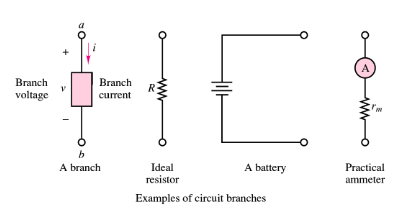
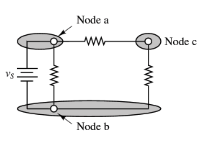
- 7NodeThe junction of two or more branches
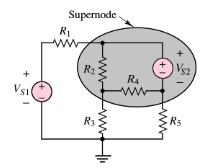
- 8SupernodeThe defining of a region that encloses more than one node
- 9LoopAny closed connection of branches
- 10MeshA loop that does not contain other loops
- 11ChargeThe fundamental electric quantity of static electricity and the current that flows in metal wires connected to a battery
- 12Coulomb (C)Unit of current
- 13Elementary ChargeElectron and protons often referred to as
- 14Kirchhoff's current law (KCL)The sum of the currents at a node must equal zero - because charge cannot be created but must be conserved

- 15Electric CurrentThe time rate of change of charge passing through a predetermined area
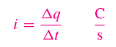
- 16AmperesUnits of current where 1 ampere (A) = 1 coulomb/second
- 17In order for a current to flow, ________.there must exist a closed circuit
- 18VoltageThe total work per unit charge associated with the motion of charge between two points
- 19Volts
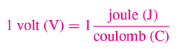
- 20Potential DifferenceThe voltage, or ___________, between two points in a circuit indicates the energy required to move charge from one point to the other.
- 21Kirchhoff's Voltage Law (KVL)the net voltage around a closed circuit is zero - no energy is lost of created in an electric circuit

- 22Reference VoltageIn a circuit, any one node may be chosen as the reference node
- 23SourcesThe elements that provide energy
- 24LoadsElements that dissipate energy
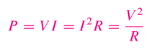
- 25Power =P=VI

- 26i-v characteristic (or volt-ampere characteristic)A functional relationship between voltage and current
- 27ResistanceThe magnitude of which depends on the electrical properties of the material
- 28ResistorA device that exhibits linear resistance properties
- 29Ohm's LawThe voltage across an element directly proportional to the current flow

- 30ohms (Ω)Unit of resistance R
- 31ResistivityThe resistance of a material depends on resistivity (ρ)
- 32ConductivityInverse of resistivity (σ)

- 33Conductance as inverse of resistance

- 34Ohm's law restate in terms of conductance

- 35Power RatingThe maximum allowable power dissipation
- 36Short CircuitA circuit element with resistance approaching zero
- 37Open CircuitA circuit element whose resistance approaches infinity
- 38In SeriesTwo or more circuit elements are said to be in series if the current from one element exclusively flows into the next element
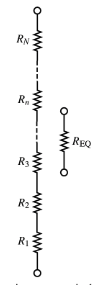
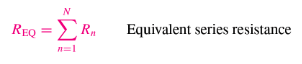
- 39EQ: Equivalent Series Resistance
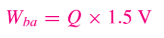
- 40EQ: When the work done in moving Q from b to a
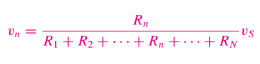
- 41Voltage DividerThe voltage across each resistor in a series circuit is directly proportional to the ratio of its resistance to the total series resistance of the circuit
- 42EQ: Voltage Divider
- 43In ParallelTwo or more circuit elements are said to be in parallel if the elements share the same terminals
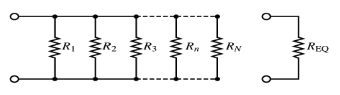
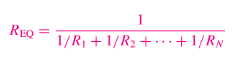
- 44EQ: Equivalent Parallel Resistance
- 45EQ: Current Divider Rule

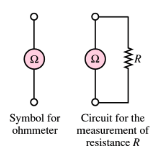
- 46Ohmmeter RuleThe resistance of an element can be measured only when the element is disconnected from any other circuit
- 47OhmmeterDevice that measures resistance
- 48AmmeterDevice that measures current flowing
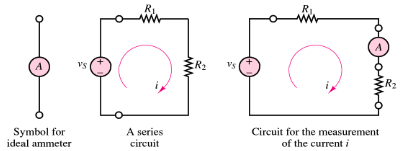
- 49Ammeter Rule1. Must be placed in series with the element whose current is to be measured
2. Should not restrict the flow of current - 50VoltmeterDevice that measures voltage
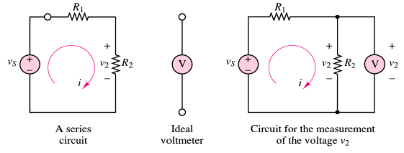
- 51WattmeterDevice that measures power dissipated
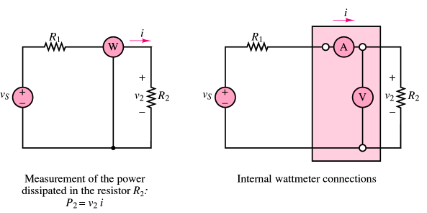
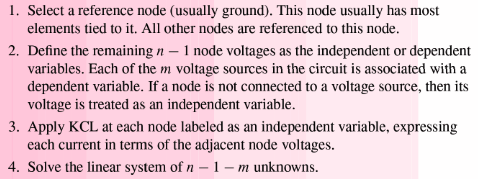
- 52Node voltage methodBased on defining the voltage of each node as an independent variable - one node is selected as a reference node
- 53Node Voltage Analysis Method
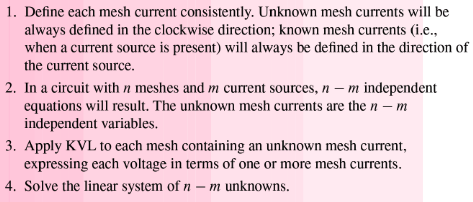
- 54Mesh CurrentsWrite the appropriate number of independent equations, using mesh currents as the independent variables
- 55Mesh Current Analysis Method
- 56The Principle of SuperpositionIn a linear circuit containing N sources, each branch voltage and current is the sum of N voltages and currents, each of which may be computed by setting all but one source equal to zero and solving the circuit containing that single source

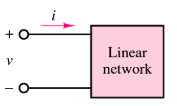
- 57One-Port NetworkA two-terminal device, described by and i-v characteristic
- 58Equivalent CircuitA view of a very complicated circuit in terms of a much simpler equivalent source and load circuits
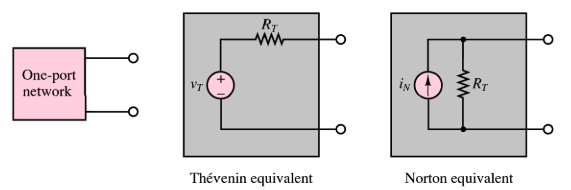
- 59The Thevenin TheoremWhen viewed from the load, any network composed of ideal voltage and current sources, and of linear resistors, may be represented by an equivalent circuit consisting of an ideal voltage source vt in series with an equivalent resistance Rt

- 60The Norton TheoremWhen viewed from the load, any network composed of ideal voltage and current sources, and linear resistors, may be represented by an equivalent circuit consisting of an ideal current source iN in parallel with an equivalent resistance Rn

- 61Computation of Equivalent Resistance of a One-Port Network That Does Not Contain Dependent Sources
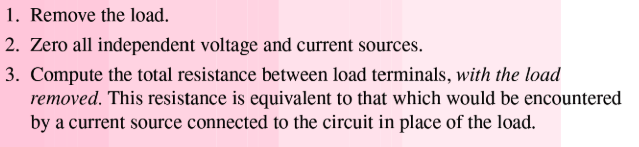
- 62Thevenin and Norton equivalent resistances are _________.one and the same quantity

- 63Thevenin Equicalent VoltageEqual to the open-circuit voltage present at the load terminals (with the load removed).
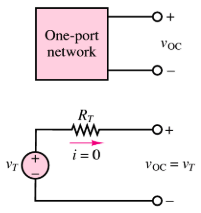
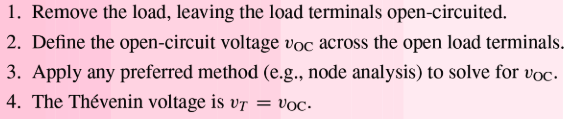
- 64Computing the Thevenin Voltage
- 65Norton CurrentEqual to the short-circuit current that would flow if the load were replaced by a short circuit
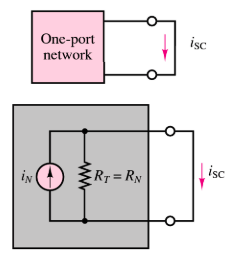
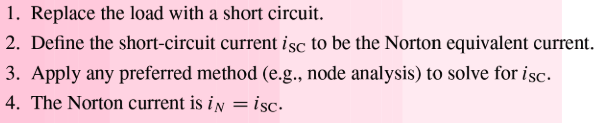
- 66Computing the Norton Current
- 67Source TransformationsAny circuit in Thevenin equivalent form may be replaced by a circuit in Norton equivalent form
- 68FIG: Equivalence of Thevenin and Norton Representations
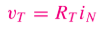
- 69EQ: Relationship for determining Thevenin resistance

- 70Maximum Power Transfer TheoremThe amount of power transferred to the load rom the source under the most ideal conditions
Informações
- Descrição
- Engineering FlashCards sobre Basic EE - Exam I, criado por Emily Beck em 16-02-2021.
- Criado por
- Emily Beck
- Visualizações
- 1
- Avaliação