
Flashcards
Lecture 15- Tissues of the Human Body
Flashcards do conjunto (79)
- 1What is the apical surface of the epithelium?The surface exposed to a body cavity, lining an organ or exposed to an exterior and can contain microvilli or cilia.
- 2What is the basal surface of the epithelium?The surface attached to a basement membrane secreted by the cells and adheres the tissue firmly to nearby connective tissue.
- 3What are the different types of epithelial tissue layers called?Simple epithelium, stratified epithelium and pseudostratified epithelium
- 4What is the structure of simple epithelium?Single layer allowing diffusion, osmosis, filtration, secretion and absorption to take place
- 5What is the structure of stratified epithelium?Multiple layers of cells, protecting deeper layers from wear and tear.
- 6What is the structure of pseudostratified epithelium?Single layer of cells that appear to consist of multiple layers as they have nuclei at different levels.
- 7What are the different epithelial cell shapes?Squamous, cuboidal, columnar and transitional
- 8What are squamous epithelial cells?Flat cells with oval nuclei
- 9What are cuboidal epithelial cells?Cube like cells with a central nuclei
- 10What are columnar epithelial cells?Column shaped cells with variable nuclei
- 11What are transitional epithelial cells?Variable shaped cells
- 12How do you classify epithelia?1: The type of layers (simple, stratified or pseudostratified) 2: The cell shape (squamous, cuboidal, columnar or transitional)
- 13How do you name multilayered epithelia?Named after top layer
- 14What is simple squamous epithelia adapted for?Diffusion, osmosis and similar process requiring a minimal barrier
- 15Where is simple squamous epithelia found?It lines the capillaries and blood vessels, lymph vessels and alveoli
- 16What is simple cuboidal epithelia adapted for?Absorption, secretion and protection
- 17Where is simple cuboidal epithelia found?It lines parts of the kidney tubules, ducts of many glands and part of the ovary.
- 18What are non-ciliated simple columnar epithelia adapted for?Adapted for absorption and secretion
- 19What can non-ciliated simple columnar epithelia contain?Microvilli and goblet cells that produce mucus
- 20Where can non-ciliated simple columnar epithelial be found?Lines the digestive tract, gallbladder and large ducts of glands
- 21What are ciliated simple columnar epithelia adapted for?The movement of substances across the epithelial surfaces
- 22What do ciliated simple columnar epithelia possess?Apical cilia
- 23Where can ciliated epithelia be found?Uterus, bronchi and paranasal sinuses
- 24Do non ciliated pseudostratified columnar epithelia contain goblet cells?No
- 25Can ciliated pseudostratified columnar epithelia contain goblet cells?Yes they can
- 26Where can non-ciliated pseudostratified columnar epithelia be found?It is rare but it is found in parts of the male urethra
- 27Where can ciliated pseudostratified columnar epithelia be found?Line most of the trachea, primary bronchi, parts of the male reproductive and urinary tract, nasal cavity and large excretory ducts
- 28What is the role of stratified squamous epithelia?Protects against abrasion
- 29What are the two different types of stratified squamous epithelia?Non keratinised and keratinised
- 30Where can non-keratinised stratified squamous epithelia be found?Lines the mouth, vagina and anus
- 31What are keratinocyte cells?Cells in which keratin is produced
- 32What is the process of keratinisation?As the cells traverse the layers, they fill with keratin, become squamous and anucleate and eventually die as they reach top layer
- 33What is desquamation?The process by which keratinised cells slough off
- 34What is the role of the keratinised layer?It provides a waterproof barrier, protecting against abrasion and pathogens
- 35What is the role of stratified cuboidal epithelial?Provides protection
- 36Where is stratified cuboidal epithelia found?Ducts of sweat glands, larger salivary glands and parts of male urethra
- 37What is the role of stratified columnar epithelia?Protective
- 38Where is stratified columnar epithelia found?Salivary glands and male urethra
- 39What is the role transitional epithelia?Able to stretch
- 40What prevents transitional epithelia from leaking?Tight junctions
- 41Where is transitional epithelia found?urinary bladder, ureters and parts of urethra
- 42What is a gland?A single or group of epithelial cells adapted for secretion
- 43What do exocrine glands do?Secrete material directly into ducts or onto apical epithelial surface
- 44What are exocrine glands composed of and what do they secrete?They are composed of glandular epithelia and secrete mucus, sweat, oil, earwax and digestive enzymes
- 45What do endocrine glands do?"ductless glands'" that secrete materials through the basal surface which diffuses through the basement membrane, connective tissue and into the bloodstream (e.g. hormones)
- 46What are the two structural classifications of exocrine glands?Unicellular and multicellular glands
- 47What is the structure of unicellular glands?They have goblet cells but no ducts are involved
- 48What is the structure of multicellular glands?Usually involves ducts
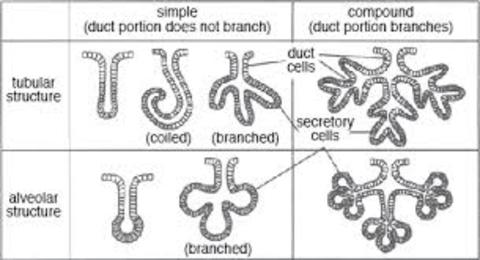
- 49What are the different classifications of ducts according to their shape?
- 50What are the different functional classifications of exocrine glands?Holocrine, merocrine and apocrine
- 51What are holocrine glands?Cell accumulates substance for secretion, dies and discharges its contents (oil in sebaceous glands)
- 52What are merocrine glands?Secretion occurs by exocytosis (sweat glands)
- 53What are apocrine glands?Small pieces of cell containing secretion break off and cell repairs itself
- 54Name two types of endocrine release?Paracrine and autocrine
- 55What does paracrine mean?Neighbouring cells are effected
- 56What does autocrine mean?The same cell is affected
- 57What is the structure of connective tissue?Cells are sparsely distributed within extracellular matrix material produced by connective tissue cells (except for blood matrix)
- 58What does the matrix contain?Fluid, dissolved molecules and protein fibres (e.g. collagen and elastin)
- 59What is the structure of collagen and where is it found?Thick and strong. Found in tendons.
- 60What is the structure of elastin and where is it found?Thin and elastic. Found in skin.
- 61What determines the function of connective tissue?The composition of the matrix
- 62What are the four types of connective tissue?Connective tissue proper, cartilage, bone and blood
- 63What are the two types of connective tissue proper?Loose and fibrous/dense
- 64What are the three types of loose tissue?Areolar (wraps organs), Adipose (fat tissue) and Reticular (supporting framework in liver)
- 65What are the three types of fibrous /dense tissue?Regular (tendons and ligaments), Irregular (heart valves, around cartilage and muscle) and elastic (lungs, walls of arteries, bronchial tubes)
- 66What is the structure of muscle tissue?Rich in overlapping protein filaments known as myosin and actin which are responsible for muscle shortening
- 67What is required for muscles to contract?ATP
- 68What are the three types of muscle tissue?Skeletal, cardiac and smooth
- 69What type of movement does skeletal muscle perform?Voluntary
- 70What are skeletal muscle attached to and how are they attached?They are attached to bones via tendons
- 71What is the appearance of skeletal muscle?Strained in appearance and consists of long cells with many nuclei
- 72What type of movement does cardiac muscle perform?Involuntary
- 73What is the appearance of cardiac muscle?Strained in appearance and consists of branched cells with a single nuclei
- 74What is the role of intercalated disks within cardiac muscle?They electrically couple cells
- 75What type of movement does smooth muscle perform?Involuntary
- 76Where is smooth muscle found?Walls of blood vessels, gastrointestinal tract, uterus and part of the urinary system
- 77What is the appearance of smooth muscle?Lacks striations and spindle shaped cells with single nuclei
- 78What are the two main components of nervous tissue?Neurones and glial cells
- 79What is the role of glial cells?They are protective and supporting
Informações
- Descrição
- Biology- Semester 2 (Lecture 15) FlashCards sobre Lecture 15- Tissues of the Human Body, criado por emma_moran em 28-01-2014.
- Criado por
- emma_moran
- Visualizações
- 56
- Tags
- Avaliação