
Flashcards
Definitions
Flashcards do conjunto (45)
- 1Independent variable?It is not affected by other variables
e.g. time continues regardless of what happens - 2Dependent variable?Changes as the independent variable changes, its what you measure
- 3What does it mean if a signal is 2D?It has 2 spacial variables
e.g. an image has brightness (independent) and then position (dependent) - 4Discontinuity?Turning off a signal does a lot of damage, mathematically, as all the energy has to go somewhere.
- 5Continuous signals?() used to denote this type of signal
Have existed from -∞ and will continue to exist until ∞ - 6Discrete signals?[] used to denote this type of signal
We don't know the value between measurements, can't extrapolate as this is the same as making up results - 7Sample rate?This is how often you sample a signal, if the sample rate is high enough a signal can be continuous
- 8The unit step function?u(t) = 0 when t < 0
u(t) = 1 when t >= 0
Sending a signal u(t) turns it on, -u(t) turns it off - 9Duty cycle?How often a signal is "on", a lower duty cycle means less power is required
- 10Linear systems?The output is the same regardless of what time the input occurs
- 11Time invariant?Time taken for operation on input to produce output is unchanged regardless of input value
- 12Unit ramp function?r(t) = 0 when t < 0
r(t) = t when t >= 0
Allows for power supplied to a system to be slowly increased - 13Delta function?The derivative of the unit step function
Contributes unity to any mathematical operation
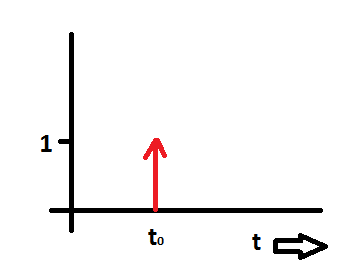
Only exists at a single point - 14What is the graphical representation of the delta function?
- 15The sinusoidal function?v(t) = Asin(wt + ф)
or
v(t) = Asin(w[t + t0])
Where -t0 or -ф/w is where is crosses the x-axis - 16The exponential function?v(t) = V*exp(st)
s < 0 asymptotic with positive x-axis
s < 0 asymptotic with negative x-axis - 17Time reversal?y(t) = x(-t)
The signal is flipped about the y-axis - 18Time scaling?y(t) = x(a*t)
if a > 1 signal is compressed by factor 1/a, hence the signal is sped up
if a < 1 the signal is stretched by factor a, hence the signal is slowed down - 19Data collection leads to?A reversal of data as the data you record first is the oldest
- 20Black box?A representation of linear time invariant systems. The system is represented as an input output operator
- 21Causality?The output of a casual system y(t1) does not depend on inputs x(t) t > t1.
In simple terms this means you can't get the output before the input is applied - 22System memory?The ouput y(t1) requires multiple values of x(t) t < t1
A causal system is has memory if the output depends on past values of the input - 23Impulse response?The response of a system as result of a sudden transfer of energy
- 24Linear system?If the input to a system x1(t) produces output y1(t) and the input to a system of x2(t) produces the output y2(t), then the system is linear if the input:
ax1(t) + bx2(t) produces ay1(t) + by2(t) - 25Convolution?Describes the action of an observing instrument or a system when it takes a weighted mean of some physical quantity of a range of some variable
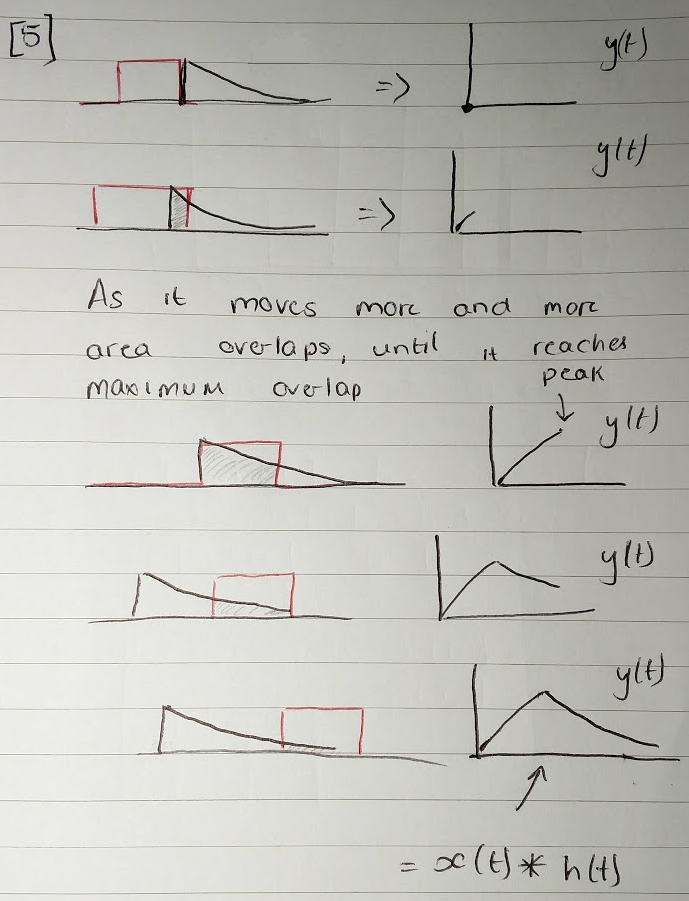
- 26How to convolve two signals?Take one function and reverse it, then slide the two functions past each other. Multiply corresponding values of each signal and then add results at each shift
- 27Graphical example of continuous convolution?
- 28Frequency required when using fourier series?Smooth functions, lower frequency therefore fewer harmonics.
Functions with sharp points, higher frequency therefore more harmonics. - 29Even function?f(x) = f(-x)
e.g. cosine - 30Odd function?f(x) = -f(-x)
e.g. sine - 31Commutative property?a[n] * b[n] = b[n] * a[n]
The order in which two signals are convolved makes no difference - 32Associative property?(a[n] * b[n]) * c[n] = a[n] * (b[n] * c[n])
When convolving 3 signals it doesn't matter which ones are convolved first to form the intermediate signal - 33Distributive property?a[n] * b[n] + a[n] * c[n] = a[n] * (b[n] + c[n])
This shows the operation of parallel systems with added outputs can be combined to form one system - 34Linearity of fourier transform?F[ax1(t) + bx2(t)] = aF[x1t] + bF[x2t]
- 35Tine shift of fourier transform?The effect of time shift, t0, is to introduce a linear phase term in the frequency domain.
F[x(t-t0)] = exp(-jwt0) * F[x(t)] - 36The similarity property of fourier transform?if F[x(t)] = F(w)
then F[x(at)] = 1/|a| * F(w/a) - 37Convolution theorem?if f(t) has the FT F(w)
and g(t) has the FT G(w)
then F[f(t) * g(t)] = F(w)G(w) - 38What is frequency spectrum of an impulse train with separation T in the time domain?An impulse train with separation 1/T Hz in the frequency domain
- 39If you do something faster in the time domain what will it mean for the amount of bandwidth required?It will increase the bandwidth required
- 40Nyquist criteria?In order to reconstruct a sampled signal, the sample frequency must be twice the maximum frequency of the signal
- 41What is aliasing?Spectral overlap in the frequency domain, mean a signal can't be reconstructed
- 42Bandwidth?The range between the upper and lower frequency cut offs.
- 43Upper and Lower frequency cut offs?The frequency at which the voltage of a signal is -3dB compared to its maximum voltage.
- 44-3dB?The half power point
- 3dB = 20log(voltage) = 10log(power) - 45How to find the period of a discrete signal?Find the smallest value of the integer N so that the following relation is true for some value of integer k > 0
(coefficient of the discrete variable)*N = 2πk
Informações
- Descrição
- Engineering (16ELA004 - Signals & Systems) FlashCards sobre Definitions, criado por Ben Evans em 13-04-2017.
- Criado por
- Ben Evans
- Visualizações
- 5
- Avaliação