
Flashcards
The Brain and the Nervous System
Flashcards do conjunto (73)
- 1neuronA specialized cell in the nervous
system that accumulates and transmits
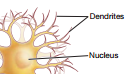
information - 2dendritesThe branched part of a neuron that receives impulses and conducts them toward the cell body
- 3cell bodyThe portion of the neuron
containing the metabolic machinery that
keeps the cell alive and functional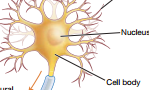
- 4axonThe part of a neuron that
transmits impulses to glands, muscles, or
other neurons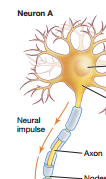
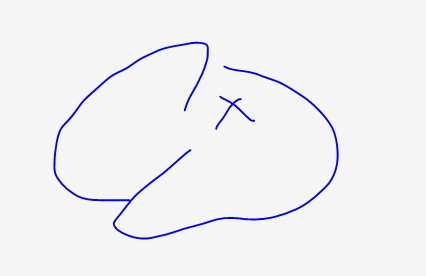
- 5Which side of the brain is this?The LEFT side
- 6efferent neuronsNerves that carry
messages outward from the central
nervous system. - 7afferent neuronsNerves that carry
messages INward toward the central
nervous system. - 8interneuronsNeurons that are
neither afferent nor efferent, but instead
carry information from one neuron to
another.
NEURON TO NEURON
(not within a neuron) - 9gliaA type of cell in the nervous system
long believed to provide a “support”
function for neurons; recent research
indicates that glia provide many other
functions as well. - 10myelina fatty substance that males up some types of glial cells; these cells wrap around the axon of some neurons, providing an insulating "myelin sheath" around these neurons
- 11action potentialA brief change in the electrical charge of a neuronal membrane; the physical basis of the signal that travels the length of the neuron.
- 12resting potential–70 millivolts
The voltage difference between the inside and the outside of a neuronal membrane when the neuron is not firing - 13excitation thresholdthe voltage difference between a neuron's interior and exterior that, if exceeded, causes a neuron to fire
(about –55 millivolts in mammals) - 14refractory periodThe time after an
action potential during which a neuron’s
cell membrane is unprepared for the
next action potential. - 15depolarizeIn the nervous system, to
lose the charge that normally exists
across the neuronal membrane - 16propagationthe spread of the action potential down an axon, caused by successive changes in electrical charge along the length of the axon's membrane.
- 17How does the action potential look as it travels along the axon? (Illustration)like a heartbeat (?)
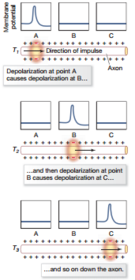
- 18all-or-none lawThe law that all action
potentials have the same strength and
speed regardless of the triggering
stimulus - 19synapseThe small gap between two
adjacent neurons, consisting of the
presynaptic and postsynaptic neurons’
membranes and the space between
them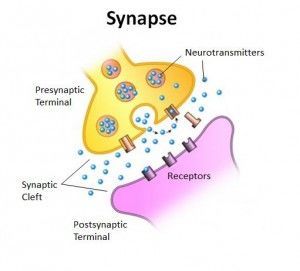
- 20neurotransmittersChemicals released by one neuron (usually the presynaptic neuron), which trigger a response in another neuron (usually the postsynaptic neuron); the chief means of communication among neurons.
- 21What does "snyaptic transmission" look like? (Illustation)
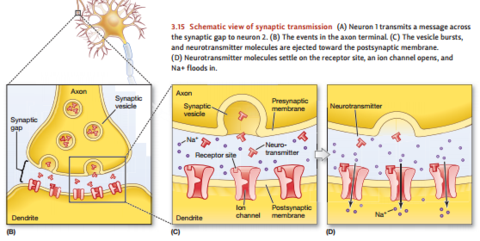
- 22synaptic reuptakeThe presynaptic
neuron’s process of reabsorbing its own
neurotransmitters after signaling so that
they can be released again the next time
the neuron fires. - 23Dopamine (DA)Influences movement, motivation, emotion.
- 24Norepinephrine (NE)Helps control arousal level; influences wakefulness, learning, and memory
- 25GlutamatePerhaps the major excitatory transmitter in the brain; plays a
crucial role in learning and memory. - 26Gamma-amino butyric acid (GABA)The most widely distributed inhibitory transmitter of the central
nervous system - 27SerotoninInvolved in many of the mechanisms of sleep, mood, and arousal
- 28Acetylcholine (ACh)Released at many synapses and at the junction between nerves
and muscles; the release of ACh makes the muscle fibers contract.
Involved in many of the mechanisms of sleep, mood, and arousal. - 29"Lock-and-key" model of synaptic transmissionTransmitter molecules will affect the postsynaptic membrane only id their shape fits the shape of certain receptor molecules in that membrane - much as a KEY has to fit into a LOCK.
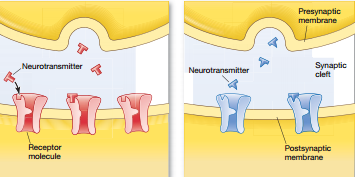
- 30agonistsDrugs that enhance a
neurotransmitter’s activity. - 31antagonistsDrugs that impede the
activity of a neurotransmitter. - 32What do AGONISTS do? (Illustration)
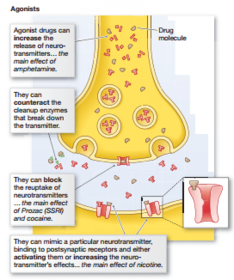
- 33What do ANTAGONISTS do? (Illustration
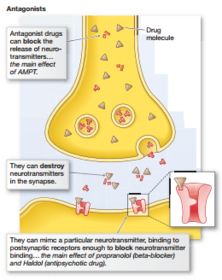
- 34blood-brain barriera layer of tightly joined cells
that surrounds the blood vessels in the brain and literally acts as a filter to prevent toxins
from reaching the central nervous system - 35endocrine systemThe system of
glands that release secretions directly
into the bloodstream and affect organs
elsewhere in the body - 36hormoneA chemical released by a
gland. Hormones travel through the
bloodstream and influence functions
such as metabolic rate, arousal level, and
the liver’s sugar output. - 37transcranial magnetic stimulation (TMS)The technique of applying repeated magnetic simulation at the surface of the skull to temporarily stimulate or disable a target brain region
- 38electroencephalogram (EEG)A record of the brain’s electrical activity
recorded by placing electrodes on the
scalp - 39event-related potential (ERP)Electrical changes in the brain that correspond to the brain's response to a specific event; measured with EED
- 40CT (computerized tomography) scanA technique for examining brain structure by constructing a composite of K-ray images taken from many different angles
- 41MRI (magnetic resonance imaging)A neuroimaging technique that
documents the effects of strong
magnetic pulses on the molecules that
make up brain tissue. A computer then
assembles this information into a picture
of brain structure. - 42PET (positron emission tomography) scanA technique for examining brain
function by observing the amount of
metabolic activity in different brain
regions - 43functional MRI (fMRI) scanA technique for examining brain function by measuring blood flow and oxygen use within the brain
- 44central nervous system (CNS)The
brain and spinal cord. - 45peripheral nervous system (PNS)The afferent and efferent nerves that
extend from the brain and spinal cord to
connect them with the organs and
muscles - 46somatic nervous system (SNS)The division of the peripheral nervous system
that controls the skeletal muscles and
transmits sensory information. - 47autonomic nervous system (ANS)The division of the peripheral nervous
system that receives information from
and controls the internal organs. - 48sympathetic branchThe division of
the autonomic nervous system that
mobilizes the organism for physical
exertion. - 49parasympathetic branchThe division
of the autonomic nervous system that
restores the body’s normal resting state
and conserves energy. - 50brain stemThe brain region at the top
of the spinal cord that includes the
medulla and the pons. - 51cerebellumThe part of the brain that
controls muscular coordination and
equilibrium. - 52cerebral cortexThe outermost layer of
the forebrain. - 53cerebral hemisphereOne-half (left or
right) of the cerebrum, the topmost part
of the brain. - 54frontal lobeThe area at the front of
each cerebral hemisphere; includes tissue
crucial for many aspects of planning and
controlling thoughts and behavior. - 55parietal lobethe area in each cerebral hemisphere that lies between the frontal and occipital lobes; includes tissue crucial for receiving information from the skin senses
- 56temporal lobethe areas in each cerebral hemisphere lying below the temples; includes tissue crucial for hearing and many aspects of language use
- 57occipital lobethe rearmost area of each cerebral hemisphere, includes tissue crucial for processing visual information
- 58hypothalamusA subcortical structure that plays a vital role in controlling many motivated behaviors, like eating, drinking, and sexual activity
- 59limbic systemA group of interconnected structures (including the hypothalamus, the amygdala, and others) that are crucial for emotion, motivation, and many aspects of learning and memory.
- 60amygdalaAn almond-shaped, temporal
lobe structure that plays a central role in
emotion and evaluating stimuli - 61hippocampusA temporal lobe structure that plays a pivotal role in learning and forming new memories.
- 62lateralizationFunctional differences between the two cerebral hemispheres. E.g., in most right-handers, the left hemisphere is specialized for language, while the right hemisphere is better at some visual and spatial tasks
- 63corpus callosumThe thick bundle of
fibers connecting the cerebral
hemispheres - 64projection areasAreas in which the
brain tissue seems to form a “map” of
sensory information. - 65contralateral controlthe typical pattern in vertebrates in which movements of the RIGHT side of the body are controlled by the LEFT hemisphere, while movements of the LEFT side are controlled by the RIGHT hemisphere.
- 66apraxiaa serious disturbance in beginning or carrying out voluntary movements
- 67visual agnosiaThe inability to
recognize a visual stimulus despite the
ability to see and describe it. - 68neglect syndromeThe result of
certain right parietal lobe lesions that
leave a patient completely inattentive to
stimuli to her left, including the left side
of her own body - 69aphasiaAny of number of linguistic disorders caused by injury to or malformation of the brain.
- 70prefrontal areaThe frontmost portion
of the frontal lobes, involved in working
memory, strategy formation, and
response inhibition - 71executive controlProcesses such as
making plans or overriding habitual
responses that let the brain direct its
own cognitive activities - 72perseverationThe tendency to repeat
a response inappropriately; often a result
of deficits in executive control caused by
prefrontal lesions - 73brain plasticityThe capacity for the
brain to alter its structure and function
Informações
- Descrição
- FlashCards sobre The Brain and the Nervous System, criado por feelingthepayne em 20-10-2014.
- Criado por
- feelingthepayne
- Visualizações
- 907
- Tags
- Avaliação