
Flashcards
C2-C
Flashcards do conjunto (27)
- 1What is the relative mass of the proton ?1
- 2What is the relative mass of the neutron ?0
- 3What is the relative mass of the electron ?1/1800
or
1/2000
or
very small - 4What is the mass number ?The total number of protons and neutrons in an atom
- 5What is the atomic number ?The number of protons in an atom
- 6What is an isotope ?Atoms of the same element can have different numbers of neutrons; these atoms are called isotopes of that element.
- 7Give a definition for the relative atomic mass of an elementThe relative atomic mass of an element (Ar) compares the mass of atoms of the element with the 12C isotope.
It is an average value for the isotopes of the element. - 8Give a definition for the relative formula mass of a compoundThe relative formula mass (Mr) of a compound is the sum of the relative atomic masses of the atoms in the compound
- 9What is one mole of a substance ?The relative formula mass of a substance, in grams.
- 10Elements and compounds can be detected and identified using instrumental methods. List the advantages of using instrumental methods.Instrumental methods are
1. accurate,
2. sensitive
3. rapid
4. are particularly useful when the amount of a sample is very small. - 11What type of chemical analysis can be used to identify additives in foods.Artificial colours can be detected and
identified by paper chromatography - 12Why do you use pencil and not pen to draw the base line in paper chromatographyit might dissolve in the solvent and make it difficult to interpret results.
***do not say it would effect the result*** - 13Suggest why it is important to be able to identify the colour additives in food.To check if safe to eat
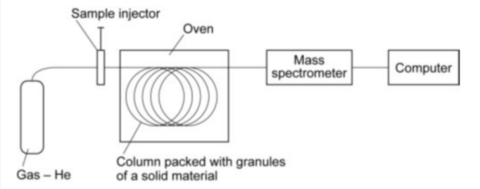
- 14Describe how gas chromatography works.Different substances, carried by a gas, travel through a column packed with a solid material at different speeds, so that they become separated.
The time taken for a substance to travel through the column can be used to help identify the substance - 15What is the output of the gas chromatography column linked to ?the output from the gas chromatography column can be linked to a mass spectrometer, which can be used to identify the substances leaving the end of the column
- 16What do the number of peaks on the output of the gas chromatograph tells us ?the number of peaks on the output of a gas
chromatograph shows the number of compounds present - 17What is the retention time ?The time taken for a substance to reach the detector
- 18What part of the mass spectrometer graph gives the molecular mass of a substance ?The molecular mass is given by the molecular ion peak.
- 19Why do different compounds separate in a gas chromatography column?Different substances travel at different speeds
- 20In what part is the mixture separated ?The column
- 21Why is helium used as a carrier gas in chromatography?It is inert (uncreative)
- 22When a blood sample is taken from an athlete the sample is often split into two portions. Each portion is tested at a different laboratory.To avoid bias
- 23Even though no atoms are gained or lost in a chemical reaction, it is not always possible to obtain the calculated amount of a product , give 3 reasons why ? aka : why is the actual yield always less than the theoretical yield ?1. the reaction may not go to completion because it is reversible
2. some of the product may be lost when it is separated from the reaction mixture
3. some of the reactants may react in ways
different from the expected reaction. - 24What is the amount of product obtained in a chemical reaction called ?The amount of a product obtained is known as the yield.
- 25What formula is used to calculate the % yield ?actual yield / theoretical yield x 100
- 26What is the symbol for a reversible reaction?

- 27Give an example of a reversible reaction ?
