
Mapa mental
Ethical theories
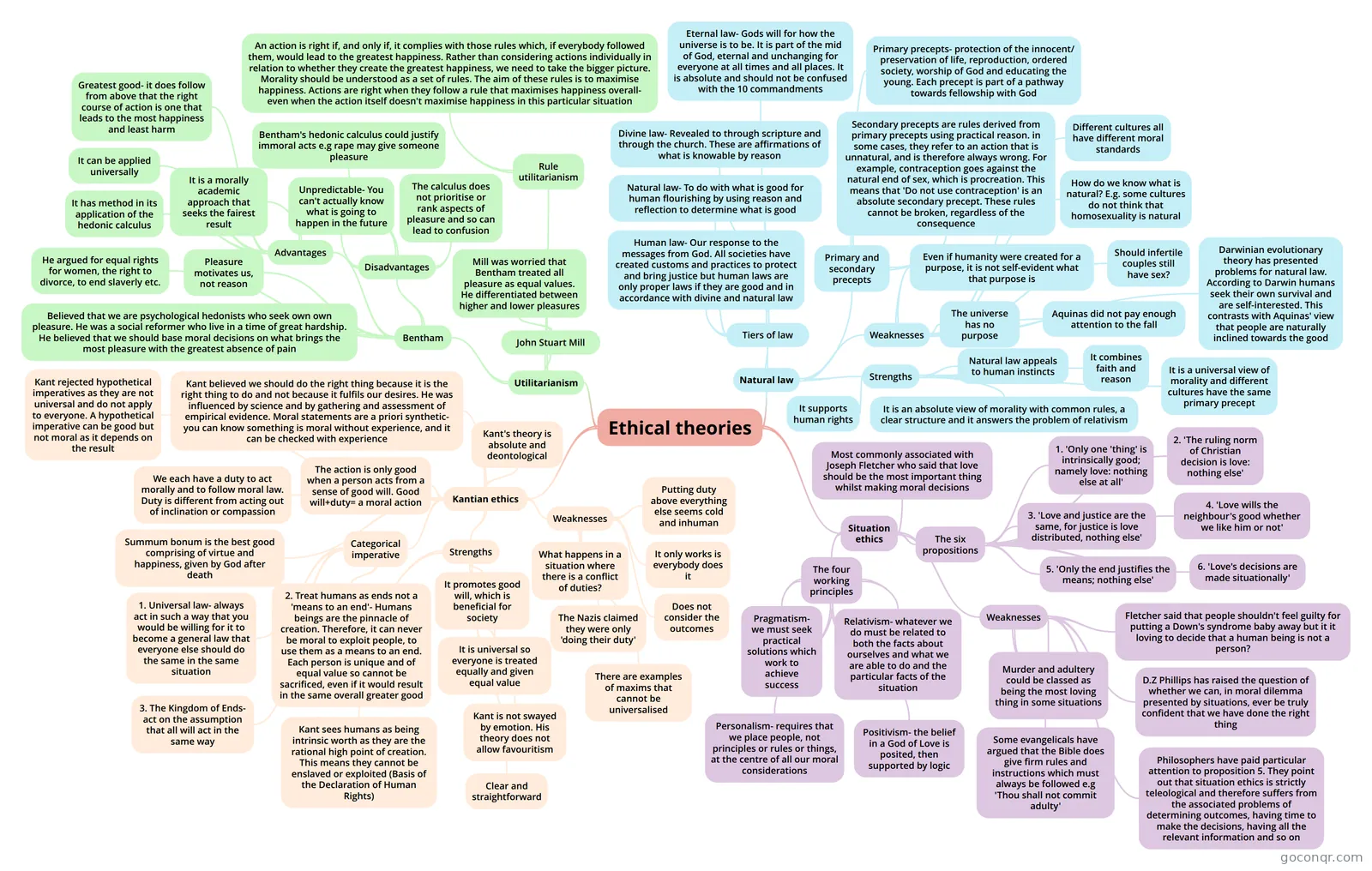
Mind map: Ethical theories
Conteúdo do mapa
Ethical theories
Natural law
- Strengths
- It is an absolute view of morality with common rules, a clear structure and it answers the problem of relativism
- It is a universal view of morality and different cultures have the same primary precept
- It supports human rights
- It combines faith and reason
- Natural law appeals to human instincts
- Weaknesses
- The universe has no purpose
- Even if humanity were created for a purpose, it is not self-evident what that purpose is
- How do we know what is natural? E.g. some cultures do not think that homosexuality is natural
- Different cultures all have different moral standards
- Should infertile couples still have sex?
- Darwinian evolutionary theory has presented problems for natural law. According to Darwin humans seek their own survival and are self-interested. This contrasts with Aquinas' view that people are naturally inclined towards the good
- Aquinas did not pay enough attention to the fall
- Primary and secondary precepts
- Primary precepts- protection of the innocent/ preservation of life, reproduction, ordered society, worship of God and educating the young. Each precept is part of a pathway towards fellowship with God
- Secondary precepts are rules derived from primary precepts using practical reason. in some cases, they refer to an action that is unnatural, and is therefore always wrong. For example, contraception goes against the natural end of sex, which is procreation. This means that 'Do not use contraception' is an absolute secondary precept. These rules cannot be broken, regardless of the consequence
- Tiers of law
- Eternal law- Gods will for how the universe is to be. It is part of the mid of God, eternal and unchanging for everyone at all times and all places. It is absolute and should not be confused with the 10 commandments
- Divine law- Revealed to through scripture and through the church. These are affirmations of what is knowable by reason
- Natural law- To do with what is good for human flourishing by using reason and reflection to determine what is good
- Human law- Our response to the messages from God. All societies have created customs and practices to protect and bring justice but human laws are only proper laws if they are good and in accordance with divine and natural law
- Strengths
Situation ethics
- The six propositions
- 1. 'Only one 'thing' is intrinsically good; namely love: nothing else at all'
- 2. 'The ruling norm of Christian decision is love: nothing else'
- 3. 'Love and justice are the same, for justice is love distributed, nothing else'
- 4. 'Love wills the neighbour's good whether we like him or not'
- 5. 'Only the end justifies the means; nothing else'
- 6. 'Love's decisions are made situationally'
- The four working principles
- Relativism- whatever we do must be related to both the facts about ourselves and what we are able to do and the particular facts of the situation
- Pragmatism- we must seek practical solutions which work to achieve success
- Personalism- requires that we place people, not principles or rules or things, at the centre of all our moral considerations
- Positivism- the belief in a God of Love is posited, then supported by logic
- Most commonly associated with Joseph Fletcher who said that love should be the most important thing whilst making moral decisions
- Weaknesses
- Fletcher said that people shouldn't feel guilty for putting a Down's syndrome baby away but it it loving to decide that a human being is not a person?
- Murder and adultery could be classed as being the most loving thing in some situations
- D.Z Phillips has raised the question of whether we can, in moral dilemma presented by situations, ever be truly confident that we have done the right thing
- Some evangelicals have argued that the Bible does give firm rules and instructions which must always be followed e.g 'Thou shall not commit adulty'
- Philosophers have paid particular attention to proposition 5. They point out that situation ethics is strictly teleological and therefore suffers from the associated problems of determining outcomes, having time to make the decisions, having all the relevant information and so on
- The six propositions
Utilitarianism
- Bentham
- Believed that we are psychological hedonists who seek own own pleasure. He was a social reformer who live in a time of great hardship. He believed that we should base moral decisions on what brings the most pleasure with the greatest absence of pain
- He argued for equal rights for women, the right to divorce, to end slaverly etc.
- Pleasure motivates us, not reason
- Advantages
- It has method in its application of the hedonic calculus
- It is a morally academic approach that seeks the fairest result
- It can be applied universally
- Greatest good- it does follow from above that the right course of action is one that leads to the most happiness and least harm
- Disadvantages
- Unpredictable- You can't actually know what is going to happen in the future
- The calculus does not prioritise or rank aspects of pleasure and so can lead to confusion
- Bentham's hedonic calculus could justify immoral acts e.g rape may give someone pleasure
- John Stuart Mill
- Mill was worried that Bentham treated all pleasure as equal values. He differentiated between higher and lower pleasures
- Rule utilitarianism
- An action is right if, and only if, it complies with those rules which, if everybody followed them, would lead to the greatest happiness. Rather than considering actions individually in relation to whether they create the greatest happiness, we need to take the bigger picture. Morality should be understood as a set of rules. The aim of these rules is to maximise happiness. Actions are right when they follow a rule that maximises happiness overall- even when the action itself doesn't maximise happiness in this particular situation
- Bentham
Kantian ethics
- Kant believed we should do the right thing because it is the right thing to do and not because it fulfils our desires. He was influenced by science and by gathering and assessment of empirical evidence. Moral statements are a priori synthetic- you can know something is moral without experience, and it can be checked with experience
- We each have a duty to act morally and to follow moral law. Duty is different from acting out of inclination or compassion
- Kant's theory is absolute and deontological
- The action is only good when a person acts from a sense of good will. Good will+duty= a moral action
- Summum bonum is the best good comprising of virtue and happiness, given by God after death
- Categorical imperative
- 1. Universal law- always act in such a way that you would be willing for it to become a general law that everyone else should do the same in the same situation
- 2. Treat humans as ends not a 'means to an end'- Humans beings are the pinnacle of creation. Therefore, it can never be moral to exploit people, to use them as a means to an end. Each person is unique and of equal value so cannot be sacrificed, even if it would result in the same overall greater good
- 3. The Kingdom of Ends- act on the assumption that all will act in the same way
- Strengths
- It is universal so everyone is treated equally and given equal value
- It promotes good will, which is beneficial for society
- Kant is not swayed by emotion. His theory does not allow favouritism
- Kant sees humans as being intrinsic worth as they are the rational high point of creation. This means they cannot be enslaved or exploited (Basis of the Declaration of Human Rights)
- Clear and straightforward
- Weaknesses
- Putting duty above everything else seems cold and inhuman
- What happens in a situation where there is a conflict of duties?
- It only works is everybody does it
- The Nazis claimed they were only 'doing their duty'
- Does not consider the outcomes
- There are examples of maxims that cannot be universalised
- Kant rejected hypothetical imperatives as they are not universal and do not apply to everyone. A hypothetical imperative can be good but not moral as it depends on the result
Informações
- Descrição
- AS level Philosophy ethics and theology (Ethics) Mapa Mental sobre Ethical theories, criado por Lily Duffy em 12-12-2017.
- Criado por
- Lily Duffy
- Visualizações
- 0
- Avaliação